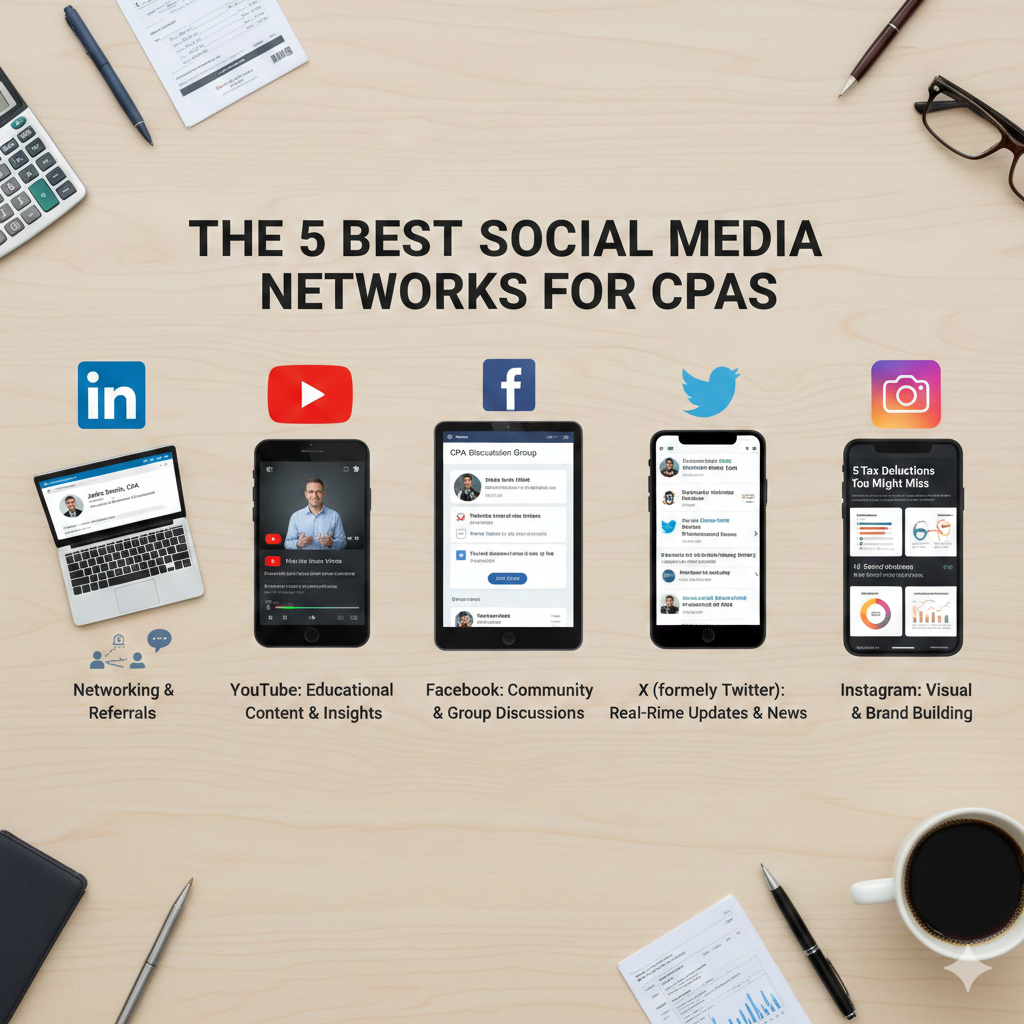
Social media is not something most CPAs grew up thinking of as a professional tool. It can feel frivolous, time-consuming, or simply outside the culture of a profession built on precision and discretion. But the reality is that social media has become one of the most cost-effective ways for accounting professionals to build their reputation, attract new clients, and stay visible in an increasingly competitive market. The key is not being everywhere at once — it is being in the right places with intention. Here are the five platforms that deliver the most value for CPAs.
LinkedIn is not optional for CPAs. It is the single most important social media platform the profession has, and the gap between it and everything else is significant. LinkedIn is where business owners, executives, financial professionals, and potential referral partners spend time in a professional mindset — which means they are actively receptive to content about taxes, accounting, business finance, and related topics in a way they simply are not on other platforms.
For CPAs, LinkedIn serves multiple functions simultaneously. It acts as a living resume and credibility signal for anyone who searches your name before reaching out. It is a publishing platform where thoughtful articles about tax strategy, financial planning, or industry-specific accounting issues can reach thousands of people without any advertising budget. And it is a relationship-building tool that allows you to stay warm with referral partners — attorneys, financial advisors, bankers, and insurance professionals — who can send clients your way for years.
The CPAs who use LinkedIn most effectively are not the ones posting the most frequently. They are the ones who post consistently and specifically, speaking directly to the problems their ideal clients are trying to solve. A post explaining how a recent tax law change affects S-corporation owners will resonate far more deeply with the right audience than a generic post about the importance of good bookkeeping.
Facebook may not feel like the obvious choice for a professional services firm, but its sheer scale makes it impossible to ignore. With nearly three billion monthly active users, Facebook contains an enormous concentration of small business owners, entrepreneurs, and self-employed individuals — which happens to be the most lucrative and loyal client base for most CPA practices.
Facebook Groups in particular represent an underutilized opportunity for accounting professionals. Groups organized around specific industries, local business communities, or entrepreneurial interests are full of people asking exactly the kinds of questions a CPA is qualified to answer. Showing up consistently in those spaces — not to sell, but to genuinely help — builds visibility and trust with potential clients in a way that traditional advertising never could.
Facebook’s advertising platform is also worth mentioning. The ability to target ads by profession, industry, income level, and geography gives CPAs a remarkably precise tool for reaching their ideal client. A CPA who specializes in real estate investor tax strategy can run a highly targeted campaign that reaches only real estate investors in their metro area, for a fraction of what a comparable print or direct mail campaign would cost.
YouTube
YouTube is the world’s second-largest search engine, and that single fact should reframe how CPAs think about it. When a small business owner does not understand quarterly estimated taxes, they do not reach for a textbook — they go to YouTube. When a freelancer wants to understand the difference between an LLC and an S-corporation, they search YouTube. When a real estate investor wants to learn about cost segregation studies, they search YouTube.
A CPA who publishes clear, helpful video content on these topics positions themselves as the expert in the room before a potential client has ever sent an email. Video also builds a level of personal connection that written content simply cannot replicate — viewers feel like they know the person on screen, which dramatically lowers the psychological barrier to picking up the phone.YouTube videos are also permanent and searchable, which means a well-optimized video can generate views and inbound inquiries for years after it was recorded. The upfront investment in learning to produce reasonably good video content pays compounding dividends over time in a way that few other marketing activities can match.
Instagram might seem like the least obvious fit for a CPA, but it has proven genuinely effective for accounting professionals who understand how to use it — particularly those trying to build a personal brand or reach younger entrepreneurs and business owners. The platform’s visual nature forces CPAs to communicate complex ideas simply and accessibly, which is itself a valuable skill that tends to resonate with clients who are intimidated by financial concepts.The most effective CPAs on Instagram use a combination of short educational content, behind-the-scenes glimpses of their work life, and relatable posts about the realities of running a financial practice. This humanizes the profession in a way that a formal LinkedIn post does not, and it attracts a different kind of client — typically younger, digitally native, and running businesses in creative, technology, or lifestyle industries.Instagram’s Stories and Reels features are particularly useful for short tax tips, reminders about deadlines, and quick explanations of financial concepts. None of this content needs to be elaborate. Authenticity consistently outperforms polish on Instagram, which means a CPA speaking directly to the camera on their phone can outperform a competitor spending thousands on professional video production.
X (formerly Twitter)X occupies a unique space in the social media landscape for CPAs because its audience skews heavily toward business professionals, journalists, policymakers, investors, and entrepreneurs — a concentration of high-value potential clients and referral partners that no other platform quite replicates. During tax season, financial news cycles, and major regulatory changes, X becomes an active hub of conversation that knowledgeable CPAs can meaningfully participate in.
The platform rewards brevity and clarity, which means CPAs who can distill complex financial concepts into sharp, accessible observations build followings quickly. A CPA who becomes a reliable, plain-spoken voice on tax policy or small business finance during a major news event — a new tax bill passing, a change in IRS enforcement priorities, a significant court decision — can gain significant visibility in a very short time.
X is also a powerful tool for staying connected with journalists and media professionals who cover business and finance. CPAs who are active and credible on the platform are far more likely to be sought out as expert sources, which translates into earned media coverage that money genuinely cannot buy.
Choosing Where to Start
The temptation when reading a list like this is to try to be active on all five platforms immediately, which is a reliable path to burnout and mediocre results everywhere. A far better approach is to start with LinkedIn — because it is the most professionally aligned and the most forgiving of imperfect execution — and add one additional platform once you have developed a consistent rhythm there. Pick the second platform based on where your ideal clients actually spend their time, not based on where you personally enjoy scrolling.
Social media rewards consistency above everything else. A CPA who publishes one genuinely useful post per week for three years will build something durable and valuable. One who posts intensely for six weeks and then disappears will build nothing at all. The platform matters less than the commitment to showing up, providing real value, and letting the audience find you over time.