Posted on

Financial Literacy: The Core Concepts You Need to Understand Money and Build Wealth

Financial literacy is often treated like a collection of tips—save more, spend less, invest early—but that approach misses the deeper structure behind how money actually works. To be financially literate is not just to follow advice, but to understand the underlying systems that govern income, spending, risk, and long-term wealth creation. Once those systems are clear, decisions become less about guesswork and more about strategy.

At the core of financial literacy is the concept of cash flow. This is the movement of money into and out of your life, and it matters more than most people initially realize. Income is only one side of the equation. What determines your financial trajectory is the gap between what you earn and what you spend, and more importantly, how consistently that gap exists. Someone earning a moderate income with stable, controlled expenses can build wealth over time, while someone earning significantly more but spending aggressively may remain stuck. Understanding cash flow forces you to see money as a system rather than a series of isolated transactions.

Closely tied to cash flow is the idea of budgeting, though not in the restrictive sense many people imagine. A budget is simply a plan for directing your money toward outcomes that matter. Without it, spending becomes reactive, shaped by impulse, social pressure, or short-term emotion. With it, spending becomes intentional. Financial literacy requires recognizing that every dollar has an opportunity cost, meaning that choosing one use for money automatically excludes another. This realization shifts your mindset from “Can I afford this?” to “Is this the best use of my money right now?”

Another essential concept is the difference between assets and liabilities. While definitions can vary slightly depending on context, the general principle is straightforward. Assets tend to put money into your pocket over time, while liabilities tend to take money out. The financially literate person learns to distinguish between the two not based on labels, but on actual behavior. A house, for example, can function as either depending on its financial impact. The same applies to cars, businesses, or even education. This way of thinking prevents blind assumptions and encourages critical evaluation of every major financial decision.

Debt is another area where surface-level understanding often leads people astray. Debt is neither inherently good nor bad; it is a tool. The key is understanding the cost of borrowing and the purpose behind it. Interest rates, repayment terms, and the expected return from whatever the debt is used for all matter. Borrowing to invest in something that generates greater value over time can be rational, while borrowing for consumption often creates long-term drag on your finances. Financial literacy means being able to evaluate whether debt is working for you or against you, rather than simply avoiding it or embracing it blindly.

Saving is often framed as the foundation of financial stability, but its role goes beyond simply setting money aside. It represents delayed consumption and creates flexibility. An emergency fund, for example, is not just a safety net; it is a form of independence. It allows you to handle unexpected events without falling into high-interest debt or being forced into poor decisions. More broadly, savings give you options. They allow you to take calculated risks, such as starting a business or investing, without putting your entire financial life at risk.

Investing builds on saving by putting money to work. While saving protects your financial position, investing is what grows it. Understanding investing requires grasping the relationship between risk and return. Higher potential returns usually come with higher uncertainty, and there are no guaranteed shortcuts. Financial literacy involves recognizing that markets fluctuate, that losses are part of the process, and that time in the market often matters more than timing the market. Concepts like diversification, compounding, and long-term thinking are essential because they reduce risk and increase the likelihood of steady growth over time.Inflation is another concept that shapes nearly every financial decision, even though it often goes unnoticed. Inflation reduces the purchasing power of money over time, meaning that the same amount of money will buy less in the future. This is why simply holding cash without investing can lead to a gradual loss of wealth in real terms. Financial literacy requires understanding that money must grow at a rate that at least keeps pace with inflation if you want to maintain your standard of living.

Taxes also play a significant role in personal finance, influencing how much of your income you actually keep. A financially literate person understands that different types of income are often taxed differently and that tax planning is not about avoidance, but about efficiency. Structuring your income, investments, and expenses in a way that minimizes unnecessary tax burden can have a substantial impact over time. Even small improvements in tax efficiency can compound into meaningful gains.

Risk management is another critical piece of the puzzle. Life is unpredictable, and financial setbacks can come from many directions, including health issues, job loss, or economic downturns. Insurance is one of the primary tools for managing these risks, but it must be understood properly. The goal is not to insure everything, but to protect against losses that would be financially devastating. This requires evaluating both the likelihood and the impact of potential risks.

Finally, financial literacy includes a strong understanding of behavior and psychology. Many financial mistakes are not caused by a lack of knowledge, but by emotional decision-making. Fear can lead to selling investments at the worst possible time, while overconfidence can lead to excessive risk-taking. Social pressure can drive unnecessary spending, and short-term thinking can undermine long-term goals. Recognizing these tendencies and developing discipline is just as important as understanding the technical aspects of finance.

In the end, financial literacy is not about mastering every detail or predicting the future. It is about building a framework for making informed decisions in an uncertain world. By understanding cash flow, budgeting, assets and liabilities, debt, saving, investing, inflation, taxes, risk, and behavior, you develop the ability to navigate your financial life with clarity and confidence. That foundation, more than any single tactic or shortcut, is what allows wealth to grow steadily over time.
Posted on

The 5 Types of Businesses With the Highest Profit Margins

If you strip business down to its core, profit margins are driven by one simple idea: how little it costs to deliver something people are willing to pay a lot for. The fewer moving parts, the less inventory, and the more scalable the product, the higher the margin tends to be. Across industries and countries, the same patterns show up again and again. Certain types of businesses consistently outperform the rest, not because they are easy, but because they are structurally advantaged.

The first category is software and digital products. Once built, a piece of software can be sold an infinite number of times at almost zero additional cost. Whether it’s a SaaS platform, a mobile app, or a downloadable tool, the economics are hard to beat. The upfront cost is often high in terms of time, skill, and development, but after that, each additional customer barely increases expenses. This is why some of the most profitable companies in the world are software businesses. The product doesn’t wear out, it doesn’t need shipping, and it scales globally without requiring a proportional increase in staff.

Closely related to this are digital education products and information businesses. Courses, ebooks, and membership communities operate on a similar principle. You create something once, and it can be sold repeatedly with minimal incremental cost. What makes this category especially powerful is that pricing is often based on perceived value rather than production cost. If someone believes your course can help them make money, improve their health, or transform their life, they will pay far more than it cost you to create it. The margin comes not just from low costs, but from the ability to command premium pricing.

Another high-margin category is financial and professional services. This includes consulting, legal services, accounting, and certain types of advisory work. In these businesses, the product is expertise. There is little to no inventory, and the main cost is time. When positioned well, professionals can charge significant fees for relatively short engagements. Over time, many shift from trading time directly for money into leveraged formats such as retainers, licensing, or packaged services, which further expands margins. The barrier to entry is higher here, but so is the ceiling.

Media and content-driven businesses also sit in this high-margin group, especially when monetized correctly. A blog, YouTube channel, or social media brand can generate income through ads, sponsorships, and digital products. The cost to produce content can be kept relatively low, while the upside can scale dramatically with audience growth. Once content is created, it can continue to generate revenue long after the initial effort. This creates a compounding effect where older content keeps working while new content expands reach, pushing margins higher over time.

Finally, there are niche luxury and branding-driven businesses. At first glance, physical products don’t seem like they belong in a high-margin discussion, but branding changes the equation. When a product is positioned as premium, exclusive, or status-enhancing, the price can far exceed the cost of production. Think of certain fashion items, fragrances, or specialty goods. The physical item may not be expensive to produce, but the brand carries the value. When executed well, this creates margins that rival digital businesses, even though the underlying product is tangible.

What ties all of these together is not the specific industry, but the structure. High-margin businesses tend to minimize variable costs, avoid heavy reliance on physical inventory, and focus on scalable or perception-driven value. They often require more thought upfront, whether in building a product, developing expertise, or crafting a brand, but they reward that effort with economics that are difficult to match in traditional models.

If you’re thinking about what to build, it’s worth paying attention to these patterns. You don’t need to chase every opportunity, but understanding why these businesses work can help you design something that gives you leverage instead of trapping you in constant effort. Over time, that difference compounds just as much as the margins themselves.

Posted on

The App Stack: How Much Software Does a Business Really Use?

Walk into any modern office — physical or virtual — and you’ll find layer upon layer of software quietly humming beneath every business decision, customer interaction, and internal process. From the CRM logging a sales call to the payroll tool processing Friday’s wages, software applications have become the operating system of the modern business. But just how many applications does the average company actually rely on? The answer is larger than most people expect — and the landscape is shifting faster than ever.

The Numbers: A Brief History of Accumulation

The rise of cloud-based, subscription software — known as Software as a Service, or SaaS — transformed how businesses buy and use technology. Instead of purchasing expensive, rigid systems, companies could simply sign up for a tool, pay monthly, and add more as needs emerged. The result was an explosion of applications.

Between 2015 and 2022, the average number of SaaS applications used by businesses grew by a staggering 1,525%. This wasn’t a fringe trend — it reshaped entire IT departments and spawned new professions dedicated purely to managing the software stack.

By company size, the differences are pronounced. Smaller companies with under 200 employees use an average of 42 SaaS applications, while large organizations with over 5,000 employees report an average of 158. At the very top end of the scale, large organizations with more than 10,000 employees use around 447 SaaS apps on average.

The Peak and the Pullback

After years of uninterrupted growth, something changed. After peaking in 2022 at 130 SaaS applications on average per company, the latest data reveals that the number dropped by 14% to 112 in 2023 — the first decline in over a decade. Since the 2022 peak, usage has fallen 18%, marking the second consecutive year of decline as businesses cut back on non-essential tools.The reason isn’t disillusionment with software. It’s discipline born from economic pressure. Over half of respondents in recent surveys felt there was more scrutiny in SaaS purchasing than before, with companies reporting wasting on average more than $135,000 in unused software licenses. Excess had become expensive. Studies show that 53% of SaaS licenses go unused within 30 days — driving major waste.

This consolidation phase reflects a maturing market. Businesses aren’t abandoning software; they’re becoming more deliberate about which software earns its place. The SaaS market is growing fast, but companies are using fewer apps. They’re cutting out weak tools and sticking to fewer, stronger platforms that do more.

The Hidden Problem: Shadow IT

Even the official count of applications understates reality. Many employees adopt tools independently — without IT’s knowledge or blessing. As of 2025, 48% of enterprise apps are shadow IT apps, meaning software employees use without the IT department’s knowledge or approval.This creates compounding risks. 56% of employees upload sensitive information into applications that are not approved, and IBM’s 2024 report found that one in every three data breaches now happens because of shadow IT. The sheer volume of applications — official and unofficial — has made governance a significant challenge in its own right.

What Businesses Are Actually Running

The applications businesses use span virtually every function. Customer relationship management (CRM), HR and payroll, project management, communication and collaboration, accounting and finance, marketing automation, data analytics, cybersecurity, and document management all form the core of a typical enterprise stack. Tools like Slack, Microsoft 365, Salesforce, HubSpot, Zoom, and Google Workspace are near-ubiquitous. Based on 2024 expense data, the most frequently renewed SaaS tools include ChatGPT, Canva, LinkedIn, Udemy, Grammarly, and Adobe Acrobat.

The typical individual department doesn’t escape this complexity. The average department in an organization uses about 87 SaaS applications — a figure that surprises most people outside of IT.

How the Landscape Will Change

The next chapter for business software is being written by artificial intelligence — specifically, autonomous AI agents capable of reasoning, deciding, and acting without constant human oversight.Unlike traditional SaaS applications that require users to click through interfaces, fill out forms, and manually execute workflows, AI agents operate as autonomous systems capable of reasoning through problems, making decisions, and taking action without constant human oversight. They understand natural language commands like “analyze our Q2 performance” — eliminating the need for users to learn complex navigation paths through multiple applications.This shift has major implications. Instead of navigating multiple dashboards, users could interact with agent-driven, conversational interfaces that perform tasks across systems — instructing an AI agent to “approve last week’s expense reports” or “generate next quarter’s sales forecast” and having the agent orchestrate workflows across HR, finance, and CRM systems behind the scenes. In this model, the number of applications a person consciously interacts with could shrink dramatically, even as the underlying infrastructure remains complex.

In three years, any routine, rules-based digital task could move from “human plus app” to “AI agent plus API.” Traditional SaaS vendors are acutely aware of this pressure and racing to embed AI capabilities into their platforms before upstart, AI-native competitors displace them.However, analysts caution against overestimating the speed of disruption. Deloitte predicts that the full replacement of enterprise applications by agents won’t happen in 2026 — it will likely take at least five years or more to come to fruition, even with the rapid pace of technological development. Traditional SaaS providers have large footprints across complex workflows that will be hard to supplant.

Pricing models will also undergo a fundamental shift. IDC predicts that by 2028, pure seat-based pricing will be obsolete, with 70% of software vendors refactoring their pricing strategies around new value metrics such as consumption, outcomes, or organizational capability. In other words, businesses may stop paying for software per employee and start paying for software per outcome.”AI isn’t going to trigger a ‘SaaSpocalypse’ so much as a ‘SaaSmorphosis,'” according to future of work economist Richard Johnson. “They both can coexist. However, the ‘S’ in SaaS that changes isn’t the software but the service.”

The average business today juggles over 100 software applications to keep its operations running — and large enterprises manage many times that. After a decade of accumulation, a period of consolidation is underway, driven by budget discipline and a desire for integration over proliferation. But the more profound transformation lies ahead: AI is poised to reshape not just how many applications businesses use, but what software fundamentally *is* — shifting it from a collection of tools employees navigate to an intelligent layer that works on their behalf.

For business leaders, the question is no longer just “which software do we need?” but increasingly “what should software actually do for us?” Those who answer that question well will be the ones writing the next chapter of this story.

Posted on

Your Greatest Successes Come When You Want To Quit

Have you ever been so close to giving up that you could taste it? That moment when the weight of your efforts feels unbearable, and the dream you once chased so passionately now seems like a distant, foolish fantasy. It’s a universal experience, this urge to quit. But what if I told you that this very feeling, the one that whispers defeat in your ear, is actually a signal that you are on the verge of your greatest success? It sounds counterintuitive, I know. When you’re exhausted, frustrated, and ready to throw in the towel, success feels like the last thing on the horizon. Yet, history and human experience are filled with stories that prove the opposite is true.

Think about the moments in your own life when you’ve been tested. Perhaps you were learning a new skill, building a business, or working on a creative project. There comes a point where the initial excitement has faded, replaced by the grind of daily effort. You encounter obstacles that seem insurmountable, and the progress you hoped for feels agonizingly slow. It’s in this valley of despair that the thought of quitting becomes most seductive. It promises relief from the struggle, an end to the disappointment. But this is precisely the juncture where the magic happens, if only you can hold on a little longer.

The reason why success often lurks just beyond the point of quitting lies in the nature of challenge and growth. When you push past your comfort zone, you enter a realm where your old methods no longer work and your resilience is truly tested. This discomfort is not a sign of failure; it is a sign of expansion. It means you are stretching beyond your previous limits, and that stretching is essential for achieving anything worthwhile. The greatest breakthroughs in science, art, and personal development have almost always come after periods of intense struggle and doubt. The scientist on the verge of a discovery, the writer wrestling with a difficult passage, the athlete pushing through exhaustion—they all face that tempting exit door. But those who resist it often find that the next step, the one they almost didn’t take, leads to something extraordinary.

Consider the simple act of perseverance itself. When you continue despite wanting to quit, you are not just moving closer to an external goal; you are building an internal strength that will serve you forever. You are proving to yourself that you are capable of more than you thought. This self-belief becomes a foundation for future successes, creating a cycle where you learn to trust your ability to endure. The success you achieve in these moments is twofold: there is the tangible achievement, but there is also the profound personal growth that comes from knowing you didn’t give up on yourself.

Of course, this isn’t about blind stubbornness. It’s about discernment. Sometimes quitting is the right choice, especially if a path is truly wrong for you. But more often than not, the urge to quit is simply a fear response to the difficulty of the journey. It’s a trick your mind plays to protect you from further discomfort. Recognizing this trick is the key. When you feel that overwhelming desire to walk away, pause and ask yourself if you are quitting because the goal is unworthy or because the path has become hard. If it’s the latter, you might be standing at the very doorstep of your greatest achievement.

So, if you find yourself in that place today, feeling like you have nothing left to give, take a breath. Acknowledge the feeling, but don’t let it drive your decision. Remember that the view from the summit is only granted to those who endure the climb. Your greatest successes are not waiting for you on the other side of comfort; they are waiting just beyond the point where you feel like quitting. All you have to do is take one more step.

Posted on

Why Sales Is Often More Lucrative Than Marketing

Sales and marketing both play essential roles in the success of a business. Each function contributes to the process of attracting customers and generating revenue. However, when it comes to personal income potential, sales is often the more lucrative field. The reason lies in how compensation is structured and how directly each role is connected to the money flowing into a company.

Sales professionals are usually paid based on the revenue they generate. In many industries, a salesperson earns commissions or bonuses tied directly to the deals they close. This creates a system where the person responsible for bringing in new business participates financially in the success they create for the company. When a salesperson closes a large contract, their earnings often increase immediately.

Because of this structure, the income ceiling in sales can be very high. A talented salesperson who consistently exceeds their targets can earn far more than their base salary through commissions. In fields such as enterprise software, financial services, or commercial real estate, high-performing sales professionals can earn incomes that rival those of senior executives.

Marketing, by contrast, usually operates under a different compensation model. Most marketing professionals receive fixed salaries that are only loosely tied to company revenue. While marketing teams certainly contribute to growth, their work is often evaluated using broader metrics such as brand awareness, website traffic, or lead generation. These indicators measure progress toward future revenue rather than revenue itself.

Because the connection between marketing activity and final sales results can be indirect, companies are less likely to structure marketing compensation around large performance-based payouts. A marketing professional may help generate thousands of leads for a company, but their compensation usually does not increase dramatically when those leads eventually turn into customers.

Another reason sales tends to be more lucrative is that it involves greater personal accountability. Salespeople operate in an environment where performance is measured clearly and frequently. Their quotas, targets, and closing rates are visible to management, and their success or failure is often immediately apparent. This level of accountability can be stressful, but it also creates the opportunity for exceptional financial rewards when someone performs well.Marketing roles generally involve longer timelines and more collective efforts. Campaigns are planned, executed, and analyzed over extended periods. Results often emerge gradually and depend on collaboration among multiple team members. While this environment can be more stable and predictable, it rarely produces the same dramatic financial upside that exists in commission-based sales roles.

There is also a psychological element to the difference. Many people are drawn to marketing because it involves creativity, storytelling, and brand building. Sales, on the other hand, requires direct persuasion and frequent rejection. Because fewer people are comfortable with that environment, companies often compensate successful salespeople generously in order to attract and retain talent.

None of this means marketing is less important than sales. In fact, effective marketing can make the salesperson’s job far easier by building awareness and trust before a conversation even begins. The two functions work best when they complement each other. Marketing creates interest in a product, while sales converts that interest into revenue.

The difference is that sales sits closest to the moment when money actually changes hands. Because of that proximity to revenue, the financial rewards for strong performance in sales tend to be greater. Companies are willing to pay handsomely for the people who directly bring new business through the door.

Posted on

Sales and Marketing Are Not the Same Thing

Sales and marketing are often spoken about as if they are interchangeable. In many conversations, people treat the two terms as if they describe the same activity. In reality, they represent two very different functions within a business, even though they work toward the same overall goal.

Both sales and marketing exist to generate revenue for a company. The difference lies in how they accomplish that objective and where they operate in the customer journey.

Marketing focuses on attracting attention and creating interest. Its purpose is to introduce a company, a product, or a service to a potential audience and communicate why it matters. Marketing shapes the message, builds the brand, and creates the initial connection between a business and the market. When someone sees an advertisement, reads a blog post, watches a video about a product, or follows a company on social media, they are interacting with marketing.

Sales begins when that attention turns into a conversation. Sales is the process of working directly with a potential customer to understand their needs and guide them toward making a purchase. Instead of speaking to a broad audience, sales usually operates on a one-to-one level. A salesperson answers questions, explains how a product solves a specific problem, addresses concerns, and negotiates the details of the transaction.

Because the two functions operate at different stages of the buying process, they require different skill sets. Marketing tends to involve communication at scale. It relies on storytelling, positioning, and understanding how to reach large groups of people through media channels. Marketers think about audiences, messaging, and visibility.

Sales, on the other hand, is more personal and interactive. It requires the ability to listen carefully, build trust, and respond to the unique concerns of each individual prospect. A salesperson must understand not only the product being offered but also the specific situation of the person considering the purchase.

Another difference lies in how success is measured. Marketing success is often evaluated through indicators such as brand awareness, website traffic, audience growth, and lead generation. These metrics measure how effectively a company is reaching potential customers and generating interest in its offerings.

Sales success is usually measured in revenue and closed deals. Sales professionals are judged by their ability to convert interest into actual purchases. Their performance is closely tied to the financial outcomes of the company.

Despite these differences, sales and marketing must work closely together. Marketing helps fill the pipeline with potential customers, while sales converts those opportunities into revenue. When the two functions are aligned, marketing brings in prospects who are well suited for the product, and sales teams can focus their efforts on people who are already interested.

When they are misaligned, problems appear quickly. Marketing may generate attention that does not translate into real buying interest, leaving sales teams frustrated with poor-quality leads. At the same time, sales teams may struggle to close deals if marketing fails to clearly communicate the value of the product to the market.

Understanding the distinction between sales and marketing is important for anyone trying to build a business. Marketing creates visibility and demand, while sales transforms that demand into actual revenue. Both roles are essential, but they operate in different parts of the journey that turns a stranger into a customer.

Posted on

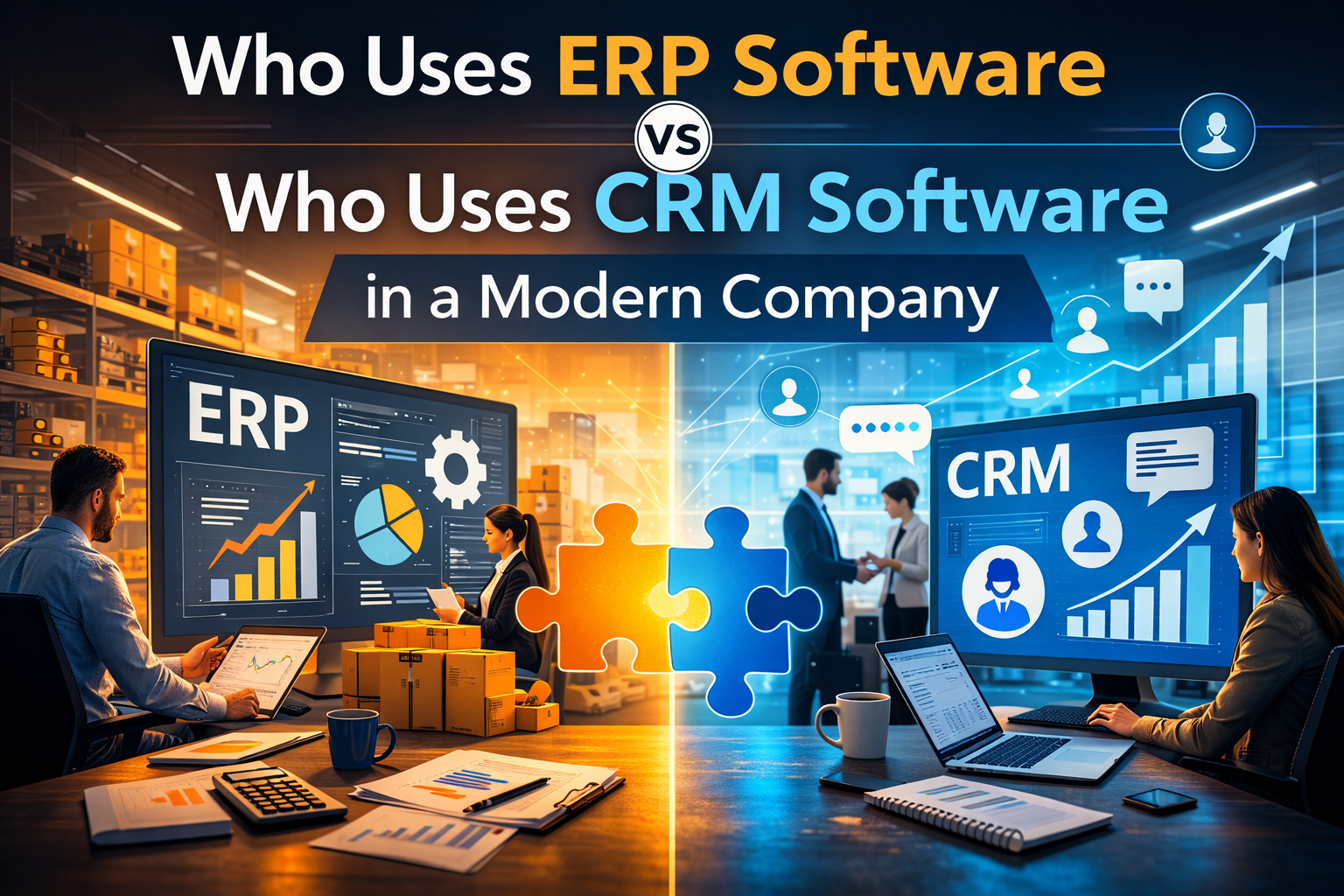
Who Uses ERP Software vs Who Uses CRM Software in a Modern Company

Enterprise Resource Planning software and Customer Relationship Management software are often mentioned together because both are core systems inside modern companies. They are foundational platforms that store critical business data and coordinate complex processes. Yet the two systems serve very different groups of employees and solve very different problems.The easiest way to understand the difference is to look at the parts of the organization that use them.

CRM software is primarily used by employees whose work revolves around customers, sales, and revenue generation. Sales teams rely heavily on CRM systems because they need a centralized place to track leads, conversations, deals, and opportunities. A salesperson might spend much of their day inside a CRM updating notes from calls, logging emails, tracking where a prospect is in the sales process, and forecasting potential revenue.

Marketing teams also interact with CRM platforms because these systems store valuable customer and prospect data. Marketers use that information to run campaigns, segment audiences, and measure how well different marketing efforts convert into real sales opportunities. When someone fills out a form on a website or signs up for a newsletter, that information often flows directly into the CRM so it can be tracked and nurtured.

Customer support and account management teams frequently use CRM software as well. They rely on it to see the history of interactions with a customer, understand what products or services have been purchased, and manage ongoing relationships. When a client submits a support request or asks for help, the CRM helps the support team understand the context of that customer relationship.In many organizations, anyone whose job depends on understanding customers will spend time inside a CRM system.

ERP software, on the other hand, tends to be used by employees who manage the internal operations of a company rather than its customer relationships. ERP systems are designed to coordinate resources across departments such as finance, accounting, procurement, inventory management, manufacturing, and human resources.

Accountants and finance professionals are among the heaviest ERP users. These systems track financial transactions, budgets, payroll, invoices, and financial reporting. When a company closes its books at the end of a month or quarter, much of the work happens inside the ERP system because that is where the financial data is stored and organized.

Operations teams rely on ERP software to manage supply chains, inventory levels, and purchasing. If a company manufactures products, the ERP system often controls production planning and tracks the movement of materials through the organization. Warehouse managers, procurement specialists, and logistics coordinators depend on ERP systems to make sure the company has the resources it needs to operate efficiently.

Human resources departments also interact with ERP platforms, particularly when the system includes modules for employee management, payroll, benefits, and workforce planning. The ERP becomes a central system of record for employees, just as it does for finances and inventory.

While CRM software focuses on relationships with people outside the company, ERP software focuses on the resources and processes inside the company.In practice, the two systems often work together. A sales team might close a deal in the CRM, which then triggers processes inside the ERP system such as invoicing, inventory allocation, or production scheduling. Information flows between the two systems so that customer-facing teams and operational teams remain aligned.

Despite this integration, the daily users of each system tend to belong to different parts of the organization. Salespeople, marketers, and support teams live in the CRM because it helps them understand and grow customer relationships. Accountants, operations managers, procurement teams, and HR professionals rely on the ERP because it organizes the internal machinery of the business.

Understanding this distinction also explains why these systems are so valuable. CRM software drives revenue by helping companies acquire and retain customers. ERP software protects profitability by ensuring that the company’s resources, finances, and operations run smoothly.

Together, they form the digital backbone of many modern organizations. One manages the outside world of customers and revenue, while the other manages the inside world of operations and resources.

Posted on

The Money Is in Using Software, Not Writing It

For decades, writing code was one of the most valuable technical skills in the economy. Software developers commanded high salaries because companies needed people who could build complex systems from scratch. The barrier to entry was high, the tools were limited, and creating reliable software required years of specialized training. In many ways, the ability to generate code was the core bottleneck in the digital economy.The rise of artificial intelligence is changing that dynamic.

Modern AI tools can generate large amounts of functional code in seconds. Tasks that once required hours of programming can now be accomplished through prompts and iteration. Entire applications can be scaffolded rapidly, and debugging assistance is available instantly. While this doesn’t eliminate the need for skilled engineers, it dramatically reduces the scarcity of basic code generation.

When something becomes easier to produce, its economic value tends to fall.This shift is already pushing the real economic value of software away from the act of writing code and toward something more practical: implementing, maintaining, and effectively using software systems.

Most companies do not actually struggle with the idea of software. They struggle with making software work inside their organization. Businesses have complicated processes, legacy systems, fragmented data, and employees who must be trained to use new tools. Installing a piece of software is easy. Integrating it into the daily operations of a real company is much harder.

That is where the money increasingly lies.A company might be able to generate a basic CRM system with AI-assisted coding, but turning that system into a reliable tool that sales teams actually use requires configuration, integration, workflow design, and ongoing support. Data must be migrated. Automation rules must be designed. Security policies must be enforced. Employees must be trained. Systems must be monitored and updated over time.These are operational challenges, not purely programming challenges.

The same pattern appears across almost every category of enterprise software. Customer relationship management platforms, cybersecurity tools, marketing automation systems, analytics platforms, ERP software, and workflow management systems all require people who know how to implement them properly. Organizations need specialists who can translate business needs into working software environments.

Even companies that build their own software still face the reality that software is never truly finished. Systems require constant maintenance. APIs change. Security vulnerabilities appear. Databases grow. Integrations break. Employees leave and new ones must learn the tools. Software systems behave more like living infrastructure than completed products.As a result, the people who make money in the software ecosystem are often not the ones writing the most code. They are the ones who help businesses deploy and operate technology effectively.

Consultants, systems integrators, implementation specialists, DevOps engineers, cybersecurity professionals, and SaaS platform experts all thrive because companies need their help turning software into working systems. Their value comes from understanding both technology and real-world business operations.Artificial intelligence may even increase the demand for these roles.

As software becomes easier to generate, companies will experiment with more systems. They will deploy more tools, connect more data sources, and automate more processes. Each new piece of software adds complexity to the environment. That complexity must be managed, monitored, and optimized.In other words, the easier it becomes to create software, the more important it becomes to operate it well.

This shift mirrors what happened in other technological revolutions. When computing power became cheap, the value moved into applications and services. When the internet made publishing easy, the value moved toward distribution and attention. Now that AI makes code generation easier, the value is moving toward implementation and operations.

The winners in the AI economy will not necessarily be the people who write the most lines of code. They will be the ones who know how to make software systems actually work inside real organizations.

Businesses don’t pay for code. They pay for results.

Posted on

Why the Future Belongs to Self-Directed Learners

For much of modern history, education followed a predictable structure. People attended school, learned a defined body of knowledge, entered a profession, and gradually advanced through experience. Skills changed slowly, and the information someone learned early in life could often sustain an entire career. That world is disappearing. In an era defined by rapid technological change, global competition, and constant innovation, the individuals most likely to succeed are those who can teach themselves.

Self-directed learners are people who take responsibility for their own education. Instead of waiting for formal instruction, they actively seek knowledge, experiment with new ideas, and adapt to changing circumstances. They view learning not as something that ends after school but as an ongoing process that continues throughout life.

One reason this approach has become so important is the speed at which industries now evolve. New technologies, software platforms, and business models appear constantly. Entire fields can change dramatically within a few years. Traditional education systems often struggle to keep up with this pace because curricula take time to design, approve, and implement. By the time a new subject becomes widely taught, the most ambitious learners may have already explored it independently.

The internet has amplified this shift by placing vast amounts of information within reach of anyone with curiosity and discipline. Tutorials, courses, research papers, and technical documentation are available to a global audience. A motivated individual can learn programming languages, financial concepts, design techniques, or scientific ideas without needing to enroll in a formal program. The challenge is no longer access to knowledge but the willingness to pursue it.

Self-directed learners also develop a mindset that prepares them for uncertainty. Instead of relying on fixed instructions, they become comfortable experimenting, making mistakes, and refining their understanding over time. This ability to learn through exploration becomes especially valuable when working in fields where problems are new and solutions are not yet fully defined.

Another advantage of self-directed learning is adaptability. People who regularly teach themselves new skills become accustomed to starting from the beginning in unfamiliar subjects. They know how to break down complex topics, find reliable sources of information, and practice until they improve. This process can be repeated whenever a new challenge arises.In contrast, individuals who depend entirely on structured instruction may struggle when confronted with problems that fall outside their formal training. When the world changes faster than educational systems can respond, waiting for someone else to provide the next lesson can become a disadvantage.

Self-directed learning also encourages intellectual independence. When people actively search for knowledge, they develop their own perspectives rather than simply accepting information presented to them. This habit often leads to deeper understanding and creative thinking, both of which are essential in environments where innovation matters.

The future economy will reward those who can continuously expand their abilities. Careers are becoming less defined by a single profession and more by the ability to combine different skills over time. Someone might begin in one field, later acquire technical expertise, and eventually move into entrepreneurship or leadership. Each transition requires the capacity to learn quickly and independently.

Ultimately, the individuals who thrive in this environment will not necessarily be those with the most formal credentials. Instead, they will be the ones who cultivate curiosity, persistence, and the discipline to educate themselves. In a world where knowledge is widely available and change is constant, the ability to direct your own learning becomes one of the most powerful advantages a person can possess.

The future belongs to those who understand that education is not a stage of life but a lifelong responsibility. Self-directed learners embrace that responsibility, continually building the knowledge and skills needed to navigate an ever-changing world.

Posted on

What a Private Equity Fund Is and How It Works

A private equity fund is a pool of capital created for the purpose of investing in companies that are not publicly traded on stock exchanges. These funds are typically managed by professional investment firms that raise money from wealthy individuals, institutional investors, pension funds, and other large sources of capital. The goal of a private equity fund is to use that capital to acquire ownership in businesses, improve their performance, and eventually sell them at a profit.

Unlike investors who buy shares in public companies through stock markets, private equity investors purchase companies directly or acquire significant ownership stakes in them. Because these businesses are privately held, the investment process often involves negotiating directly with company founders, owners, or management teams. In many cases, private equity funds focus on established businesses that already generate consistent revenue and profit but may have opportunities to grow or become more efficient.

Once a private equity fund acquires a company, the investment firm usually works closely with management to increase the company’s value. This can involve expanding into new markets, improving operations, restructuring finances, or acquiring other businesses. The private equity firm often brings strategic expertise, industry connections, and additional capital to help the company grow more quickly than it might have on its own.

Private equity funds typically operate with a long-term investment horizon. Instead of seeking short-term gains, these funds often hold companies for several years while they implement changes designed to increase profitability and market value. When the investment firm believes the company has reached a significantly higher valuation, it looks for an opportunity to sell its ownership stake. This exit may occur through selling the company to another private equity firm, selling it to a larger corporation, or taking the company public through an initial public offering.

The structure of a private equity fund reflects this long-term approach. Investors commit capital to the fund for a period that often lasts around ten years. During the early years, the fund deploys that capital by acquiring companies. Over time, the firm works to improve those businesses and eventually sells them, returning profits to the investors who originally provided the capital.

Private equity has become a major force in the global economy because it provides companies with access to capital and strategic guidance outside of traditional stock markets. Many businesses choose private equity investment because it allows them to pursue growth without the short-term pressure that public companies sometimes face from quarterly earnings expectations.

For investors, private equity offers the potential for higher returns compared to traditional public market investments, although it also involves greater risk and less liquidity. Since the capital is typically locked up for many years, investors must be willing to wait before realizing the results of the fund’s investments.

In essence, a private equity fund acts as a specialized investment vehicle designed to acquire and improve businesses over time. By combining capital with strategic management, these funds aim to transform companies into more valuable enterprises and generate substantial returns for the investors who entrusted them with their capital.