Posted on

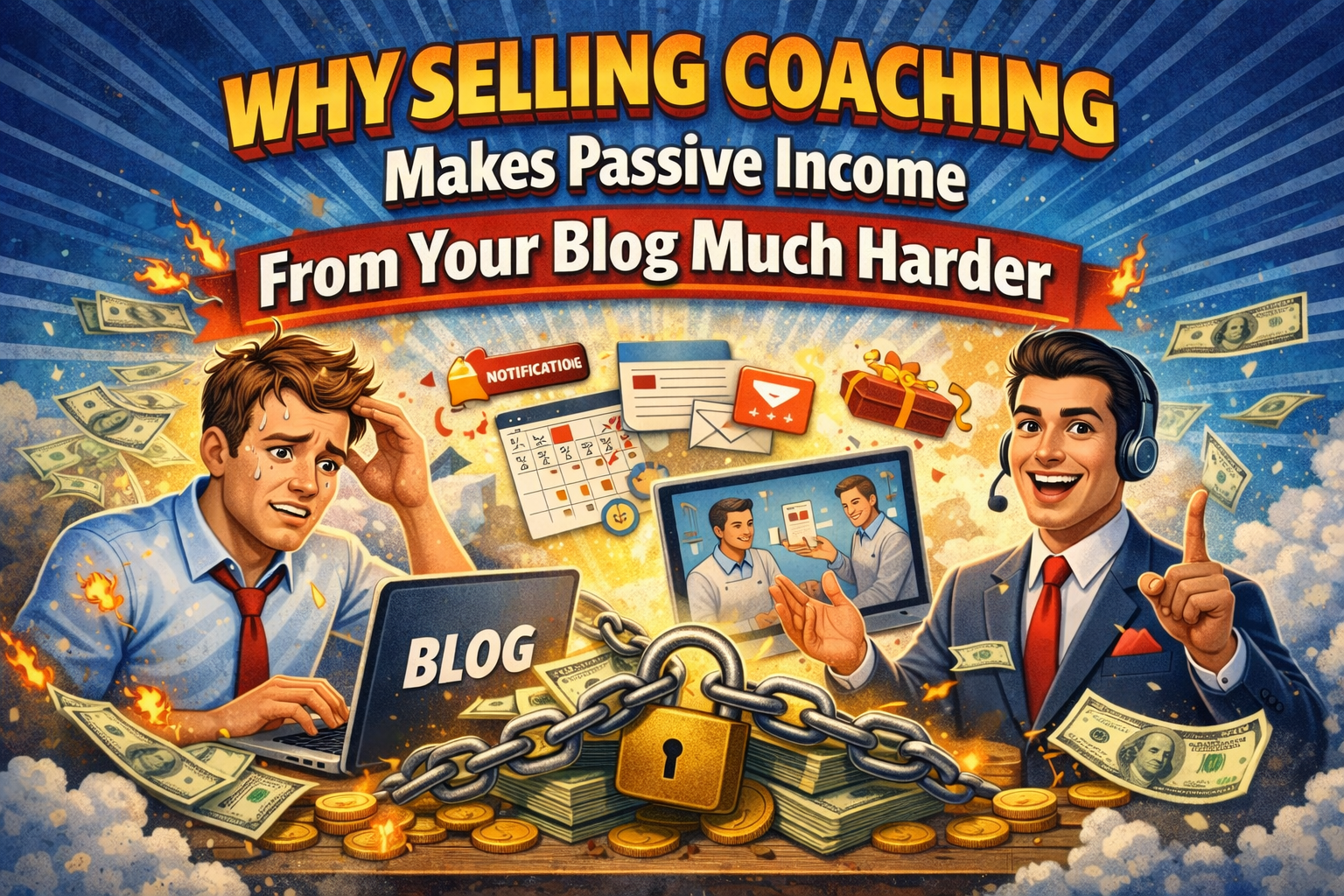
Why Selling Coaching Makes Passive Income From Your Blog Much Harder

Many bloggers eventually discover that the easiest thing to sell is coaching. If you write about business, productivity, mindset, or entrepreneurship, readers naturally begin asking for advice. Some will want calls, consulting sessions, or one-on-one guidance. Charging for that help feels like an obvious next step. It creates immediate revenue and validates that people value your knowledge.But while coaching can produce income quickly, it often works against the long-term goal of building passive income from a blog.The reason is simple. Coaching ties your revenue directly to your time.

A blog that earns passive income operates very differently. The ideal model is that a reader arrives, consumes the content, and purchases something that does not require your personal involvement. The product might be a book, a course, a piece of software, or a digital tool. Once it exists, the blog can sell it repeatedly without requiring additional hours from you.

Coaching breaks that structure. Every sale requires a new block of your time. If ten people buy coaching, you must schedule ten conversations. If fifty people buy coaching, your calendar becomes full. The revenue might grow, but it grows alongside your workload.This dynamic creates a ceiling. There are only so many hours in a day. At some point the blog stops being a scalable asset and becomes a lead generator for your personal labor.

Another issue is how coaching changes the behavior of your audience. When readers know they can simply pay to speak with you, many will skip trying to solve problems on their own. Instead of purchasing products or tools that scale, they default to asking for your direct attention. Over time the blog begins attracting readers who want access to you rather than readers who want solutions they can apply independently.

This shifts the economics of the entire platform. Instead of building a system where thousands of visitors generate income automatically, you end up managing a pipeline of conversations. The blog may still bring traffic, but that traffic converts into meetings rather than scalable sales.

There is also a psychological shift that happens when coaching becomes the main offer. The writer begins thinking about content differently. Instead of building complete resources that solve problems, there is a subtle incentive to leave some gaps. If everything is explained clearly within the articles and products, fewer people may feel the need to book a call. The business slowly drifts toward selling access instead of selling solutions.This is why many successful bloggers eventually move away from heavy coaching models. They may still offer limited consulting at a premium price, but the core of the business becomes products that work without them. Books, digital guides, software, memberships, and other scalable assets allow the blog to earn income from thousands of readers without requiring thousands of conversations.

Passive income from a blog is fundamentally about leverage. One piece of work should be able to serve many people at once. Coaching does the opposite. It converts each reader into a new commitment of time.

That does not mean coaching is bad. It can be extremely valuable for the person receiving it and profitable for the person providing it. But it is important to understand the tradeoff. Coaching is a service business, even when the leads come from a blog.If the goal is true passive income, the focus must eventually shift away from selling hours and toward building assets that deliver value without requiring your presence every time someone buys.
Posted on

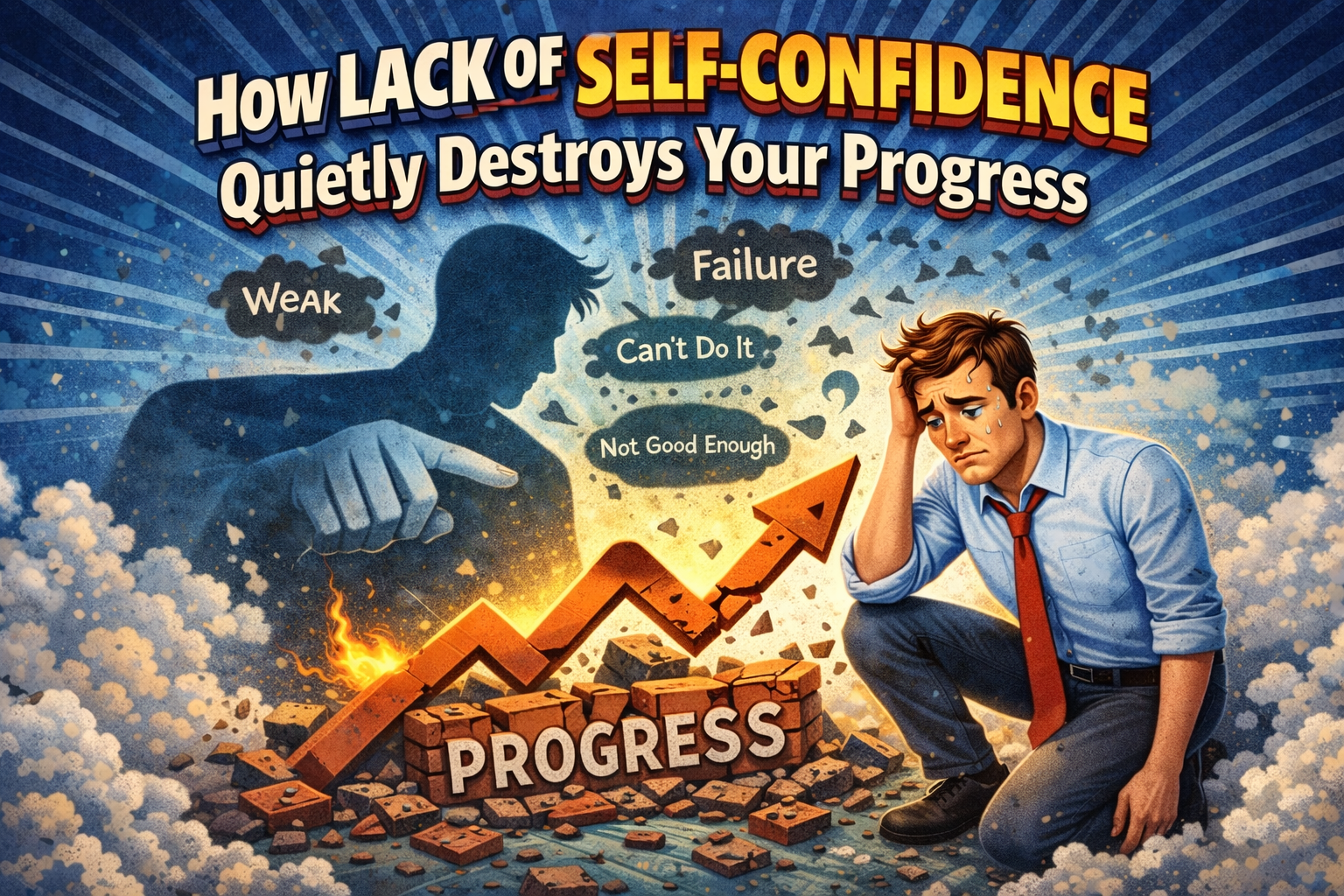
How Lack of Self-Confidence Quietly Destroys Your Progress

A lack of self-confidence rarely looks dramatic from the outside. It does not usually show up as complete inaction or obvious fear. Instead, it appears in small decisions made every day. It shows up in hesitation, underpricing, avoiding opportunities, or assuming something will not work before even trying it. Over time, these small decisions quietly destroy momentum and kill the gains a person could have made.

Confidence affects how you interpret reality. Two people can face the exact same opportunity and react in completely different ways. One sees possibility, while the other sees risk and doubt. The confident person assumes the problem is solvable. The uncertain person assumes the problem is evidence they are not capable. Nothing about the situation itself changed. Only the interpretation did.

This difference compounds quickly in entrepreneurship and career growth. Progress requires making decisions under uncertainty. You rarely have complete information. You rarely know exactly how something will turn out. The person with confidence moves forward anyway, trusting that problems can be figured out along the way. The person without confidence waits for certainty that never arrives.

As a result, opportunities pass by quietly. Someone hesitates to launch a product because they assume it is not good enough. Someone avoids raising prices because they assume customers will leave. Someone declines a partnership or business opportunity because they assume they are not experienced enough. In most cases the market never even gets a chance to decide. The opportunity dies in the mind before it ever reaches reality.

Lack of confidence also leads people to undervalue their work. When someone doubts their own abilities, they tend to price their services too low, apologize for their work, or accept poor terms simply to avoid rejection. Over time this creates a strange situation where the market begins to treat them exactly how they treat themselves. Clients expect less, competitors overlook them, and their earnings stay far below their potential.

Confidence changes how people perceive you. When someone speaks with certainty about what they offer and the value it provides, others are more willing to trust them. Confidence signals competence even before proof exists. Without that signal, people hesitate. They wonder if there is something wrong with the product, the service, or the person offering it.

This dynamic is particularly dangerous because it compounds over time. Early success often comes from taking small risks repeatedly. Each attempt creates learning, experience, and eventually results. But if lack of confidence prevents those attempts from happening, the learning never begins. Years can pass while someone stays stuck in the same place, not because they lack ability, but because they lacked the belief necessary to act.

Ironically, confidence rarely comes from feeling ready. It usually comes from acting before you feel ready and discovering that you are capable of figuring things out. Most successful people were not certain when they started. They simply refused to let uncertainty stop them from trying.

The market rewards people who show up, make offers, and put their work into the world. It cannot reward something that never exists. When self-doubt prevents action, the gains never have a chance to materialize.

In that sense, lack of confidence is not just a psychological issue. It is an economic one. It directly determines how many opportunities you pursue, how much value you ask for, and how far your work spreads into the world. The people who move forward despite uncertainty tend to accumulate experience, income, and reputation. Those who wait for confidence before acting often discover that the waiting itself is what quietly destroyed their progress.

Posted on

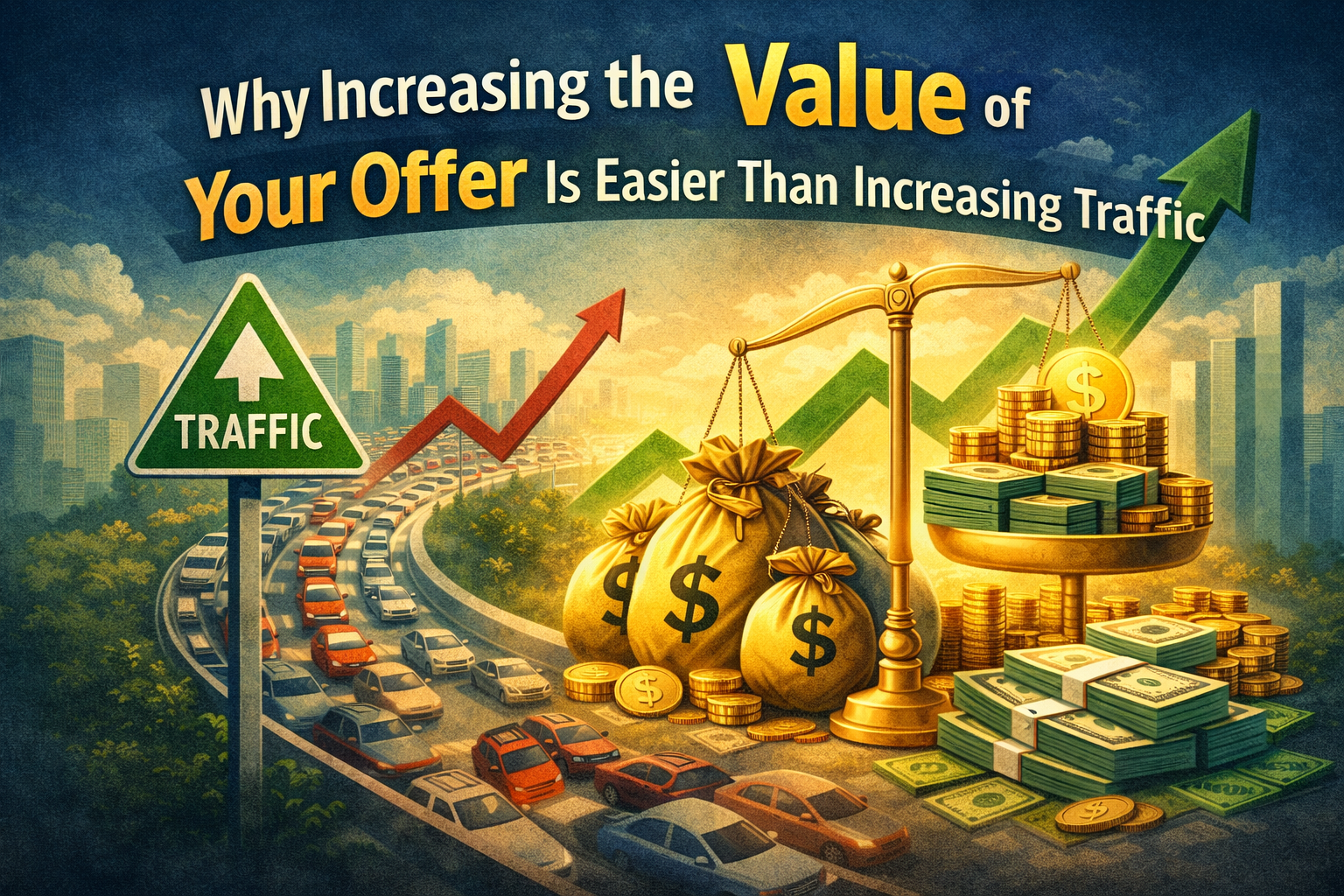
Why Increasing the Value of Your Offer Is Easier Than Increasing Traffic

Most entrepreneurs believe that the key to making more money online is traffic. When revenue is low, the instinct is almost always the same: get more visitors, run more ads, post more content, and reach more people. Traffic becomes the obsession. Yet in practice, traffic is usually the hardest lever to pull. The easier path is often increasing the price or value of what you are selling.

Traffic is difficult because it depends on competition, algorithms, attention, and distribution. Every website, creator, and business is fighting for the same limited resource: human attention. Search engines rank millions of pages. Social media feeds move faster every year. Advertising platforms grow more expensive as more companies bid for the same clicks. Getting someone to visit your site is no longer just a matter of publishing something online. It requires visibility in a crowded marketplace.

Even if you succeed in bringing people to your site, the numbers are rarely dramatic. Traffic usually grows slowly. A blog might take months or years to reach meaningful search rankings. Social media audiences compound gradually. Paid ads require testing, budget, and optimization. In other words, traffic tends to move in small increments and requires continuous effort to maintain.

Changing the value of your offer, however, can happen immediately.

A product priced at ten dollars can become a fifty-dollar product simply by improving the promise, the results, the packaging, or the audience it serves. A service charging two hundred dollars can become a two-thousand-dollar service by targeting a different type of client or solving a larger problem. The underlying traffic stays the same, but the revenue generated from each visitor increases dramatically.

This is why experienced entrepreneurs often focus on what is called revenue per visitor. Instead of asking how to attract more people, they ask how much value each visitor generates when they arrive. If a website receives one thousand visitors per month and earns one hundred dollars, the problem is not traffic alone. The deeper problem is that each visitor is worth only ten cents.Improving the offer changes that equation.

A stronger offer may involve clearer positioning. It may involve solving a more expensive problem. It may involve bundling expertise, tools, or information into something that produces a larger outcome for the buyer. When the value increases, the price can increase with it, and the economics of the business change overnight.

Consider two websites that both receive five thousand visitors per month. The first sells a five-dollar product. The second sells a five-hundred-dollar solution to a serious problem. Even if both sites convert at similar rates, the revenue difference between them will be enormous. The traffic is identical, but the value per visitor is completely different.

This is why focusing purely on traffic can lead entrepreneurs into a trap. They spend months trying to attract more visitors while ignoring the fact that the visitors they already have could be worth far more. It is often easier to transform a weak offer into a strong one than it is to double or triple your audience.

Improving value also creates a positive feedback loop. Higher prices allow more resources to be invested into better products, stronger marketing, and improved customer experiences. Better outcomes lead to stronger reputation and word of mouth. Over time, the value of each visitor increases even further.

Traffic is still important. No business survives without people discovering its offers. But traffic should not be the only lever an entrepreneur pulls when revenue is low. In many cases, the fastest path to higher income is not attracting more visitors. It is ensuring that every visitor who arrives encounters something valuable enough to justify a much higher price.

When entrepreneurs begin thinking this way, their strategy shifts. Instead of chasing endless traffic, they focus on building offers that are powerful enough to make every visitor count. And once that happens, even small amounts of traffic can become surprisingly profitable.

Posted on

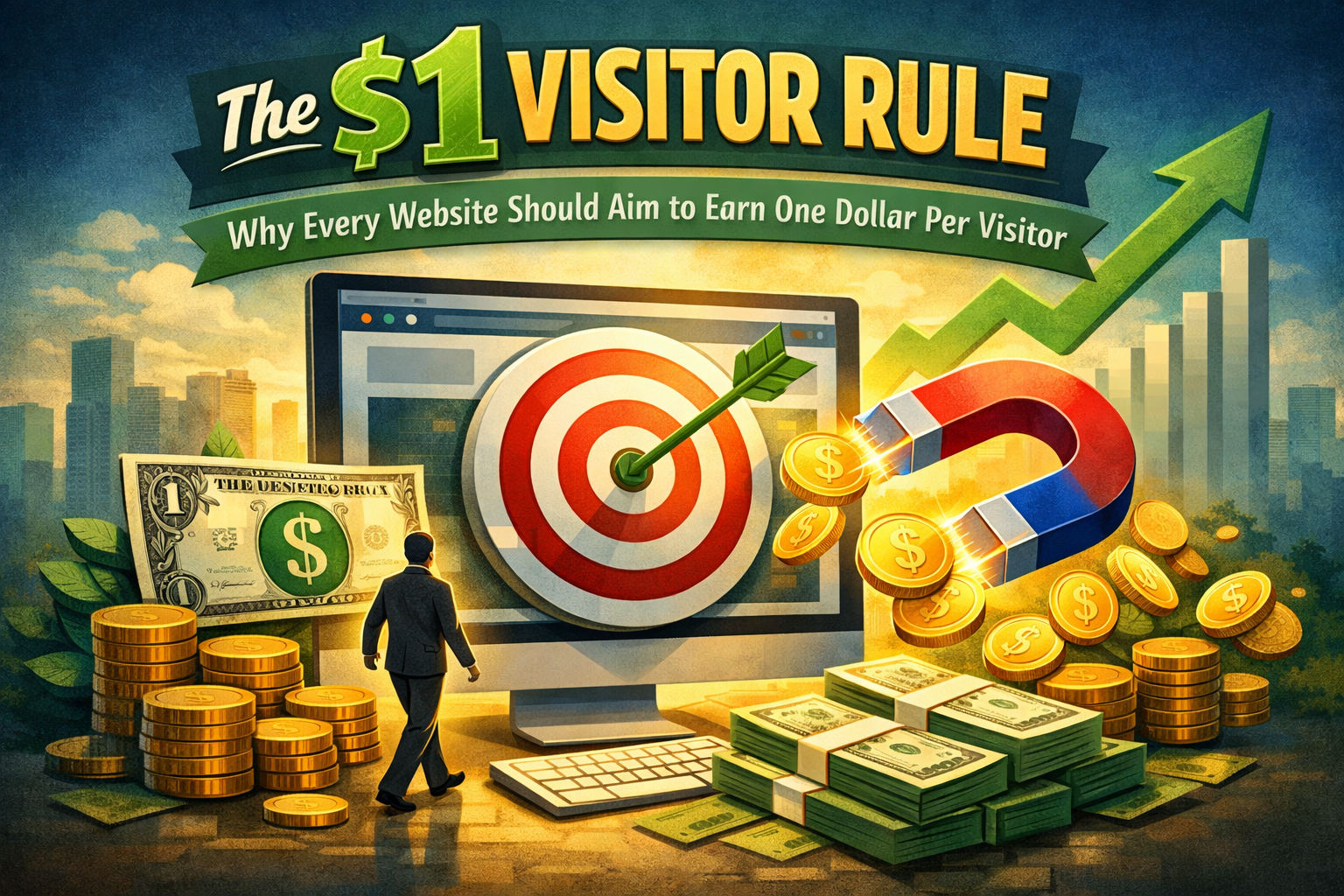
The $1 Visitor Rule: Why Every Website Should Aim to Earn One Dollar Per Visitor

Most website owners think about traffic first and money second. They obsess over page views, followers, and impressions while treating revenue as something that will appear if the audience grows large enough. This is backwards. A properly designed website can earn one dollar per visitor.

This target may sound ambitious to someone who is used to advertisers that pay a few dollars per thousand views, but that model reflects a weak business structure, not a realistic ceiling. Advertising networks were built for publishers with millions of visitors, not for independent website owners trying to build meaningful income. When a site earns only a few cents per visitor, the owner becomes dependent on enormous traffic numbers to survive.

A stronger website is designed differently. Instead of monetizing attention indirectly through ads, it converts attention into economic value. The visitor arrives with a problem, curiosity, or interest, and the site presents a solution that is valuable enough for a portion of those visitors to pay for.

Imagine a website selling a $100 digital product. If one out of every one hundred visitors buys that product, the site earns one dollar per visitor on average. This means that a website attracting only ten thousand visitors per month can generate ten thousand dollars in revenue. Suddenly, traffic becomes powerful rather than merely impressive.

The key insight is that revenue per visitor determines the true strength of a website’s business model. A site that earns five cents per visitor must attract two hundred thousand people to make ten thousand dollars. A site that earns one dollar per visitor needs only ten thousand visitors to achieve the same outcome. The difference between these two models is the difference between chasing viral traffic and building a durable online business.

This principle changes how a website should be structured. Content should not exist simply to generate page views. It should attract the exact type of visitor who is most likely to benefit from the solutions the site provides. Articles, guides, and tutorials become a way of identifying problems and demonstrating expertise rather than merely filling space.

Products also become central rather than optional. These products may take many forms, such as digital guides, courses, software tools, consulting services, or specialized knowledge packaged in a way that saves people time or helps them earn more money. The more valuable and specific the solution, the higher the potential revenue per visitor.

This approach also forces clarity. When a website aims to earn one dollar per visitor, every part of the site must contribute to that outcome. The writing must attract the right audience. The messaging must explain the value clearly. The product must solve a real problem. When these pieces align, monetization stops feeling like an afterthought and becomes the natural conclusion of the visitor’s journey.

The beauty of the one dollar per visitor goal is that it scales elegantly. If a website earns one dollar per visitor and grows to one thousand visitors per month, it generates one thousand dollars. If it grows to fifty thousand visitors, it generates fifty thousand dollars. The economics remain simple and predictable.Many successful online businesses quietly operate under this principle even if they never state it directly. They understand that traffic alone does not create income. Income comes from the value exchanged with the people who visit.

For independent creators and entrepreneurs, this mindset can be transformative. Instead of chasing millions of visitors, the focus shifts toward building a site that converts a small but meaningful portion of its audience into customers. When that happens, the website stops being a hobby and starts functioning like a real business.

In the end, a website’s success should not be measured by how many people visit it, but by how much value each visitor represents. When a site reaches the point where every visitor is worth one dollar on average, the mathematics of the internet begin working strongly in the owner’s favor.

Posted on

The True Cost of Time: How Mortgage Length and Interest Rates Multiply the Price of a Home

Most people think of a mortgage as the price of a house divided into monthly payments. What they often fail to realize is that the length of the loan and the interest rate dramatically change the total amount they will ultimately pay. A mortgage is not simply a financing tool. It is a long-term contract that can double the real price of the property depending on the terms.

To understand this clearly, imagine a home purchased for $300,000 with no down payment for simplicity. The only variable is the mortgage term and the interest rate.At a 5 percent interest rate, a 5-year mortgage adds roughly $40,000 in interest to the cost of the home. The borrower pays about $340,000 in total. The payments are very high because the loan must be paid quickly, but the amount of interest paid is relatively small.

Stretch the same loan to 10 years and the cost changes noticeably. At 5 percent, the borrower ends up paying roughly $382,000 in total. About $82,000 of that amount is interest. The house has effectively become more expensive simply because the repayment timeline doubled.When the mortgage extends to 20 years, the cost increases even more dramatically. At the same 5 percent rate, the total paid rises to roughly $475,000. Nearly $175,000 of that amount is interest. In other words, more than half of the original price of the home is paid again just for the privilege of borrowing the money.

A 30-year mortgage shows the full power of compounding interest. At 5 percent, the borrower ultimately pays about $579,000. The interest portion alone is roughly $279,000. The house costs almost twice its purchase price simply because the loan lasts three decades.Interest rates make the situation even more dramatic.

At a 3 percent rate, a 30-year loan on the same $300,000 house would cost around $455,000 in total. Interest would add about $155,000 to the price. The difference between 3 percent and 5 percent therefore increases the lifetime cost of the home by more than $120,000.

At 7 percent, the situation becomes much more expensive. A 30-year mortgage at that rate would push the total paid to roughly $718,000. Interest alone would account for about $418,000. The homeowner would pay far more in interest than the original price of the house.

Shorter loans reduce this dramatically. At 7 percent, a 20-year mortgage would cost roughly $558,000 total. A 10-year mortgage would come in closer to $418,000. A 5-year mortgage would remain near $356,000. The difference between five years and thirty years at the same rate can easily exceed $350,000 on a single home purchase.The key insight is that time is the most expensive component of borrowing money. Every additional year allows interest to compound, and the bank earns money not only on the original loan but also on previously accumulated interest.

Many homeowners choose long mortgages because they lower the monthly payment and make the home feel more affordable in the short term. However, the trade-off is enormous when viewed over decades. The longer the loan lasts, the more the property’s real price drifts away from the original purchase price.

For buyers who want to build wealth rather than slowly transfer it to a lender, the strategy is straightforward. Borrow for the shortest reasonable period and secure the lowest interest rate possible. Even small improvements in these variables can save tens or hundreds of thousands of dollars over the life of the loan.

A mortgage may allow someone to own a home today, but the terms of that mortgage determine how much the home truly costs in the end. Understanding this difference is one of the most important financial lessons a homeowner can learn.

Posted on

The Forgotten Era of American Independence: When Nearly Every Man Worked for Himself

Walk through any modern American city today and you’ll see a landscape shaped by employment. Glass office towers filled with salaried workers, retail chains with hourly employees punching clocks, factories operating on shift schedules. We take for granted that most people work for someone else—that employment is the natural order of economic life. But travel back two centuries to the early 1800s, and you would find a radically different America. An America where the concept of “going to work” meant walking to your own workshop, field, or storefront. An America where the vast majority of men were not employees, but proprietors of their own livelihoods.

This was the age of the self-employed majority, a chapter of American history so thoroughly erased from our collective memory that we struggle to imagine it ever existed.

The Economic Landscape of a Young Nation

In the decades following the Revolution, the United States remained overwhelmingly rural and agricultural. The census of 1810 revealed that roughly eighty-five percent of Americans lived in rural areas, with the majority engaged in farming. But these were not the tenant farmers or agricultural laborers that would later populate the industrial era. These were independent proprietors who owned their land, however modest the plot, and worked it for their own account.

The typical American farmer of 1820 did not receive wages. He did not have a boss. He arose each morning to labor on property he owned, producing goods he would sell or trade in markets he chose, keeping the profits or absorbing the losses himself. His economic fate rested entirely in his own hands, for better or worse. This was self-employment not as a modern career choice or entrepreneurial aspiration, but as the default condition of working life.

The pattern extended far beyond agriculture. In towns and villages across the new nation, skilled craftsmen operated as independent artisans. The blacksmith owned his forge. The carpenter maintained his own tools and hired helpers only when demand required. The printer might employ a few journeymen, but he remained the master of his shop, bearing full responsibility for its success. The merchant purchased goods on his own credit and sold them at prices he determined. The physician, the lawyer, the surveyor—all operated as independent practitioners building personal reputations and private practices.

Why Independence Prevailed

Several forces conspired to make self-employment the norm rather than the exception. The abundance of land available for settlement meant that any white man with modest means could acquire property and establish himself as an independent farmer. The relative scarcity of labor meant that those who possessed skills could command premium rates working for themselves rather than accepting subordinate positions. The limited scale of enterprise meant that most businesses required little capital to enter, allowing craftsmen to set up shops with tools they already possessed.

The legal and social structure reinforced this independence. The United States had inherited no feudal tradition of fixed social ranks. No aristocracy controlled access to land or opportunity. White men enjoyed political rights that were explicitly tied to property ownership and independence, creating powerful incentives to maintain autonomous economic standing. To be a dependent employee was to occupy a diminished status, suitable for apprentices, indentured servants, or the unfortunate. The ideal of the independent citizen-proprietor shaped not just economic behavior but the very definition of American manhood.

The Meaning of Work

For these self-employed men, work was not a discrete activity separated from life, governed by clock time and corporate policy. The farmer’s labor followed the rhythms of seasons and weather. The artisan’s schedule responded to customer demand and personal energy. The merchant’s hours stretched to accommodate opportunity. There were no weekends in the modern sense, yet also no rigid distinction between work and leisure, no time cards to punch, no supervisors to report to.

This independence carried profound psychological weight. The self-employed man experienced directly the connection between effort and reward. He bore the anxiety of uncertainty without the comfort of guaranteed wages, but he also enjoyed the satisfaction of building something entirely his own. His identity was not occupational but proprietorial. He was not “a blacksmith” in the sense of performing a function within an organization; he was the blacksmith, the owner of that particular establishment, known by his personal reputation and individual skill.

The Beginning of the End

Even as self-employment dominated the early nineteenth century, forces were gathering that would eventually dismantle this world. The transportation revolution of canals and railroads would expand markets beyond local boundaries, favoring larger-scale operations over small workshops. The factory system, still in its infancy in New England textile mills, would eventually spread across industries. The corporate form of business organization, rare and suspect in the early republic, would become the dominant vehicle for economic activity.

Yet in 1820 or 1830, these developments remained largely invisible to most Americans. The self-employed majority appeared permanent, the natural state of a free people. The transformation to a wage-earning society would require decades, meeting resistance and generating the political conflicts over industrial capitalism that would define the remainder of the century.

Recovering a Lost Vision

We live today in the world that replaced that early American independence. The employee relationship has become so ubiquitous that we struggle to conceive of alternatives. We speak of entrepreneurship as a risky deviation from the norm, forgetting that dependence on wages was once the exception. We worry about the “future of work” while remaining ignorant of its deep past.

Understanding this history matters not for nostalgic purposes, but for expanding our sense of possibility. The early nineteenth century demonstrates that organizing economic life around independent proprietorship is not utopian fantasy but historical reality. It reveals that the employment relationship, for all its apparent inevitability, is a relatively recent invention. And it reminds us that questions about the distribution of property, the scale of enterprise, and the meaning of independence have shaped American society from its earliest days.

The self-employed majority of the early 1800s built a nation while working for themselves. Their legacy persists not in our economic structures, which have transformed beyond recognition, but in the enduring American rhetoric of independence, self-reliance, and the dignity of being one’s own master. We have forgotten that these were once lived realities for most men, not merely aspirational slogans. Recovering that memory allows us to ask more honestly what we have gained and what we have lost in the long transition from a nation of proprietors to a nation of employees.

Posted on

Protect Your Focus: Why Some People Must Be Cut Out of Your Life

Building something meaningful requires an enormous amount of focus. Whether you are trying to grow a business, develop a skill, or create long-term financial stability, your progress depends heavily on where your attention goes each day. Time is limited, energy is limited, and focus is even more limited. Because of that, one of the most important decisions you will make is who you allow to occupy space in your life.Not everyone around you is aligned with what you are trying to build.

Many people operate on completely different priorities. Their days revolve around entertainment, gossip, partying, drama, or constant socializing. None of these things are necessarily evil on their own, but they become destructive when they repeatedly pull you away from your work. The problem is not that these people exist. The problem is that they expect you to participate in the same distractions that dominate their lives.

If you are trying to build a business or create financial independence, your schedule will naturally look different from most people’s schedules. You will spend long hours thinking, writing, building, selling, learning, and solving problems. You will often choose work over comfort. To someone who is not pursuing anything serious, this can look strange or even unnecessary. They may pressure you to relax more, go out more, talk more, or simply stop taking your goals so seriously.This pressure is rarely malicious, but it is extremely dangerous.

Every distraction compounds over time. A single wasted evening may not seem important, but repeated interruptions slowly erode the momentum required to build something real. Businesses are not created through occasional bursts of motivation. They are built through long stretches of uninterrupted focus where ideas are developed, systems are improved, and problems are solved one after another.

Certain people disrupt this process constantly. They call during work hours. They expect immediate replies to messages. They invite you to events when you should be working. They bring unnecessary drama into your life. They question your priorities and make you feel strange for choosing productivity over entertainment.Over time, these influences begin to chip away at your discipline.

Protecting your work requires boundaries. In some cases, those boundaries will be enough. You may simply need to limit communication, reduce time spent together, or make it clear that your schedule is focused on building something meaningful. The people who respect your goals will adapt to those boundaries. They may not fully understand your path, but they will recognize that it matters to you.

Others will not adapt.

Some individuals become resentful when they realize they no longer control your time and attention. They may mock your ambitions, create unnecessary conflict, or try to pull you back into the same patterns that keep them stuck. When this happens, the difficult truth becomes clear. Maintaining the relationship will come at the expense of your progress.At that point, distance becomes necessary.

Cutting people out of your life is not about arrogance or believing you are better than anyone else. It is about recognizing that your environment shapes your behavior. The people around you influence how you spend your time, how you think, and how seriously you treat your goals. If someone consistently pulls you away from the work that matters, they are actively interfering with your future.Serious builders eventually understand this principle.They begin to guard their attention carefully. They choose relationships that support growth rather than distraction. They surround themselves with people who respect focus, discipline, and long-term thinking. Instead of constant interruptions, their environment becomes quieter, more intentional, and far more productive.

This shift often feels uncomfortable at first. Letting go of familiar relationships can create a sense of isolation. But that isolation is often temporary. As you continue building and improving your life, you begin to attract people who operate on the same wavelength. Conversations become more constructive, collaboration becomes easier, and the overall quality of your environment improves.

Success rarely comes from trying to please everyone around you. It comes from protecting the time and focus required to build something valuable.If certain people consistently create distractions, undermine your work, or pull you away from your goals, the most responsible decision may be to step away from those relationships. Your future is shaped by what you do each day, and what you do each day is heavily influenced by who you allow into your life.

Protect your focus, and your work will have room to grow.

Posted on

Consume Only a Fraction of Your Net Worth To Get Rich

Most people think the path to wealth is about earning more money. While income matters, the real difference between people who build lasting wealth and those who struggle financially often comes down to consumption. The fastest way to save large amounts of money is not necessarily to increase income dramatically, but to drastically limit how much you consume.One powerful rule of thumb is simple: try to keep your total annual spending at one-tenth of your net worth or less.

This principle flips the way most people think about money. Instead of asking how much they can afford to spend based on income, they measure spending relative to the wealth they have already built. The result is a lifestyle that naturally protects and compounds financial progress.

Consider what happens when someone ignores this idea. A person with a net worth of $100,000 who spends $60,000 per year lives in a constant state of financial fragility. A job loss, market downturn, or unexpected expense can quickly destabilize their situation. Their spending is too large relative to the wealth cushion they have built.

Now imagine someone with that same $100,000 net worth spending only $10,000 per year. Their lifestyle may appear modest from the outside, but their financial position is dramatically stronger. They are accumulating capital instead of constantly draining it. Every year that their investments grow or their savings increase, the gap between their consumption and their wealth becomes even larger.

The real power of this approach is psychological as much as financial. When consumption stays small relative to net worth, financial stress begins to disappear. Spending decisions become calmer and more deliberate. Instead of chasing status purchases or lifestyle inflation, money becomes a tool for building long-term stability.

This discipline also creates an extraordinary compounding effect. If someone consistently spends only a small fraction of their net worth, the majority of their financial resources remain invested or available for opportunity. Over time, the capital base grows faster than the lifestyle built on top of it. Wealth begins to expand almost quietly, without the constant pressure to earn more just to maintain a standard of living.

Many people believe that a higher income automatically leads to wealth, but history repeatedly shows the opposite. Plenty of high earners remain financially unstable because their consumption rises with every increase in income. Larger paychecks simply lead to larger houses, larger car payments, and larger financial obligations.

The people who build real wealth often do the opposite. As their net worth increases, their consumption rises very slowly, if at all. Their lifestyle grows cautiously while their assets compound aggressively in the background.

Living this way does not necessarily mean deprivation. It means intentionality. It means asking whether each purchase meaningfully improves life or simply feeds the habit of spending. Most consumption provides only temporary satisfaction. Financial security, on the other hand, creates a lasting sense of freedom.

The rule of spending one-tenth of net worth forces a powerful shift in perspective. Instead of trying to look wealthy, the focus becomes actually becoming wealthy. Money stops being something that flows constantly outward and instead becomes something that quietly accumulates.

Over time, the difference becomes enormous. Someone who limits consumption relative to net worth will eventually reach a point where their investments and savings can support their lifestyle indefinitely. Financial independence stops being a distant dream and becomes a mathematical outcome of disciplined behavior.

In a world that constantly encourages spending, the most powerful financial strategy may simply be restraint. Wealth grows not from how much money passes through your hands, but from how much of it you allow to stay.

Posted on

Excuses Have No Value

Excuses feel comforting in the moment, but they have no real value in the long run. They do not solve problems, create opportunities, or move anyone closer to the life they want. An excuse is simply a story we tell ourselves to soften the discomfort of responsibility. It explains why something did not happen, but it does nothing to change what happens next.

In the world of results, excuses carry no weight. Markets do not care why a product failed to sell. Employers do not care why a deadline was missed. Customers do not care why a service was not delivered properly. Outcomes are what matter. The person who produces results advances, and the person who does not falls behind, regardless of the reasons they give.

This reality can feel harsh, but it is also empowering. When excuses are removed from the equation, the focus shifts entirely to action. Instead of explaining failure, energy is directed toward fixing the problem. Instead of defending past mistakes, attention is placed on improving the future. The moment someone stops making excuses is often the moment they begin making real progress.

Excuses also create a dangerous mental habit. The more someone explains away setbacks, the easier it becomes to repeat the same patterns. Every missed opportunity can be justified. Every mistake can be blamed on circumstances. Over time, this mindset builds a wall between effort and accountability, making growth almost impossible.

People who succeed tend to develop the opposite mindset. They do not pretend circumstances are always fair or easy, but they refuse to treat those circumstances as final explanations. When something goes wrong, their instinct is to ask what could have been done differently. They look for leverage, strategy, and improvement rather than comfort.In entrepreneurship, this mindset becomes even more important. When you run your own business, there is no one else to absorb the consequences of your decisions. Traffic does not arrive because you meant well. Revenue does not grow because you tried hard. The only currency that matters is value delivered and problems solved. Excuses cannot substitute for either.

Excuses also have a hidden cost. Every time someone chooses to justify a failure instead of learning from it, they delay their own progress. Time passes whether improvement happens or not. The person who spends that time making adjustments pulls ahead, while the person making excuses stays exactly where they started.

The truth is that everyone faces obstacles. Some people begin with fewer resources, less support, or more difficult circumstances. Those realities are real, but excuses still have no economic or practical value. They do not create skills, build networks, or generate income. Only action does that.

When excuses disappear, something powerful happens. Responsibility becomes clear. Problems become solvable. Progress becomes measurable. The focus shifts from defending the past to building the future.In the end, excuses are easy but useless. They provide temporary emotional relief but no lasting benefit. The people who move forward in life are not the ones with the best explanations for why things went wrong. They are the ones who stop explaining and start building.

Posted on

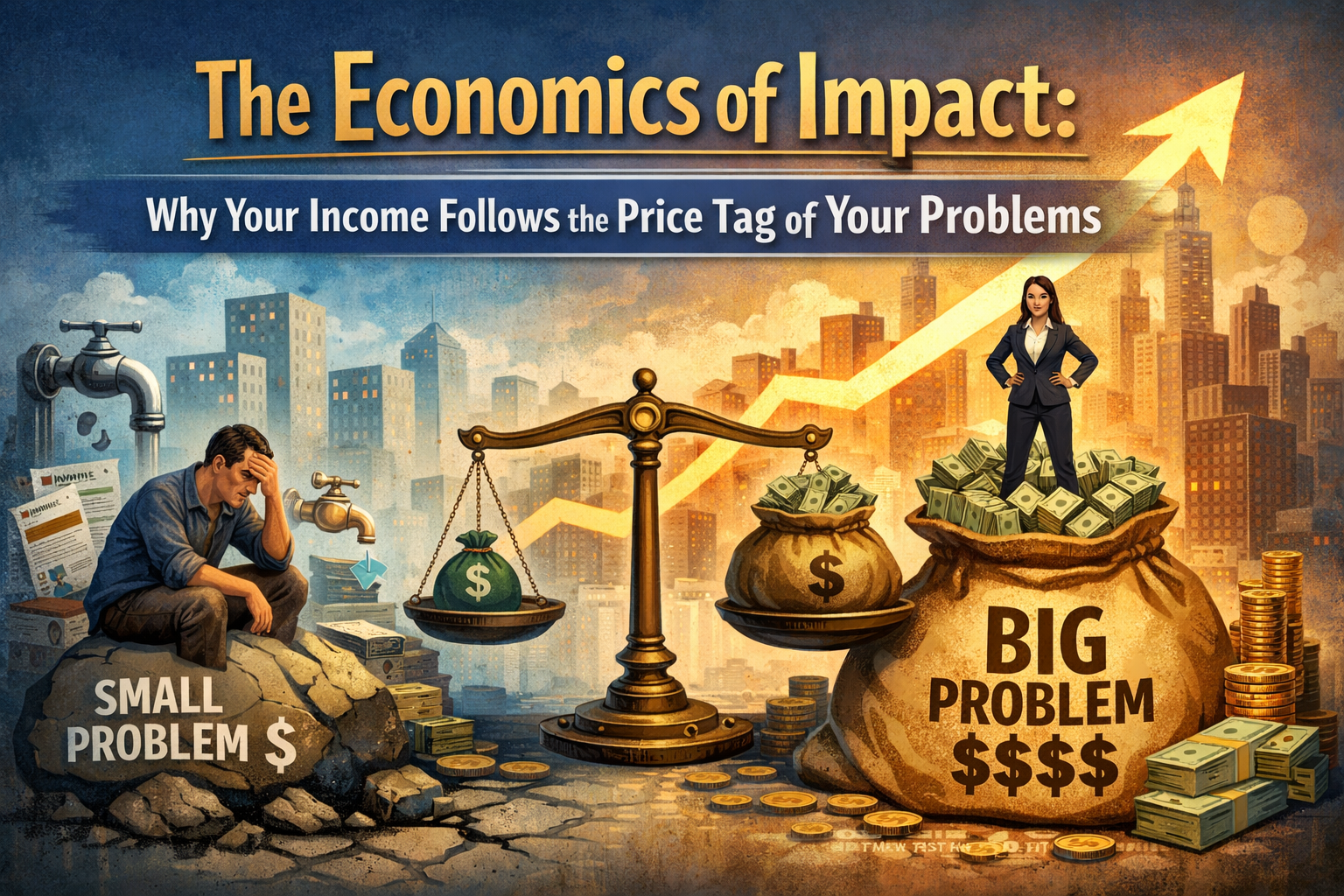
The Economics of Impact: Why Your Income Follows the Price Tag of Your Problems

There is a peculiar paradox in the modern workforce. We celebrate the notion of hard work as if effort alone were the currency of success. We tell stories of the diligent employee who arrives first and leaves last, who answers emails at midnight and never takes a full lunch break. Yet this person, for all their sweat and sacrifice, often finds themselves earning incrementally more than colleagues who appear to do far less. The explanation is not favoritism, nor is it luck. It is something far more fundamental and, once understood, far more controllable. The market does not reward effort. It rewards the alleviation of pain at scale.

Consider the trajectory of a software engineer fresh out of university. In their first role, they fix bugs. They patch code that causes minor inconveniences—perhaps a button that misaligns on mobile screens or a form that occasionally fails to submit. These are real problems, certainly, and solving them requires genuine skill. But the cost of these problems remaining unsolved is measured in mild frustration, in a handful of customer support tickets, in a slight dip in conversion rates that the company might not even notice. The engineer is paid accordingly, perhaps a comfortable salary that reflects their competence but hardly their exhaustion.

Now watch that same engineer a decade later, having moved through the ranks to become an architect or a technical fellow at a major technology firm. They are no longer fixing buttons. They are designing systems that prevent millions of dollars in fraud, or infrastructure that allows a company to expand into new markets worth billions, or algorithms that optimize supply chains affecting thousands of jobs. The problems they solve are existential. If they fail, the consequences cascade through balance sheets and shareholder reports. If they succeed, the value they create is measured in eight or nine figures. Their compensation has grown not because they work harder—indeed, they may work fewer hours than they did as a junior—but because the problems they have learned to solve are orders of magnitude more expensive to leave broken.

This pattern repeats across every industry imaginable. A junior lawyer reviews contracts for typos and minor compliance issues. A partner at the same firm structures mergers where a single misplaced clause could cost either party hundreds of millions. A young consultant creates slide decks summarizing market research. A senior partner orchestrates the turnaround of a failing conglomerate, where the alternative to their advice is bankruptcy and the loss of ten thousand livelihoods. The progression is never about the volume of work. It is about the stakes.

The mechanism that connects problem value to income is not mysterious. It is the fundamental logic of exchange. When you sell your labor, you are not selling your time. You are selling a solution. The buyer of that solution—whether an employer, a client, or a market—performs a calculation, often unconsciously, about what that solution is worth to them. A solution that prevents a ten-thousand-dollar loss is worth perhaps a few hundred dollars to acquire. A solution that prevents a ten-million-dollar catastrophe is worth hundreds of thousands, or millions, to secure. The person capable of delivering the latter solution will find that multiple buyers compete for their attention, driving their price upward until it reflects the magnitude of the relief they provide.

This is why specialization in high-stakes domains yields such dramatic returns. A cardiac surgeon does not necessarily work longer hours than a pediatrician, but the cost of a failed heart surgery is immediate death, while the cost of a delayed ear infection treatment is discomfort and a follow-up appointment. The surgeon’s skill is deployed against a more expensive problem, and their income reflects this. A quantitative trader who designs models to manage systemic risk for an investment bank is paid fortunes not because trading is inherently noble, but because the problems of uncontrolled exposure can erase institutions overnight. Their solutions are insurance against catastrophe, and insurance against catastrophe is always priced at a premium.The implication for anyone seeking to increase their economic value is clear, though perhaps uncomfortable. The path to greater income runs through greater danger, greater complexity, and greater responsibility. It requires moving away from problems that are safe, well-understood, and populated with many competent solvers, toward problems that are ambiguous, consequential, and sparsely populated with those capable of addressing them. This is not a call to recklessness. It is a call to education, to the deliberate acquisition of skills that are rare and applicable to costly situations. It is a call to reputation, to the building of a track record that proves one can be trusted with high-stakes outcomes. And it is a call to courage, to the willingness to step into situations where failure is possible and expensive, because those are the only situations where success is transformativeally valuable.

There is a temptation to view this reality as cynical, as evidence that the economic world is coldly utilitarian. But this misses the deeper truth. The most expensive problems are often those that affect the most people, or that determine the survival of organizations that employ thousands, or that unlock possibilities previously thought impossible. Solving them is not merely lucrative. It is genuinely consequential. The cardiac surgeon saves lives. The engineer enables global communication. The strategist preserves jobs. Their high incomes are not distortions but signals—signals that their work matters immensely, that the costs of their absence would be borne by many, and that their presence creates possibilities that would otherwise remain closed.

The worker who wishes to escape the trap of modest returns must therefore ask themselves not how they can work more, but how they can matter more. They must identify the bottlenecks in their organization or industry where pain accumulates, where risk concentrates, where the cost of failure is highest. They must then cultivate the specific expertise required to address those bottlenecks. This is difficult. It requires saying no to the comfort of competence in easy domains. It requires enduring the anxiety of operating at the edge of one’s abilities. It requires accepting that one’s value is not intrinsic but contingent on the problems one can solve.

But the reward is not merely financial. There is a profound satisfaction in solving problems that matter, in knowing that one’s work has prevented disaster or enabled breakthrough. The income is the market’s recognition of this satisfaction’s scarcity. The individual who learns to solve expensive problems finds themselves not only wealthier but more necessary, more central to the enterprises they serve, more capable of shaping the world according to their vision of what is possible.The economy, in its relentless efficiency, has always known this. It is time the rest of us learned it too.