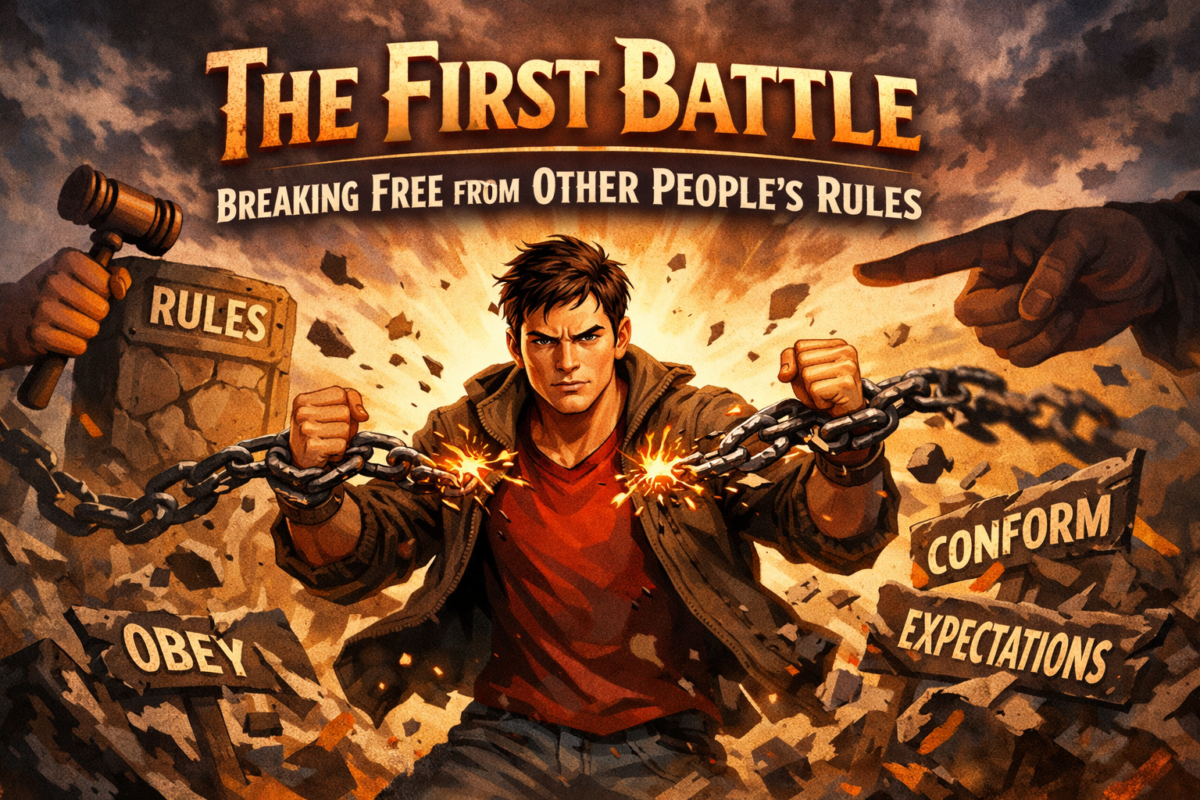
There’s a strange contradiction in how people approach rebellion. They’ll rage against systems, institutions, and abstract powers while remaining completely subordinate to the specific human beings standing right in front of them. They’ll post manifestos about freedom while asking permission to take a lunch break. They’ll dream of revolution while checking their phone every three minutes to see if someone approved of what they said.If you’re going to fight the world, here’s what matters first: stop being ruled by other people.
Not “the system.” Not “society.” Not capitalism or bureaucracy or any other grand abstraction that lets you feel revolutionary while remaining safely powerless. I mean the actual human beings who tell you what to do, whose approval you crave, whose disappointment you fear, whose expectations shape your choices more than your own desires ever could.
This is harder than fighting abstractions because it’s personal and immediate. It’s easy to be against “the establishment” when the establishment is a faceless entity you’ll never meet. It’s much harder to be against your boss, your parents, your friends, your partner, or the social circle whose judgment you’ve internalized so deeply you don’t even recognize it as external anymore.
Most people who think they’re fighting the world are actually just switching which humans rule them. They leave one job for another with a different boss. They reject their parents’ values and adopt their peer group’s values instead. They escape one relationship and immediately seek another person to orient their life around. The faces change but the fundamental posture remains the same: looking outward for permission, validation, and direction.
Real independence starts with recognizing how much of your life is shaped by the need to please, impress, or avoid conflict with specific people. It’s not about becoming a hermit or burning every bridge. It’s about shifting the foundation of your decision-making from “what will they think” to “what do I actually want.” This sounds simple but it’s not, because we’re social creatures who’ve spent our entire lives learning to read rooms, please authorities, and maintain relationships by contorting ourselves into acceptable shapes.
The tyranny of other people’s rule operates mostly through anticipation. You don’t need an actual boss standing over you if you’ve internalized their voice so completely that you pre-emptively edit yourself. You don’t need your family to explicitly disapprove if you’ve already decided not to do something because you know they would. The most effective control is the control you enforce on yourself to avoid consequences that might never actually come.
Breaking this pattern requires something uncomfortable: disappointing people. Not for its own sake, not to be contrarian, but as a necessary cost of living according to your own judgment. You have to be willing to have someone think less of you. You have to be able to tolerate someone being upset with you. You have to accept that some relationships might end or change dramatically when you stop playing the role you’ve been assigned.
This doesn’t mean being cruel or thoughtless. It means that other people’s preferences, no matter how strongly expressed, are not commands you must obey. Their disappointment is not an emergency you must fix. Their vision of who you should be is not more valid than your own just because they feel strongly about it.
Economic independence helps but isn’t sufficient. Plenty of people with money still structure their entire lives around other people’s approval. And plenty of people with limited resources have managed to carve out genuine autonomy by being willing to accept material consequences for their choices. The question isn’t whether you can survive without anyone else’s help—that’s rarely possible—but whether you’re making decisions based on your own assessment of what matters or based on managing other people’s reactions.
The world you might want to fight—unjust systems, destructive norms, institutional failures—is ultimately made of people making choices. If you can’t even escape being ruled by the specific individuals in your immediate life, you have no realistic chance of changing anything larger. You’re just adding your voice to the chorus of the controlled, people who’ve outsourced their agency so completely they don’t realize they’re already living in the condition they claim to oppose.
Start with the small tyrannies. The meeting you don’t want to attend. The favor you don’t want to do. The opinion you’re afraid to express. The choice you’re not making because someone would disapprove. These aren’t trivial matters separate from larger struggles for freedom. They’re the foundation. If you can’t govern yourself in basic daily interactions, you’re not fighting the world. You’re just fantasizing about it while remaining in chains you could unlock yourself.