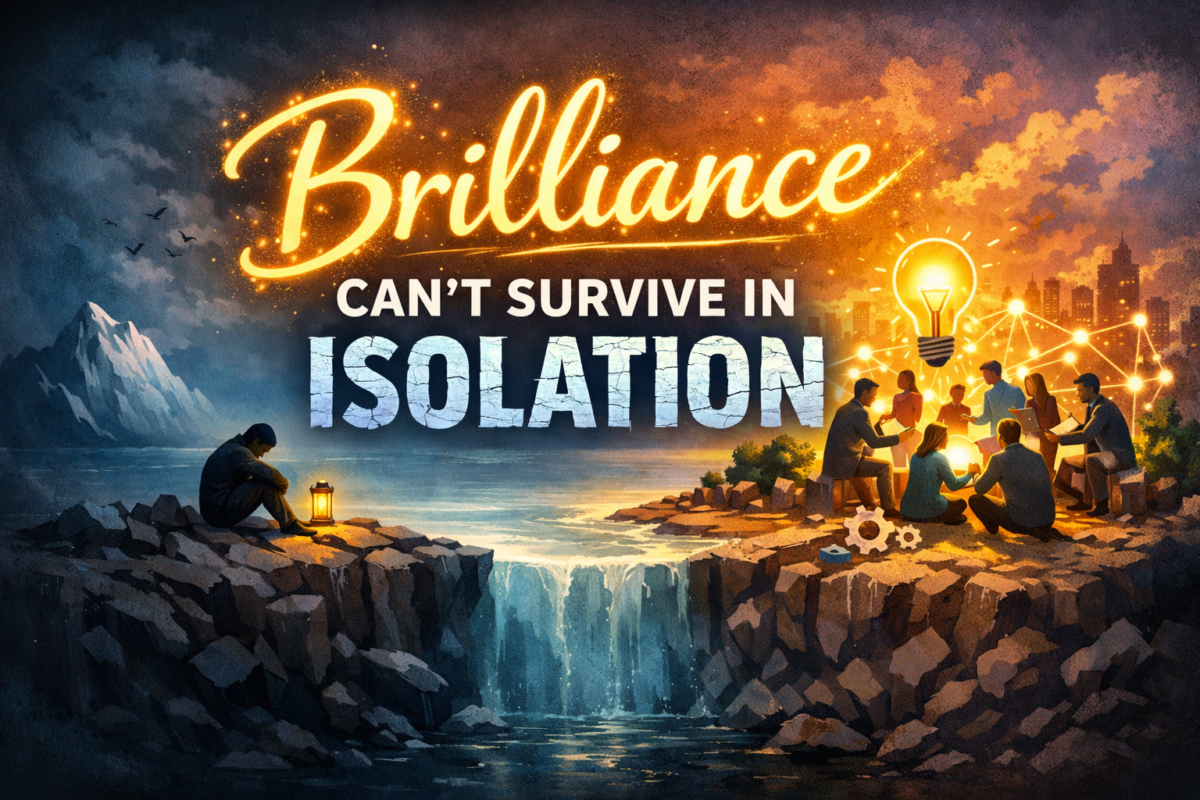
There’s a pervasive myth in our culture that raw intelligence is enough. We celebrate the lone genius, the maverick who sees what others can’t, the brilliant mind that transcends their circumstances. But here’s an uncomfortable truth that anyone who’s actually tried to accomplish something meaningful will recognize: your intelligence becomes functionally irrelevant when you’re working in an environment of incompetence.
Think about it this way. You can be the most analytically gifted person in the room, capable of seeing ten moves ahead, synthesizing complex information, and generating innovative solutions. But if every decision you make has to pass through people who can’t understand your reasoning, if every project requires collaboration with colleagues who miss obvious problems, if every plan gets derailed by preventable mistakes, then what good is your intelligence doing?
Your cognitive horsepower doesn’t operate in a vacuum. It requires a certain quality of input to produce meaningful output. Feed a sophisticated analytical engine garbage data, flawed assumptions, and illogical constraints, and you’ll get garbage results regardless of the engine’s potential. This isn’t just frustrating on an emotional level, it’s a structural problem that undermines the very possibility of success.
Consider what actually happens in these situations. You identify a problem early and propose a solution. Nobody understands why it’s a problem. By the time the issue becomes undeniable, it’s too late for your solution to work. You design an elegant system, but it gets implemented incorrectly because the people building it don’t grasp the underlying logic. You spot the fatal flaw in a plan, but you’re outvoted by people who find your concerns too abstract or technical. Again and again, you watch preventable disasters unfold in slow motion, powerless to stop them because you can’t convince or circumvent the incompetence surrounding you.
The psychological toll is significant. There’s a special kind of exhaustion that comes from constantly having to explain basic concepts, from watching obviously bad ideas get enthusiastically adopted, from being perpetually unable to operate at the level you’re capable of. Over time, this creates a sense of learned helplessness. You start to doubt yourself. Maybe you’re not as smart as you thought. Maybe you’re the one missing something. The reality is often simpler and darker: you’re being dragged down to the median capability of your environment.
This dynamic plays out everywhere. In companies where middle management filters out good ideas they don’t understand, brilliant engineers and strategists find themselves stifled. In academic departments dominated by intellectual mediocrity, promising researchers get buried in bureaucracy or have their innovative work dismissed. In creative industries, talented artists and writers see their work compromised by executives who can’t distinguish between what’s bold and what’s bad.
The problem compounds because incompetent people tend to create environments that repel competence. They make decisions that seem baffling to anyone with expertise because they’re optimizing for the wrong variables. They promote people like themselves because they can’t recognize or feel threatened by superior ability. They create cultures where appearing busy matters more than being effective, where following process trumps achieving results, where consensus means catering to the least informed person in the room.
Some will argue that if you’re truly intelligent, you should be able to work around these obstacles. You should be able to communicate in ways that bridge the gap, to find clever workarounds, to succeed despite the impediments. There’s some truth to this, but it also misses the point. Yes, exceptional intelligence combined with exceptional social skills and political savvy can sometimes overcome environmental incompetence. But this requires expending enormous energy on meta-problems rather than object-level work. You’re not doing your best thinking when you’re constantly translating, politicking, and damage-controlling. You’re in survival mode, not creation mode.
The hardest part might be recognizing when you’re in this situation. We’re taught to be team players, to assume good faith, to believe that hard work and talent will win out. We internalize the idea that if we’re struggling, we must be the problem. But sometimes the environment really is the limiting factor. Sometimes you’re not failing to reach your potential because of some personal deficiency but because you’re trying to run sophisticated software on hardware that can’t support it.
What’s the answer? The uncomfortable reality is that environment matters more than we want to admit. You can be exceptionally intelligent and accomplish very little if you’re in the wrong context. You can be moderately intelligent and accomplish great things if you’re surrounded by competent, motivated people who elevate your thinking and execute well on shared goals. The people around you don’t just influence your work, they define the ceiling of what’s possible.
This isn’t an argument for elitism or contempt toward those with less ability. It’s a recognition that collaboration requires a baseline of shared competence. A surgeon needs a capable surgical team. A quarterback needs receivers who can catch. A CEO needs executives who can think strategically. When that baseline doesn’t exist, individual brilliance becomes trapped potential, unable to manifest as actual achievement.
If you find yourself in this situation, the strategic question isn’t how to work harder or be smarter. It’s whether you can change your environment or need to leave it entirely. Because the brutal truth is that your intelligence is only as useful as the system you’re operating within allows it to be. And no amount of individual capability can compensate for being surrounded by people who can’t or won’t meet you at the level required for meaningful work.