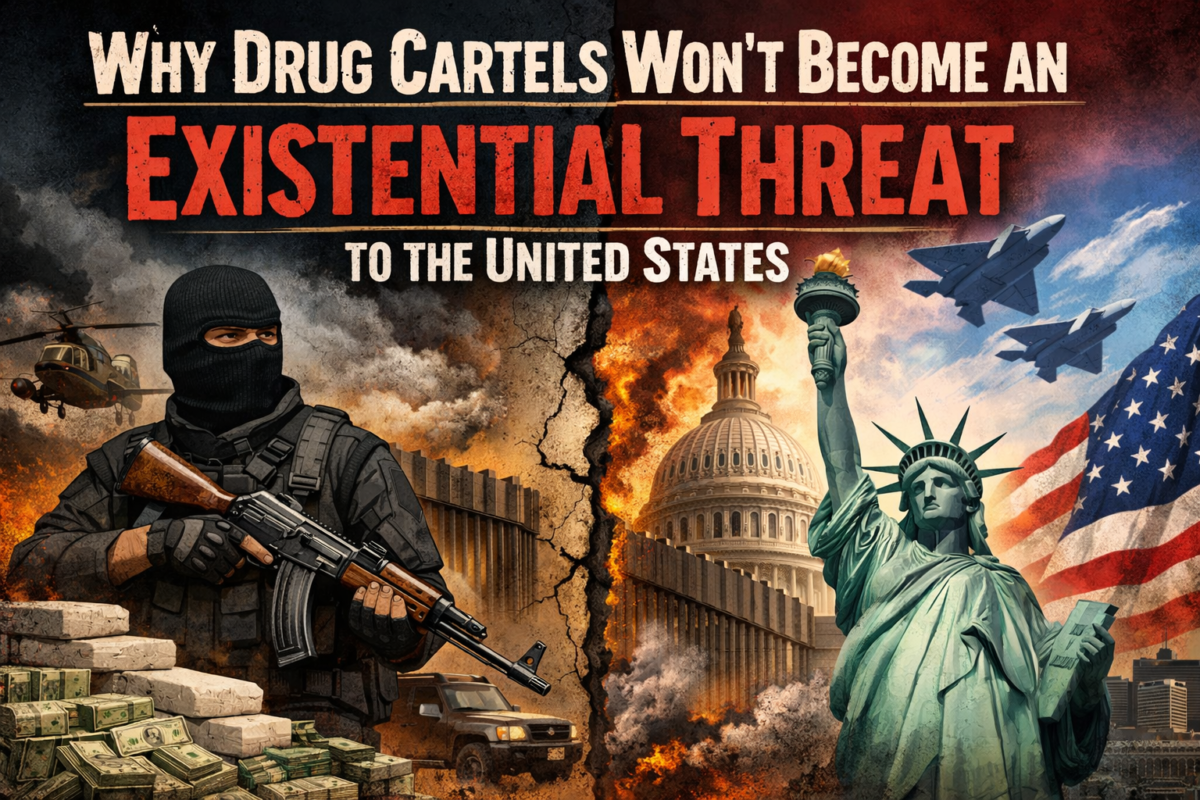
The specter of drug cartels destabilizing the United States has become a recurring theme in political discourse and media coverage. Images of violence spilling across borders, fentanyl deaths mounting, and criminal organizations wielding sophisticated weaponry fuel fears that these groups might somehow pose a fundamental threat to American sovereignty or social order. But when we look beyond the headlines and examine the structural realities of how cartels operate and how American society functions, a different picture emerges. Over the long term, drug cartels simply cannot become an existential threat to the United States, and the reasons why reveal important truths about power, institutions, and public consensus.
An existential threat is not merely something dangerous or harmful. Cancer kills hundreds of thousands of Americans annually, but we don’t describe it as an existential threat to the nation. Car accidents, heart disease, and countless other causes of death and suffering affect far more people than cartel violence ever could on American soil, yet we understand these as serious problems to manage rather than threats to our continued existence as a functioning society. An existential threat would need to challenge the basic ability of the United States to maintain territorial integrity, governmental legitimacy, rule of law, or social cohesion at a fundamental level.
Cartels are profit-seeking criminal enterprises, not ideological movements seeking to overthrow governments or destroy societies. Their business model depends entirely on the continued existence of stable, wealthy consumer markets. A cartel that destabilized the United States to the point of societal collapse would be destroying its own revenue stream. This creates a natural ceiling on how disruptive these organizations can afford to be. They want Americans alive, employed, and able to purchase drugs, not living in a failed state where commerce breaks down and law enforcement becomes militarized to the point of making drug trafficking impossible.
The fundamental asymmetry of power between the United States government and any criminal organization also matters enormously. The US federal government commands resources, technology, intelligence capabilities, and legitimate force that dwarf anything a cartel could marshal. When the political will exists to treat something as a true national security priority, American institutions have repeatedly demonstrated the ability to mobilize overwhelming resources. The fact that cartels currently operate with some degree of impunity in certain contexts reflects policy choices about enforcement priorities and strategies, not an inability to confront them if they genuinely threatened core national interests.
Consider what would happen if a cartel actually attempted actions that rose to the level of an existential threat, perhaps by launching sustained terrorist attacks on American soil, assassinating federal officials en masse, or attempting to seize territory. The response would be swift and devastating. The same nation that has prosecuted wars across the globe, that eliminated Osama bin Laden in a sovereign nation without permission, that maintains the world’s most sophisticated intelligence apparatus, would bring those capabilities to bear domestically with far fewer constraints than international operations require. The restraints on current drug enforcement stem largely from civil liberties concerns, constitutional protections, and questions about whether aggressive tactics are worth their social costs. An organization that genuinely threatened American survival would not benefit from those restraints.
Moreover, the political consensus against cartels would become absolute in any scenario where they posed a real existential threat. Right now, debates about drug policy encompass a wide range of views, from aggressive interdiction to harm reduction to legalization. These debates exist because people recognize complex tradeoffs. But if cartels were actually threatening to destroy American society rather than profiting from vice markets, that complexity would vanish. The same broad coalition that rallied after September 11th would coalesce, but with the target being criminal organizations operating in neighboring countries. No meaningful political constituency exists that would tolerate cartels if they genuinely threatened the nation’s survival.
This points to perhaps the most important factor preventing cartels from becoming an existential threat: the American public would never allow it. We sometimes underestimate how much potential force a democratic society can mobilize when there’s genuine consensus about a threat. The United States has prosecuted major wars, conducted massive domestic mobilizations, and fundamentally reorganized its government and society when facing real existential threats. The Greatest Generation didn’t earn its name by accident. The idea that criminal organizations trafficking in narcotics could somehow overwhelm that collective capacity strains credulity.
The comparison to Mexico, where cartels have at times seemed to challenge state authority, illuminates rather than undermines this point. Mexico’s struggles with cartels stem from specific historical factors including institutional weakness, corruption at multiple levels of government, economic disparities, and proximity to production regions. Even in Mexico, cartels have not succeeded in overthrowing the government or establishing alternative sovereignty, despite facing a state with far fewer resources than the United States. The cartels have carved out space to operate, corrupted officials, and inflicted terrible violence, but they have not and cannot actually replace the Mexican state because doing so would require capabilities and objectives they don’t possess.
The United States, with vastly more robust institutions, greater economic resources, broader legitimacy, more sophisticated law enforcement, and geographic distance from production zones, is far less vulnerable to the specific dynamics that have challenged Mexico. American institutions, for all their flaws, command a degree of loyalty and effectiveness that would make cartel infiltration at a destabilizing scale extraordinarily difficult. When the FBI, DEA, or other federal agencies target an organization, they bring to bear tools that have successfully dismantled numerous criminal enterprises over the decades.
Some might argue that the opioid crisis demonstrates cartels can inflict massive harm on American society, and this is absolutely true. The fentanyl epidemic has killed hundreds of thousands and devastated communities. This represents a serious public health crisis and a law enforcement challenge. But it does not represent an existential threat to the United States as a functioning nation-state. As horrific as these deaths are, they occur within a society that continues to function, with governments that continue to operate, institutions that persist, and a social fabric that, while strained, has not unraveled. We have the capacity to address the opioid crisis through some combination of enforcement, treatment, harm reduction, and policy reform. The question is one of political will and strategic choices, not capability.The long-term trajectory matters here as well. Social attitudes toward drugs evolve, policy approaches adapt, and enforcement strategies improve. The same nation that went from Prohibition to regulated alcohol markets, that has seen some states legalize marijuana while maintaining federal prohibition, demonstrates capacity for policy evolution. As fentanyl’s devastating impact becomes clearer, political pressure for more effective responses grows. This might take the form of enhanced interdiction, different approaches to treatment, harm reduction strategies, or even eventual reconsideration of prohibition policies. The point is that democratic societies can adapt their responses to evolving threats, especially when those threats become sufficiently visible and painful.
Cartels also face their own vulnerabilities that prevent them from growing powerful enough to threaten the United States existentially. They are criminal organizations dependent on secrecy, vulnerable to infiltration, prone to internal power struggles, and ultimately constrained by the need to convert their activities into usable wealth within the legitimate economy. Every point where they intersect with legal systems, financial institutions, or legitimate commerce creates opportunities for state action against them. The more powerful and visible they become, the more they invite the attention of law enforcement and intelligence services that can degrade their capabilities.
The international dimension also works against the possibility of cartels becoming an existential threat. While Mexico faces serious challenges from these organizations, the Mexican government has not collapsed, and the United States maintains strong bilateral relationships and cooperation on security issues. If cartels were somehow to grow so powerful that they genuinely threatened American sovereignty, the international response would isolate them completely. No legitimate government would tolerate criminal organizations that posed that level of threat to the United States, and the cartels would find themselves facing coordinated action from multiple state actors with overwhelming advantages in resources and legitimacy.
Perhaps most fundamentally, the American public’s tolerance for disorder is limited. We are a society that expects functioning infrastructure, reliable institutions, and general public safety. When those expectations are seriously violated, political pressure for corrective action becomes irresistible. The cartel violence that has plagued parts of Mexico would be completely intolerable to American voters if it occurred on US soil at anywhere near that scale. The political system would respond with whatever measures were necessary to restore order, because elected officials who failed to do so would be removed from office.
This doesn’t mean cartels aren’t a serious problem or that their activities don’t cause real harm. They do, and that harm deserves serious policy responses. But there’s an important difference between a serious criminal justice and public health challenge and an existential threat to the nation. Conflating the two leads to poor policy choices, whether in the form of militarized responses that undermine civil liberties or panic that distorts our understanding of what’s actually at stake.
The long-term outlook suggests cartels will remain a manageable problem rather than an existential threat because the structural factors that prevent them from becoming one are durable. American institutions will continue to be stronger than any criminal organization. The public will continue to demand order and safety. The asymmetry of power between nation-states and criminal enterprises will persist. And cartels themselves will remain constrained by their nature as profit-seeking organizations dependent on the continued functioning of the societies they exploit.
Understanding this doesn’t require complacency. It requires clear-eyed assessment of the actual nature of the challenge we face so we can develop proportionate, effective responses. The drug trade causes real suffering, addiction ruins lives, and cartel violence claims innocent victims. These problems deserve serious attention and resources. But they should be addressed as the serious yet manageable challenges they are, not elevated to the status of existential threats, which would distort both our understanding and our response. The United States has faced and overcome genuine existential threats in its history. Drug cartels, for all the harm they cause, do not belong in that category and will not in the future.