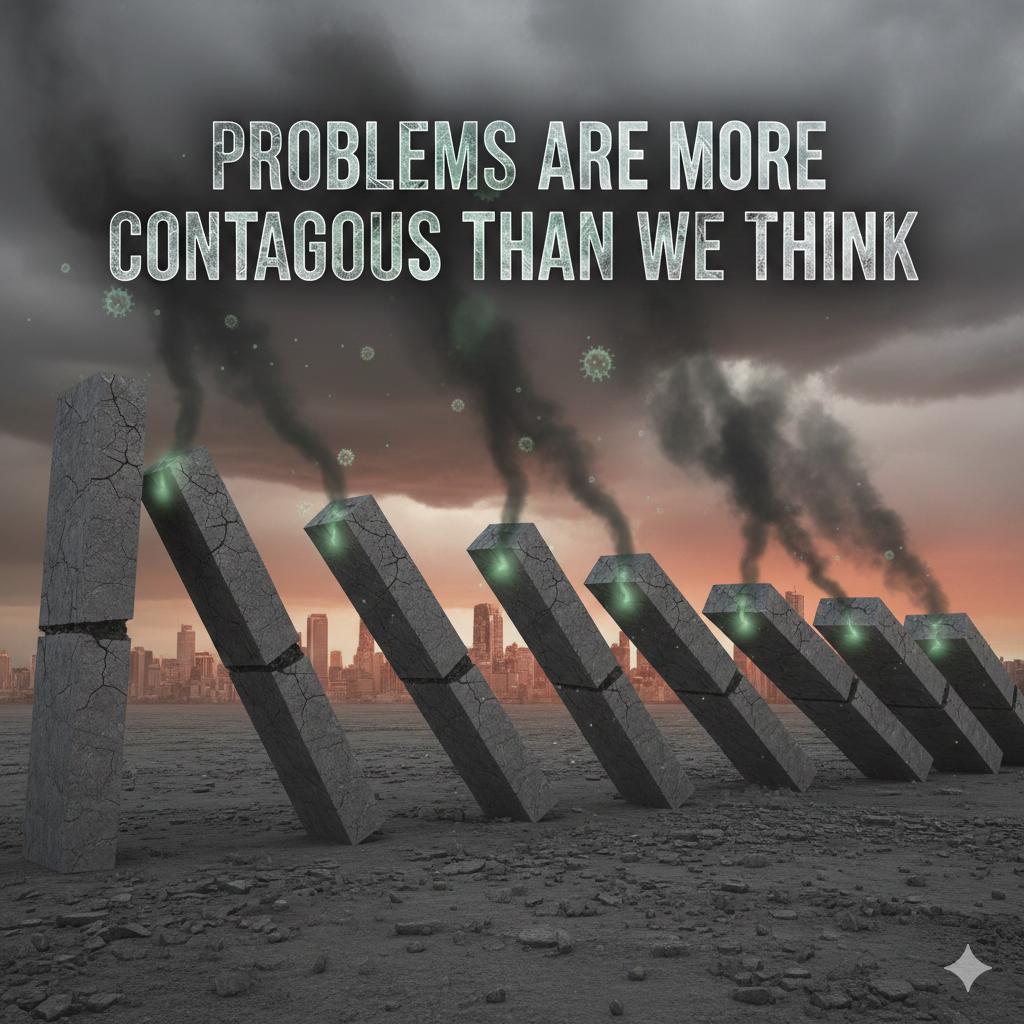
There’s a peculiar phenomenon that plays out in neighborhoods, workplaces, and communities everywhere, yet most people only recognize it in hindsight. A single broken window appears on an abandoned building. Within months, the entire block shows signs of neglect. One team member starts missing deadlines, and soon the whole department operates in crisis mode. A friend begins canceling plans regularly, and before long, flakiness becomes the group norm.
Problems, it turns out, don’t stay contained. They spread through social networks and physical spaces with surprising efficiency, often faster than the solutions meant to stop them. Understanding this contagion effect isn’t about pessimism or paranoia. It’s about recognizing a fundamental truth of human psychology and social dynamics that can help us protect what matters most.The mechanism behind this spread operates on multiple levels simultaneously. At the most basic level, we’re dealing with simple observation and imitation. Humans are remarkably attuned to the behavior of those around them, constantly calibrating what’s normal, acceptable, or expected based on environmental cues. When we see others engaging in certain behaviors without consequence, we unconsciously adjust our own behavioral boundaries. This isn’t weakness or lack of character. It’s how our brains efficiently navigate complex social worlds by using others as reference points.
But the contagion goes deeper than mere imitation. There’s a powerful psychological phenomenon where the presence of problems actually changes our assessment of risk and appropriateness. When disorder already exists in an environment, our internal threshold for contributing to that disorder drops dramatically. It’s the difference between being the first person to drop litter on a pristine beach versus adding your wrapper to a beach already scattered with trash. The cognitive and emotional cost of the second action feels negligible compared to the first.
This works in professional settings just as powerfully as in physical spaces. When one person starts arriving late to meetings without pushback, it signals that punctuality isn’t actually valued despite what official policies might say. Others pick up on this unspoken message and adjust accordingly. When someone cuts corners on a project and faces no consequences, it communicates that quality standards are negotiable. The contagion isn’t just about individual choices anymore. It’s about collective redefinition of norms.
The emotional dimension of contagion deserves particular attention because it operates largely below conscious awareness. Anxiety, pessimism, cynicism, and resignation spread through groups like viruses, often without anyone realizing they’ve been infected. Someone who works alongside a chronically stressed colleague will likely experience elevated stress themselves, even if their own workload is manageable. A friend group with one persistently negative member often sees collective mood and outlook shift downward over time.
These emotional contagions create self-reinforcing cycles. Stress makes people less patient and more reactive, which creates conflicts that generate more stress. Cynicism makes people less likely to contribute effort or take initiative, which leads to poorer outcomes that justify more cynicism. The predisposition to see problems spreads faster than the problems themselves, creating an atmosphere where difficulties are expected, amplified, and sometimes even unconsciously generated to confirm existing negative expectations.
Physical environments act as particularly efficient vectors for this kind of spread. A well-maintained space communicates care, attention, and standards. It tells everyone who enters that this place matters and that maintaining it is a shared responsibility. The moment visible deterioration appears and remains unaddressed, that message changes. Now the space communicates neglect, and each person who encounters it receives subtle permission to contribute their own small acts of carelessness.
The speed of this deterioration often shocks people who haven’t witnessed it before. A fence gets tagged with graffiti. Within days, more tags appear. A dumpster overflows because pickup was delayed. Suddenly trash accumulates around it even after it’s been emptied. What changed wasn’t the physical availability of space or disposal options but the psychological signal about what behavior was acceptable in that location.
Organizations face the same dynamic with policies and practices. When rules are stated but not enforced, when standards are proclaimed but not upheld, when problems are acknowledged but not addressed, people receive clear information about what actually matters versus what’s just rhetoric. This gap between stated values and enacted reality becomes its own kind of contagion, breeding cynicism and disengagement that spread far beyond the original issue.
The challenge with all forms of contagion is that early intervention requires acting when the problem still seems small, when taking action might feel like an overreaction. There’s a natural human tendency to minimize concerns, to wait and see, to avoid being the person who makes a big deal out of nothing. This tendency is precisely what allows contagion to accelerate. By the time the problem feels obviously serious enough to warrant action, it’s already spread significantly and become much harder to contain.
Effective prevention requires recalibrating our sense of urgency around early warning signs. When you notice a behavioral norm starting to slip in your team, addressing it immediately isn’t overreacting. It’s preventing the recalibration of everyone’s expectations about what’s acceptable. When you see physical deterioration beginning in your neighborhood, reporting it or fixing it yourself isn’t being uptight. It’s maintaining the signals that keep broader decline from taking hold.
This doesn’t mean treating every minor issue as a crisis or living in constant vigilance about potential problems. It means developing awareness of what kinds of issues tend to spread and recognizing the difference between isolated incidents and early indicators of pattern shifts. One person having a bad day isn’t contagion. One person developing a pattern of negative behavior that goes unaddressed is a different matter entirely.
The social dynamics make early intervention particularly challenging because it often means being the first person to say something, to push back, or to raise concerns. There’s real social cost to breaking the silence around emerging problems. It can feel awkward, confrontational, or like you’re being unnecessarily critical. But the alternative cost of allowing problems to normalize and spread is invariably higher, even though it’s distributed across more people and arrives more gradually.
Context matters enormously in determining how quickly contagion spreads and how difficult it is to reverse. Environments with strong existing positive norms, clear communication, and established trust can often absorb and correct for problems relatively quickly. The immune system, so to speak, is robust. But in environments already stressed, where norms are weak or trust is low, the same small problem can cascade rapidly because there’s less resilience to contain it.
This is why maintaining positive conditions isn’t just about current quality of life. It’s about building resistance to future problems. A team with strong collaborative habits and open communication can usually address emerging conflicts before they metastasize. A neighborhood with active community connections and shared investment can typically rally to address problems while they’re still manageable. The social capital and positive norms act as preventative infrastructure.
Personal susceptibility to contagion varies but isn’t fixed. We all have domains where we’re more vulnerable to absorbing problematic patterns from our environment and others where we’re more resistant. Often our vulnerabilities align with existing insecurities, stress points, or areas where we lack strong independent standards. Someone confident in their professional abilities might be largely immune to workplace cynicism but highly susceptible to social anxiety spreading through their friend group.
Recognizing your own vulnerability points isn’t about self-criticism. It’s about strategic awareness that helps you protect yourself and avoid inadvertently becoming a vector for problems yourself. If you notice that spending time with certain people consistently leaves you more anxious, pessimistic, or behaviorally different in ways you don’t prefer, that’s valuable information about a contagion pattern affecting you.
The flip side of understanding negative contagion is recognizing that positive patterns spread through the same mechanisms. Enthusiasm, optimism, conscientiousness, and kindness are all contagious when consistently modeled, especially by people with social influence or formal authority. This is why leadership matters so much and why individual choices to maintain standards have effects beyond just the immediate situation.
When you’re the person who continues showing up on time, doing thorough work, maintaining optimism, or keeping shared spaces clean even as others slack, you’re not just avoiding personal contribution to decline. You’re maintaining a competing signal about what’s normal and expected. Sometimes that’s enough to slow or reverse contagion. Other times it isn’t, but at minimum you’ve prevented the problem from spreading through you to others in your network.
The key insight is that problems rarely stay contained at their source. They change the environment in ways that make similar and related problems more likely to emerge elsewhere. Understanding this doesn’t mean becoming hypervigilant or pessimistic about every small issue. It means developing realistic awareness about how social dynamics work and calibrating your response accordingly.
Prevention is almost always easier than cure, even though it often feels like overreaction at the time. The awkwardness of addressing a problem early, the effort of maintaining standards when others aren’t, the social cost of being the first to speak up—these are real but temporary difficulties. The alternative of waiting until the problem is undeniable means dealing with something larger, more entrenched, and affecting more people.
The goal isn’t perfection or constant crisis management. It’s cultivating appropriate responsiveness to early signals, maintaining your own standards even when social pressure shifts, and understanding that your choices about what you accept, ignore, or address have effects that ripple outward in ways you might not immediately see but that ultimately shape the environment everyone shares.