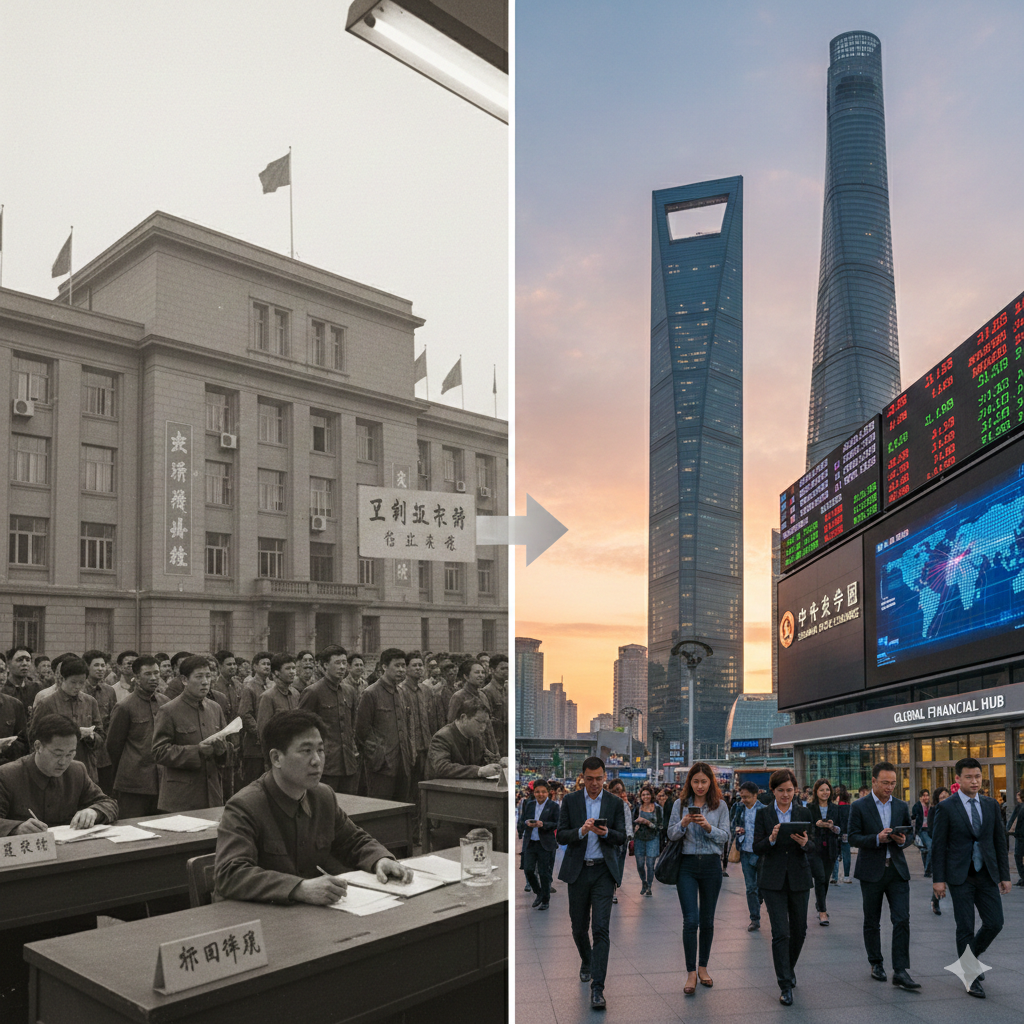
The story of stock exchanges in China is one of dramatic transformation, ideological struggle, and remarkable adaptation. Unlike Western markets that evolved gradually over centuries, China’s securities markets emerged suddenly after decades of complete absence, compressed centuries of financial evolution into mere decades, and now stand among the world’s largest despite being relatively young.
The Pre-Revolutionary Era
China’s first encounter with modern stock trading came in the late nineteenth century, when foreign traders established informal securities markets in the treaty ports of Shanghai and Hong Kong. The Shanghai Securities and Commodities Exchange, founded in 1891, was Asia’s first formal exchange, though it primarily served foreign interests and traded rubber, precious metals, and foreign company shares rather than domestic Chinese enterprises.
During the Republican period between 1912 and 1949, Chinese stock markets experienced chaotic growth. Shanghai became home to multiple exchanges where shares of banks, railways, and manufacturing companies changed hands amid rampant speculation. These markets operated without meaningful regulation, and the period was marked by manipulation, fraud, and spectacular crashes. The association between stock markets and economic chaos would later influence Communist attitudes toward securities trading.
The Socialist Interlude
When the Chinese Communist Party took power in 1949, it swiftly eliminated stock exchanges as part of its program to abolish private ownership and establish a centrally planned economy. For three decades, the very concept of shareholding was ideologically suspect, associated with capitalism and bourgeois exploitation. State-owned enterprises operated according to central plans, receiving government allocations rather than raising capital through markets. The notion that ordinary citizens might own shares in productive enterprises was fundamentally incompatible with socialist orthodoxy.
The Cautious Reopening
The revival of stock markets in China came gradually and tentatively following Deng Xiaoping’s economic reforms that began in 1978. As China experimented with market mechanisms while maintaining Communist Party control, some state-owned enterprises began issuing shares to employees and local residents as a way to raise capital. These early shares, issued in the 1980s, were often informal certificates that traded over-the-counter or through unofficial brokers.
The government viewed these experiments with ambivalance. While recognizing the need for capital to fuel economic growth, officials worried about creating a class of wealthy shareholders and reintroducing the speculative excesses that had characterized pre-revolutionary markets. The ideological challenge was substantial: how could a socialist state permit private ownership of productive assets?
The solution came through conceptual innovation. Chinese theorists argued that stock markets could serve socialism by allowing the state to maintain control over enterprises while raising capital from citizens. Under this framework, shareholders would not be capitalist exploiters but participants in socialist construction, and markets would allocate resources more efficiently than central planning while the Party retained ultimate authority.
The Birth of Modern Exchanges
The Shanghai Stock Exchange was reestablished on December 19, 1990, almost exactly a century after China’s first modern exchange. Just four months later, in April 1991, the Shenzhen Stock Exchange opened in the southern city that had become China’s laboratory for economic experimentation. Both exchanges operated under strict government supervision, with limited numbers of listed companies and tight controls on who could trade.
The early years were tumultuous. With few investment alternatives and enormous pent-up demand, share prices swung wildly. The government struggled to balance its desire for orderly markets against public enthusiasm for trading. Initial public offerings attracted massive oversubscription, with applicants sometimes outnumbering available shares by hundreds to one. The August 1992 riots in Shenzhen, when frustrated investors who failed to obtain IPO application forms clashed with police, demonstrated both the intense public interest and the challenges of managing market access.
Growth and Development
Throughout the 1990s and 2000s, Chinese stock markets expanded dramatically. State-owned enterprises were restructured into joint-stock companies and listed on the exchanges, part of a broader program to reform the state sector without privatizing it. The government maintained controlling stakes in most listed companies, especially in strategic sectors like banking, energy, and telecommunications, ensuring that markets served state objectives rather than challenging state power.
The markets also became increasingly sophisticated. Regulatory frameworks developed, professional intermediaries emerged, and trading systems modernized. The China Securities Regulatory Commission, established in 1992, gradually strengthened oversight and enforcement. Foreign investors gained limited access through qualified programs, bringing international capital and practices into Chinese markets.
However, Chinese exchanges retained distinctive characteristics. State influence remained pervasive, with regulators controlling the pace of new listings, intervening during market volatility, and sometimes suspending trading during turbulent periods. Listed companies often pursued policy objectives alongside profit maximization, and the boundary between commercial and political considerations remained fluid.
The Modern Era
By the 2010s, Chinese stock exchanges had become global powerhouses. The combined market capitalization of Shanghai and Shenzhen surpassed that of Japan and rivaled European markets. Major Chinese technology companies achieved valuations comparable to their Western counterparts, and indices like the Shanghai Composite became watched indicators of Chinese economic health.
The government continued innovating to address market limitations. In 2019, Shanghai launched the STAR Market, a technology-focused board with more relaxed listing requirements modeled partly on NASDAQ, reflecting government priorities around technological advancement. The Stock Connect programs linking Shanghai and Shenzhen with Hong Kong facilitated cross-border investment while maintaining capital controls.Chinese exchanges have also begun competing for international listings, particularly from emerging market companies seeking alternatives to New York and London. This reflects both the markets’ growing sophistication and China’s broader ambitions for financial influence.
Ongoing Challenges
Despite remarkable growth, Chinese stock markets face persistent challenges rooted in their unique development. Corporate governance remains weak by international standards, with controlling shareholders and connected parties sometimes expropriating minority investors. Information disclosure is often inadequate, and accounting fraud periodically surfaces. The predominance of retail investors contributes to volatility and short-term speculation rather than long-term value investing.
More fundamentally, the tension between market mechanisms and state control creates ambiguity about how Chinese markets actually function. When do commercial considerations prevail, and when do political factors dominate? This uncertainty complicates both domestic investment decisions and international integration.The story of Chinese stock exchanges illustrates the country’s broader economic transformation: embracing market mechanisms while maintaining state authority, achieving spectacular growth while facing governance challenges, and integrating globally while preserving distinctive characteristics. From ideological rejection to massive scale, China’s journey with stock markets has been compressed, contradictory, and consequential for the global financial system.