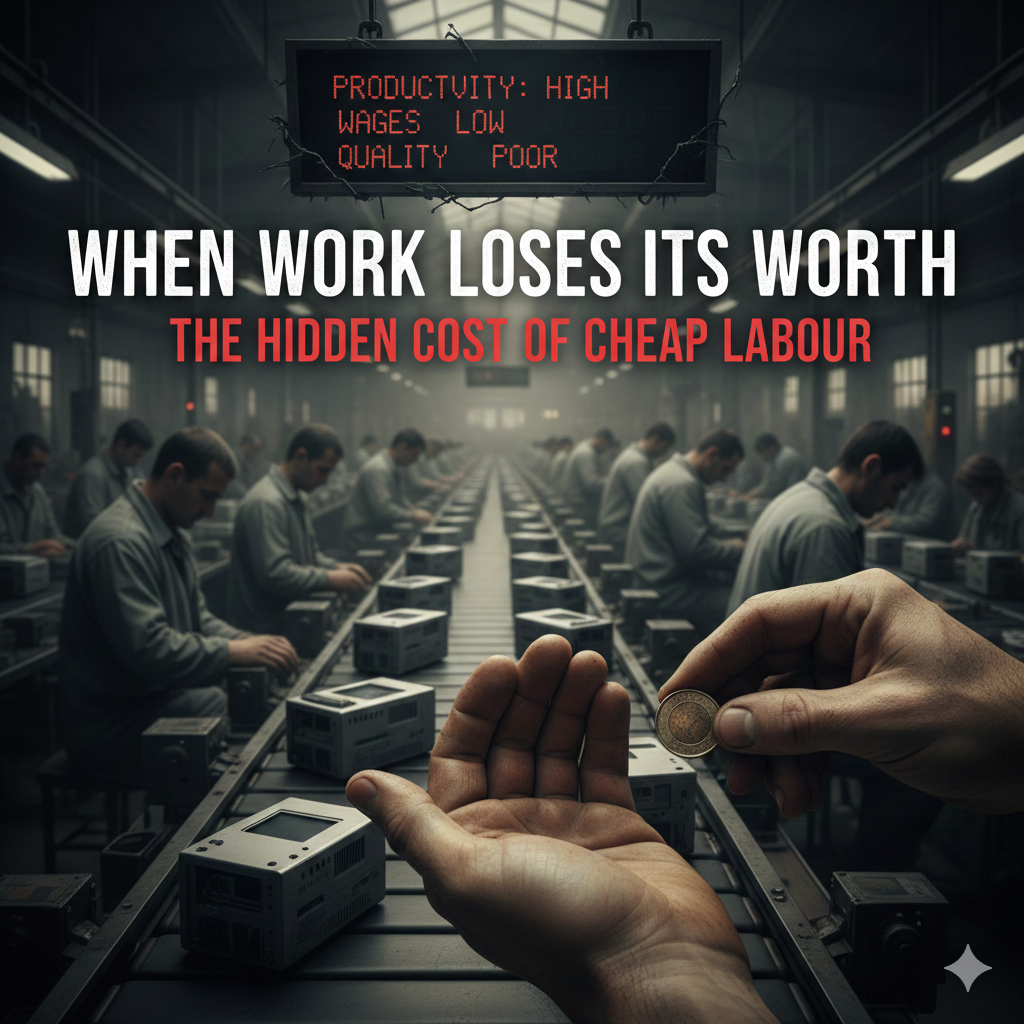
There’s a pervasive economic fantasy that cheaper labour is always better for society. Lower wages mean lower prices, which means more purchasing power for consumers, which means prosperity for all. It’s a tidy equation that collapses the moment you remember that consumers and workers are the same people.
When labour becomes too cheap, something fundamental breaks in the social contract. We’re not talking about competitive markets finding efficient prices. We’re talking about a race to the bottom where human effort is valued so little that working full time can’t support a basic life. This isn’t a theoretical concern. Large swaths of the developed world are already living in this reality, and the consequences ripple far beyond individual paycheques.
The most obvious problem is that cheap labour creates poverty despite employment. When jobs pay so little that workers need government assistance to survive, we’ve created a bizarre system where taxpayers subsidize profitable companies. Walmart employees on food stamps aren’t a bug in the system; they’re a feature of an economy that has decided labour can be priced below subsistence levels. The company profits, the worker struggles, and the public picks up the tab for the difference between wages and survival.
But the damage goes deeper than finances. When work is cheap, it becomes disposable. Employers have no incentive to invest in training, development, or retention when they can simply replace workers at minimal cost. This creates a workforce trapped in perpetual precarity, unable to develop skills or build careers because they’re treated as interchangeable parts. The psychological toll of being treated as expendable is profound. It erodes dignity, ambition, and any sense that effort will be rewarded.
Cheap labour also destroys the incentive for productivity improvements. Why invest in better tools, equipment, or processes when it’s cheaper just to throw more underpaid workers at a problem? This is how economies stagnate. Innovation happens when labour is valuable enough that replacing it with better methods makes economic sense. When workers are dirt cheap, technological progress slows because there’s no pressure to find more efficient ways of doing things. You see this pattern throughout history: slavery retarded technological development in ancient economies, and extreme wage suppression has similar effects today.
The consumer benefit of cheap labour is also largely illusory. Yes, prices might be lower, but when most people are earning poverty wages, they can’t actually afford to buy much anyway. An economy built on cheap labour is an economy built on shrinking demand. Workers who can barely pay rent aren’t buying homes, cars, or taking vacations. They’re not investing in their children’s education or starting businesses. The entire economic engine sputters because the fuel of consumer demand has been drained away.
Then there’s the social fabric. Communities disintegrate when people work multiple jobs just to survive, with no time for family, civic engagement, or basic human connection. Parents who never see their children because they’re working three part-time jobs with irregular schedules aren’t building strong families. Neighbors who are too exhausted and stressed to participate in community life aren’t building strong communities. Democracy itself suffers when citizens are too ground down by economic survival to engage with public life.
The political consequences are equally grim. When labour is cheap and workers are desperate, they lose bargaining power not just in the workplace but in society at large. They become easy to exploit, easy to manipulate, and easy to divide. Desperate people are more susceptible to demagoguery, conspiracy theories, and political extremism because the mainstream system has visibly failed them. The rise of authoritarian movements across the developed world correlates directly with decades of wage stagnation and the cheapening of labour.
There’s also a profound moral dimension that gets lost in purely economic analysis. Work isn’t just a commodity transaction. It’s how most people spend the majority of their waking hours and how they contribute to society. When that work is valued so cheaply that it can’t provide a decent life, we’re making a statement about the worth of human beings. We’re saying that someone’s full-time effort and contribution isn’t valuable enough to deserve security, dignity, or hope for the future.
Some will argue that cheap labour helps developing countries industrialize and lift people out of poverty. There’s historical truth to this, but it’s not an argument for keeping labour perpetually cheap. The countries that successfully developed didn’t stay trapped in low-wage manufacturing. They invested in education, moved up value chains, and increased wages as productivity grew. The problem isn’t starting with relatively low wages during industrialization; it’s creating systems that keep labour suppressed even as profits soar.
The counterargument you’ll hear from business interests is that higher labour costs kill jobs and competitiveness. But this ignores decades of evidence from countries with strong labour protections and high wages that remain economically successful. Germany, Denmark, and Switzerland all have expensive labour and thriving economies. They’ve proven that you can pay workers well and still compete globally if you compete on quality, innovation, and productivity rather than just racing to the bottom on costs.
Living in a world of cheap labour means accepting a society where most people work hard and stay poor, where businesses have no reason to innovate, where communities crumble under economic stress, and where democracy becomes a hollow exercise for citizens too exhausted to participate. It means accepting that human effort, skill, and contribution have minimal value. It means building an economy that serves capital while treating labour as an unfortunate expense to be minimized.
The alternative isn’t complicated, even if it’s politically difficult. It means ensuring that full-time work pays enough to live with dignity. It means protecting workers’ ability to organize and bargain collectively. It means investing in education and training so people can move into higher-value work. It means creating social safety nets that give workers enough security to negotiate fair wages rather than accepting anything out of desperation.
Most fundamentally, it means rejecting the idea that labour is just another commodity whose price should be driven as low as possible. People aren’t widgets. Their work has value not just in economic output but in human dignity. An economy that forgets this is an economy that has lost sight of its purpose, which isn’t to maximize profits but to provide the material foundation for good lives.
We know what happens when labour becomes too cheap because we’re watching it happen. We see the political instability, the social breakdown, the economic stagnation, and the human misery. The warning isn’t hypothetical. We’re living in it. The question is whether we’ll recognize the problem and change course, or whether we’ll keep insisting that cheapening human labour is somehow the path to prosperity while the evidence of failure accumulates around us.
