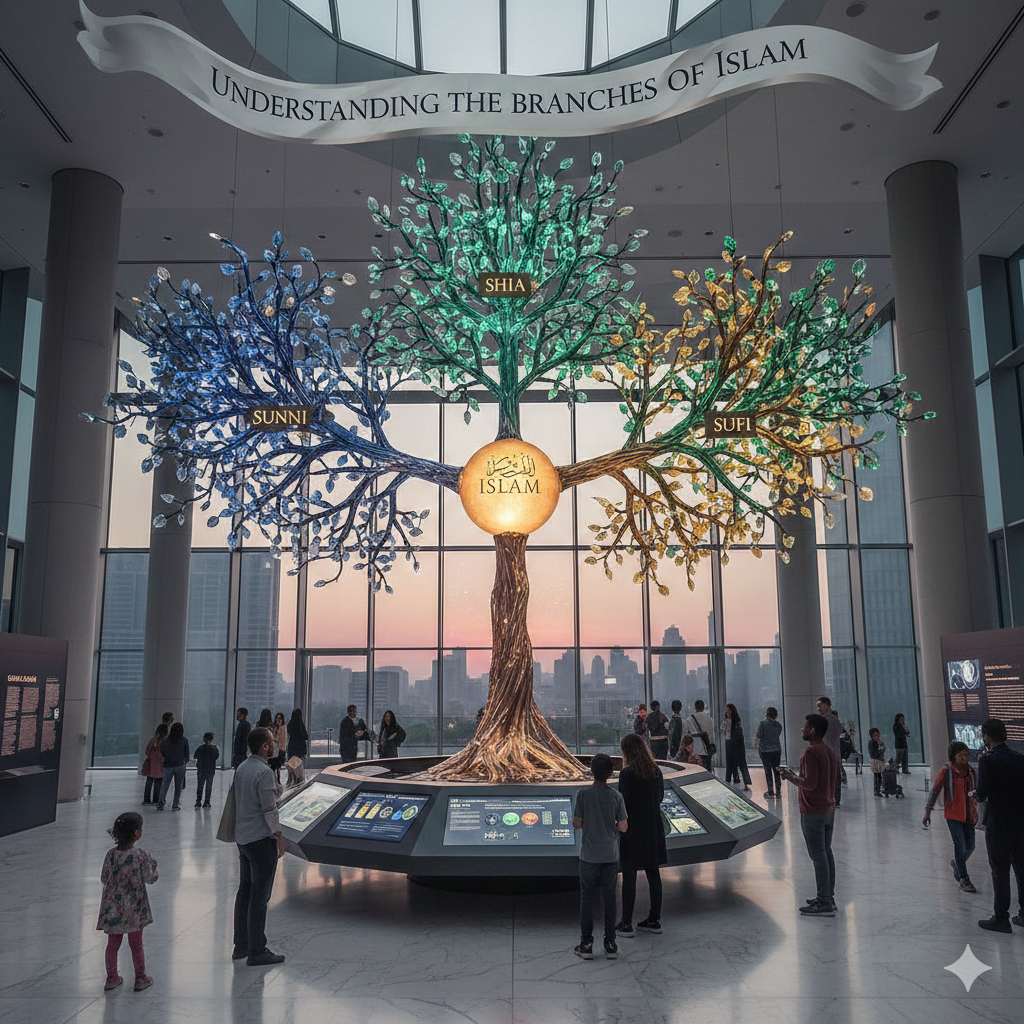
When most people think about religious diversity, they often focus on differences between major world religions. However, within Islam itself exists a rich tapestry of theological perspectives and practices that have developed over nearly fourteen centuries. Understanding these differences helps illuminate not just Islamic history, but the lived experiences of nearly two billion Muslims worldwide.
The story of Islam’s major denominations begins in the immediate aftermath of Prophet Muhammad’s death in 632 CE. The community faced an urgent question: who would lead the faithful? This wasn’t merely a political question but a deeply spiritual one that would shape the religion’s future. The disagreement over succession created a fault line that would eventually give rise to the two largest branches of Islam: Sunni and Shia.
The Sunni tradition, which today comprises roughly 85 to 90 percent of the world’s Muslims, takes its name from “Ahl al-Sunna,” meaning “people of the tradition.” Sunnis believe that the Prophet’s closest companion, Abu Bakr, was rightfully chosen as the first caliph through community consensus. They hold that leadership of the Muslim community should be determined by merit and the agreement of the faithful, rather than through hereditary succession. Sunni Islam emphasizes the importance of the community’s consensus and the practices established by Muhammad and his companions.
Within Sunni Islam, theological and legal diversity flourishes through four major schools of jurisprudence: Hanafi, Maliki, Shafi’i, and Hanbali. These schools don’t represent separate sects but rather different methodological approaches to interpreting Islamic law. A Muslim in Turkey might follow Hanafi jurisprudence while someone in Morocco follows Maliki teachings, yet both consider themselves part of the broader Sunni tradition. These schools developed in different geographical regions and historical contexts, leading to variations in how they approach questions of ritual, family law, and social practices, though they agree on fundamental beliefs.
Shia Islam, the second-largest branch, represents about 10 to 15 percent of Muslims globally. The word “Shia” comes from “Shi’at Ali,” meaning “the party of Ali.” Shias believe that Ali ibn Abi Talib, Muhammad’s cousin and son-in-law, was the Prophet’s rightful successor, designated by divine appointment rather than community consensus. This fundamental difference in understanding legitimate religious authority has profound theological implications. Shias believe in the concept of the Imamate, holding that certain descendants of Muhammad through Ali possess special spiritual insight and authority to interpret Islamic teachings.
The largest group within Shia Islam is the Twelver or Ithna Ashari tradition, predominant in Iran, Iraq, Bahrain, and Azerbaijan. Twelvers believe in a line of twelve divinely appointed Imams, beginning with Ali and ending with Muhammad al-Mahdi, whom they believe went into occultation in 874 CE and will return as a messianic figure. During this period of occultation, religious scholars called ayatollahs serve as deputies, interpreting religious law and guidance for the community. This creates a more hierarchical religious structure than typically found in Sunni Islam.Another significant Shia group is the Ismailis, also known as Sevener Shias, who diverged from the Twelver tradition over a succession dispute following the death of the sixth Imam. Ismailis recognize a living Imam, currently the Aga Khan, who provides contemporary guidance to the community. This continuous living leadership distinguishes Ismaili practice significantly from other branches of Islam. Ismaili thought has historically been characterized by esoteric interpretation of Islamic texts and an emphasis on the inner, spiritual meanings of religious practices.
The Zaydi Shias, found primarily in Yemen, represent another distinct tradition. They differ from Twelvers in their more flexible criteria for who can serve as Imam, not restricting it to a specific lineage, and in their theological positions, which share some common ground with Sunni thought. Zaydis have historically been more politically active in establishing their own states than other Shia groups.
Beyond these major branches, other traditions exist that occupy complex positions within or alongside mainstream Islam. The Ibadi tradition, neither Sunni nor Shia, traces its roots to the Kharijites, the earliest sect to break away from both Ali’s supporters and his opponents in the first Islamic civil war. Today, Ibadis are found primarily in Oman, where they form the majority, and in small communities across North Africa. They’re known for their strict adherence to Islamic principles and their distinctive legal and theological positions.
Sufism represents another dimension of Islamic diversity, though it’s not a separate denomination but rather a mystical tradition that exists across Sunni and Shia Islam. Sufis emphasize the inner, spiritual dimensions of faith, seeking direct personal experience of the divine through practices like meditation, chanting, and ritual devotion. Sufi orders, or tariqas, are led by spiritual guides called sheikhs who transmit knowledge and practices through chains of initiation stretching back to the Prophet. While some conservative Muslims have criticized certain Sufi practices as innovations, Sufism has profoundly influenced Islamic art, poetry, music, and philosophy throughout history.Various other movements and interpretations have emerged throughout Islamic history and continue to develop today. Salafism and Wahhabism represent reformist Sunni movements that advocate for returning to what they view as the pure practices of early Islam, often rejecting later innovations and traditional schools of jurisprudence. The Ahmadiyya community, founded in nineteenth-century India, faces persecution in many Muslim-majority countries because mainstream Islam rejects their founder’s prophetic claims, as traditional Islamic doctrine holds that Muhammad was the final prophet.
The differences between these denominations manifest in various ways in daily life. Prayer practices vary slightly, with Shias combining the five daily prayers into three sessions while Sunnis maintain five separate times. The call to prayer includes different phrases, funeral rites differ, and legal rulings on matters from marriage to inheritance can vary between schools and sects. Holy sites and commemorative practices also differ, with Shias placing great emphasis on pilgrimages to the shrines of the Imams and observing Ashura, the commemoration of Imam Husayn’s martyrdom, with particular intensity.
Despite these differences, Muslims across all denominations share core beliefs: the oneness of God, Muhammad as God’s messenger, the Quran as divine revelation, the importance of prayer and charity, and belief in the Day of Judgment. The similarities far outweigh the differences in fundamental theology and practice. Many Muslims emphasize that denominational identity should not overshadow the unity of the broader Islamic community.
Understanding Islamic denominations requires recognizing that these aren’t monolithic categories but living traditions containing internal diversity and ongoing debates. A Sunni Muslim in Indonesia practices Islam differently from one in Saudi Arabia, just as Iranian Shias differ from Iraqi or Lebanese Shias in various cultural and practical expressions of faith. Geography, history, culture, and politics all shape how Islamic principles are understood and practiced.
Today’s interconnected world has brought both challenges and opportunities for relations between Islamic denominations. While sectarian conflict has marked some regions, particularly where religious identity intersects with political power struggles, many Muslims work toward greater understanding and cooperation across denominational lines. Scholars from different traditions engage in dialogue, and ordinary Muslims often live peacefully as neighbors regardless of their particular tradition.The diversity within Islam reflects both human history and the universal appeal of its message across different cultures and contexts. Rather than seeing denominational differences as divisions, many Muslims understand them as reflecting the richness of Islamic tradition and the various ways communities have engaged with their faith across time and space. This internal diversity has allowed Islam to flourish across vastly different societies while maintaining a core unity of purpose and belief.