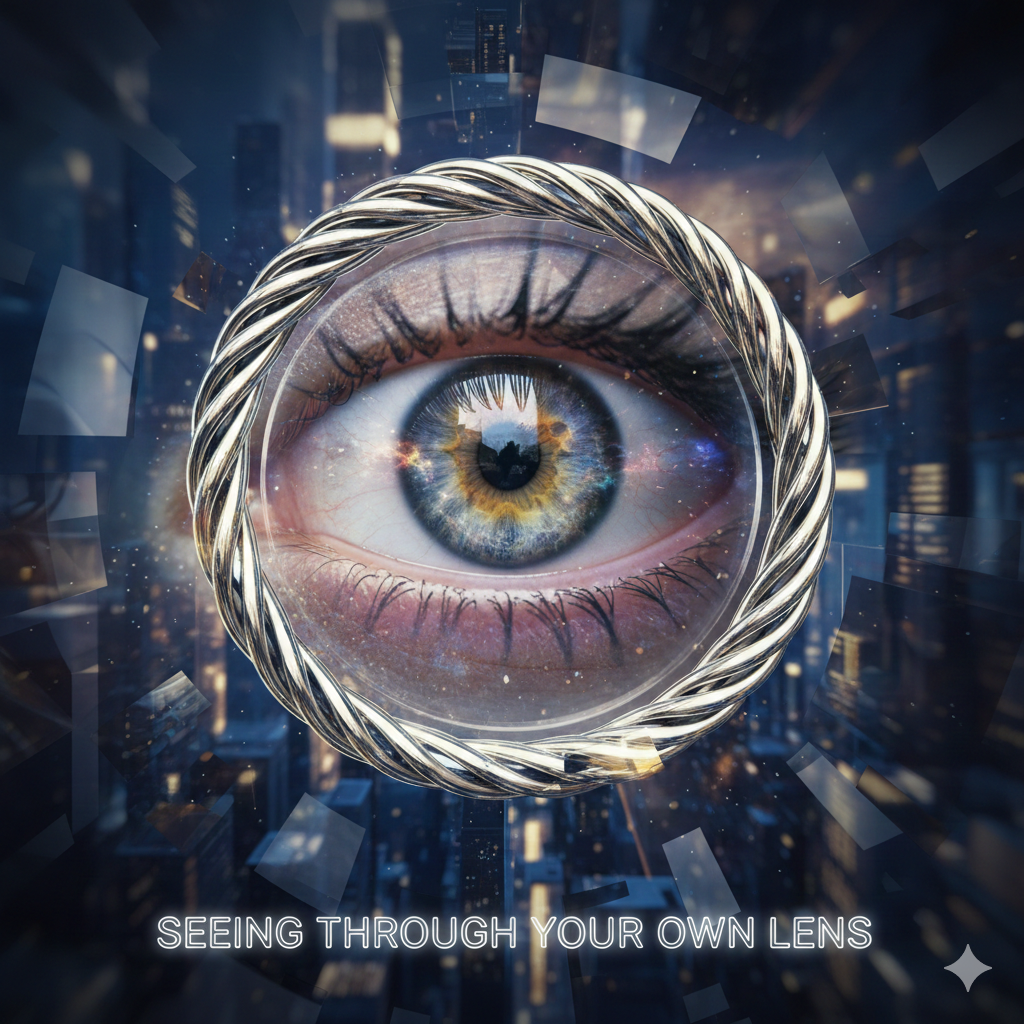
Every morning, you wake up and experience the world. You interact with people, encounter situations, and form opinions about what’s happening around you. But here’s something most of us rarely consider: none of us actually sees reality directly. We’re all looking at life through a filter.
Think of it like wearing glasses you’ve had on for so long that you’ve forgotten they’re there. These aren’t physical glasses, of course. They’re made up of your past experiences, your beliefs, your culture, your fears, your hopes, and countless other factors that shape how you interpret everything that happens to you.
Consider a simple example. Two people witness the same conversation between a manager and an employee. One person, who grew up in a family where direct communication was valued, sees a productive exchange of honest feedback. The other person, who learned early that raised voices meant danger, sees an uncomfortable confrontation. Same conversation, completely different experiences. Neither person is wrong, exactly. They’re just seeing through different filters.
These filters form gradually over time, starting from the moment we’re born. Your childhood experiences lay down some of the earliest layers. If you were praised for being cautious, you might filter new opportunities through a lens of skepticism. If you were rewarded for taking risks, you might see those same opportunities as exciting adventures. The culture you grew up in adds another layer, teaching you what’s normal, what’s rude, what’s important, and what’s trivial.Your personal history continues building this filter throughout your life. A painful breakup might tint future relationships with wariness. A professional success might make you view your capabilities more confidently. Trauma can create dark spots in the filter where certain situations trigger outsized reactions. Joy can create bright spots where particular experiences bring disproportionate happiness.
What makes these filters so powerful is that they’re largely invisible to us. We don’t usually think, “I’m interpreting this situation through my particular lens.” We just think, “This is what’s happening.” We mistake our interpretation for objective reality. When someone disagrees with our assessment of a situation, we often assume they’re wrong, confused, or perhaps even intentionally difficult. It rarely occurs to us that they might simply be wearing different glasses.
This explains so much about human conflict. Political disagreements, family tensions, workplace disputes—many of these stem from people with different filters looking at the same situation and seeing completely different things. Someone who filters the world through a lens of scarcity and competition will see very different solutions to problems than someone who filters through a lens of abundance and cooperation. Neither can fully understand why the other’s perspective seems so obviously wrong.
The tricky part is that our filters aren’t entirely inaccurate. They’re based on real experiences and genuine patterns we’ve observed. If your filter tells you to be wary of people who seem overly friendly too quickly, that might be because you’ve been burned by manipulation before. Your filter is protecting you based on actual data. The problem is that it’s applying old data to new situations that might be completely different.
Recognizing that we all have these filters doesn’t mean we should abandon our perspectives or assume all viewpoints are equally valid. Some filters are more aligned with reality than others. Some are built on misconceptions or limited information. But acknowledging that filters exist is the first step toward being able to adjust them.
When you catch yourself having a strong reaction to something, you can pause and ask yourself what filter might be at work. Why does this particular situation bother you so much? What past experience might be coloring your interpretation? When you disagree with someone, you can get curious about what their filter might look like instead of immediately assuming they’re mistaken.The goal isn’t to remove your filter entirely. That’s probably impossible, and even if you could, you’d lose valuable wisdom and pattern recognition that helps you navigate life. Instead, the goal is to become aware that you’re wearing one. To occasionally take it off, clean it, examine it, and maybe adjust it based on new information.
Life looks different when you remember that everyone around you is also seeing through their own unique filter. That difficult colleague might not be intentionally obstinate—they might just be filtering workplace interactions through past experiences of betrayal or disappointment. Your partner might not be overreacting—they might be seeing through a filter shaped by childhood experiences you know nothing about.
Understanding filters doesn’t solve all problems or resolve all conflicts. But it does open up a space for compassion and curiosity. It reminds us that our perspective, while valid and real to us, isn’t the only way to see things. And sometimes, the most important thing we can do is simply acknowledge that what we’re seeing is our view of reality, not reality itself.
The world is infinitely complex, and we all need filters to make sense of it. But every now and then, it’s worth remembering that the lens through which you see everything isn’t the same as the thing itself. And that person who sees things so differently from you? They’re not necessarily wrong. They’re just looking through different glasses.