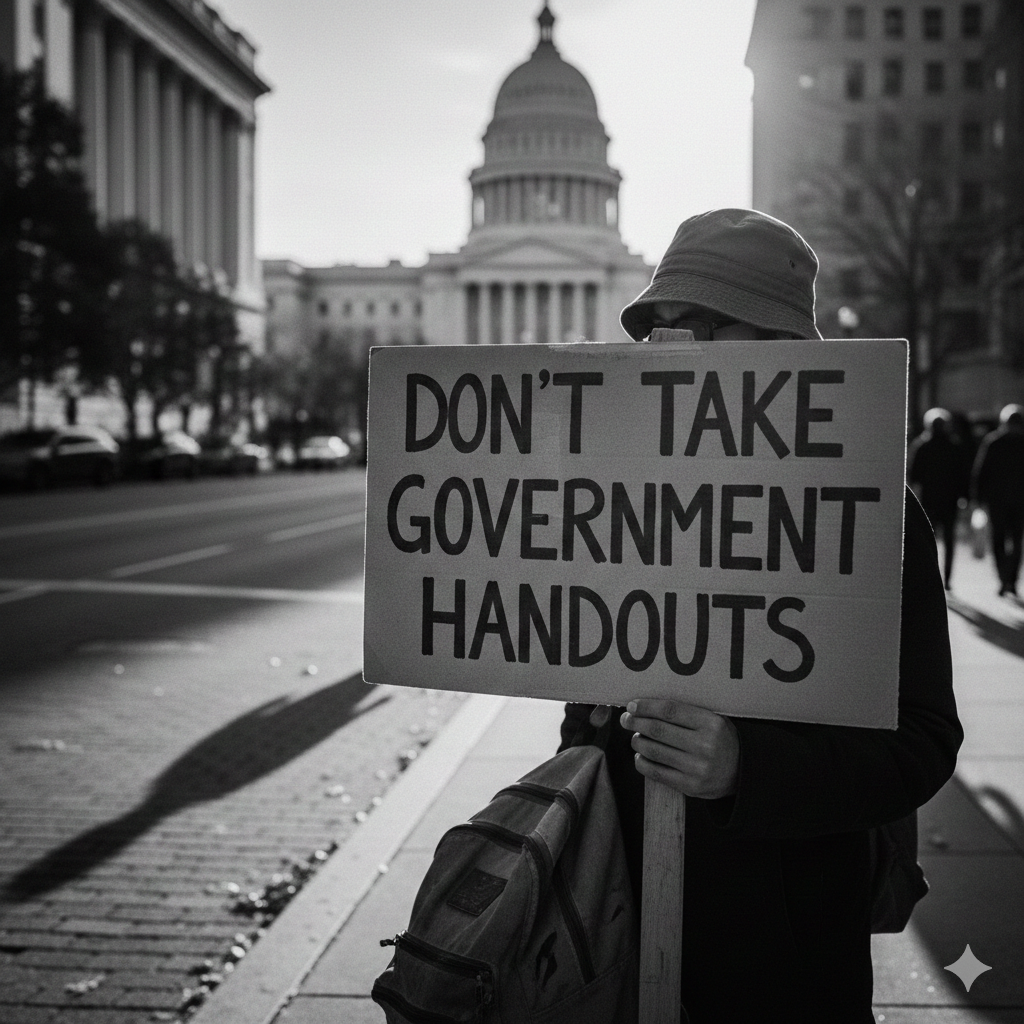
There exists a quiet erosion that occurs in the human spirit when a person begins to rely on the government for basic sustenance, not as a temporary bridge through misfortune, but as a permanent fixture in life. The act of accepting what is commonly called a “handout”—those monthly checks, food assistance cards, housing subsidies, or other forms of unearned transfer payments—carries with it a subtle yet profound cost: the slow surrender of personal dignity.
Dignity, at its core, arises from the knowledge that one stands on one’s own feet, that one’s survival and well-being flow from effort, ingenuity, and the fruits of labor. When a person rises each morning to provide for themselves and their family through honest work, they affirm their own agency. They look in the mirror and see someone capable, someone who shapes their destiny rather than merely receiving it. This sense of self-reliance is not mere pride; it is the foundation of a healthy identity. It fosters responsibility, encourages foresight, and builds the quiet confidence that comes from overcoming obstacles without external compulsion.
Yet when the state becomes the provider, this dynamic shifts in a fundamental way. The recipient no longer stands as an equal participant in society but as a client of the bureaucracy. Gratitude, if it exists at all, is directed toward distant officials and impersonal systems rather than toward one’s own accomplishments. Over time, the expectation takes root that needs will be met not through personal striving but through entitlement. The mind begins to adjust: why push harder, why take risks, why endure the discomfort of change when the baseline is secured by force of law and taxation? The very habits that cultivate dignity—discipline, perseverance, accountability—start to atrophy.
This is not to deny that hardship can strike anyone. Illness, sudden unemployment, or economic calamity can leave even the most capable person in need. In those moments, aid from family, friends, churches, or voluntary associations has historically offered relief while preserving the recipient’s sense of worth. Such help is personal; it often comes with encouragement to regain independence, and it carries no implication that the giver owes the aid indefinitely. Private charity, when it functions well, tends to reinforce the recipient’s humanity rather than diminish it, because it remains an act of mutual respect between individuals.
Government programs, by contrast, operate on a different plane. They are impersonal, standardized, and backed by coercion—tax dollars extracted from others without their direct consent. The recipient knows this. Deep down, many feel the sting of knowing their provision comes from the labor of strangers compelled by the state. That awareness breeds resentment, a sense of being lesser, of having one’s autonomy traded for material security. The longer the dependency lasts, the more it reshapes character. What begins as temporary assistance can harden into a lifestyle, and with it comes the quiet shame of knowing one’s existence is subsidized rather than earned.
Critics will argue that true dignity lies in freedom from want, that no one can hold their head high while hungry or homeless. Yet this view mistakes comfort for self-respect. A person fed by the state remains a ward of the state, their most basic decisions subject to rules, verifications, and surveillance. Real dignity emerges not from the absence of struggle but from the ability to confront and overcome it. When the government assumes the role of perpetual provider, it robs individuals of that confrontation, replacing it with a softer but more insidious form of control.
The evidence from decades of expanded welfare systems is hard to ignore. Communities once marked by resilience have, in some cases, become trapped in cycles where generation after generation expects the same support. The “dignity of work,” once celebrated as the path to independence, gives way to the routine of compliance with program requirements. The human spirit, designed for creation and self-determination, begins to shrink under the weight of learned helplessness.
None of this denies the need for a safety net in a civilized society. But the net must be temporary, conditional, and oriented toward restoration rather than maintenance. When aid becomes a way of life rather than a hand extended in crisis, it quietly strips away the very dignity it claims to protect. True compassion does not simply fill empty hands; it empowers people to fill their own once more. Anything less risks turning citizens into dependents, and in that transformation, something essential to the human soul is lost forever.