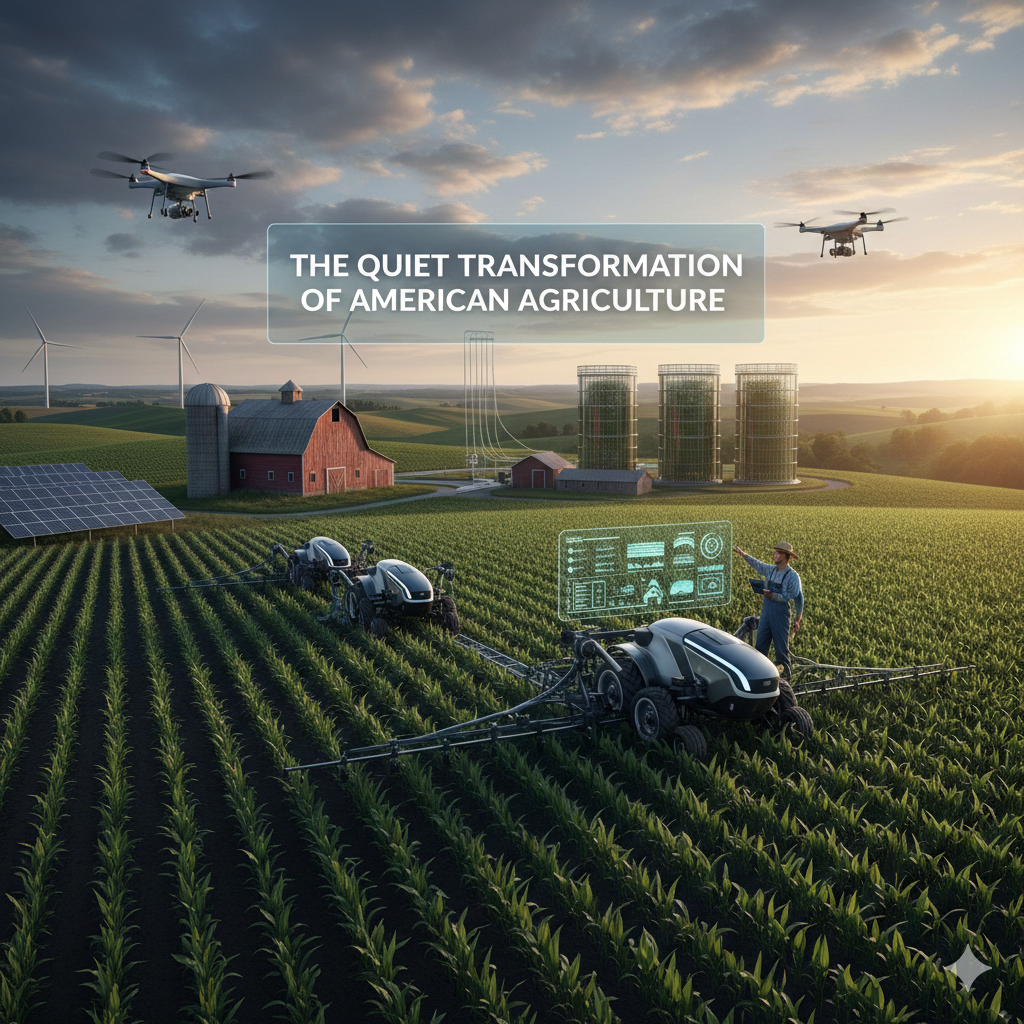
Drive through rural America today and you’ll see something that looks deceptively familiar: endless fields of corn and soybeans, the occasional farmhouse, silos dotting the horizon. But beneath this pastoral surface, American agriculture has undergone a dramatic restructuring over the past several decades. The family farm hasn’t disappeared entirely, but it’s increasingly becoming part of much larger operations, controlled by fewer and fewer hands.
The numbers tell a stark story. In the early 1900s, there were roughly 6.5 million farms in the United States. By 1950, that number had dropped to about 5.4 million, even as the country’s population swelled. Today, there are approximately two million farms remaining. But the real transformation isn’t just in the number of farms—it’s in who owns the land and how much of it they control.
The average farm size has been climbing steadily for generations. In 1950, the typical American farm covered about 215 acres. By 2020, that figure had more than doubled to around 445 acres. These averages actually mask an even more dramatic shift: while many small farms still exist, often as part-time operations or specialty producers, the vast majority of agricultural production now comes from massive operations spanning thousands of acres.
This consolidation accelerated particularly rapidly over the past two decades. Between 2000 and 2020, farms with more than 2,000 acres increased their share of total farmland significantly. In the Midwest, where corn and soybean production dominates, it’s not uncommon to find single operations managing 10,000 acres or more. Some farming operations now span multiple counties or even multiple states.
The forces driving this consolidation are numerous and interconnected. Economies of scale play a fundamental role—modern farming equipment is extraordinarily expensive, and the cost can only be justified when spread across vast acreages. A single combine harvester can cost upwards of half a million dollars. Precision agriculture technology, from GPS-guided tractors to drone monitoring systems, adds further to capital requirements. Larger operations can afford these investments and amortize them across enough production to make them economical.
Commodity prices have also pushed farms toward expansion. When profit margins per acre are thin, the logical response is to farm more acres. Global competition means American farmers increasingly compete with agricultural producers around the world, creating pressure to maximize efficiency through scale. A farmer working 200 acres can barely generate enough income to support a family at current commodity prices, but someone working 2,000 acres might build a comfortable living.The financial structure of modern agriculture reinforces consolidation. Banks and lenders prefer working with larger, more established operations that have diverse revenue streams and proven track records. This makes it easier for existing large farms to borrow money for expansion while making it harder for new farmers to enter the market. Young people wanting to start farming face daunting barriers: land prices in productive agricultural regions can exceed $10,000 per acre in prime areas, putting farm ownership out of reach for those without family wealth or land to inherit.
Corporate involvement has also reshaped farmland ownership, though this takes different forms than many people imagine. While massive corporate-owned farms exist, more common is the rise of vertically integrated supply chains where corporations don’t necessarily own the land but control production through contracts. In poultry and hog production, for instance, farmers often own the land and buildings but raise animals owned by large processors under strict contractual terms. This arrangement concentrates control without requiring direct land ownership.Investment capital has also discovered farmland. Pension funds, insurance companies, and private equity firms have increasingly viewed agricultural land as a stable investment, purchasing farmland and leasing it back to operators. Bill Gates became the largest private farmland owner in America through investment vehicles, though the land is leased to working farmers. This financialization of farmland means ownership and operation increasingly exist in separate hands.
The regional patterns of consolidation vary significantly. In the Great Plains, where wheat and cattle dominate, consolidation has been particularly pronounced. The semiarid climate and lower yields per acre mean operations need more land to be viable. In California’s Central Valley, by contrast, high-value specialty crops like almonds and grapes can support smaller acreages, though consolidation is happening there too as corporate berry producers and nut growers expand their holdings.The human consequences of this transformation ripple through rural communities. Fewer farmers means fewer customers for local businesses. The implement dealer, the feed store, the local diner—all depend on a critical mass of agricultural producers. As farms consolidate, these businesses close, and small towns hollow out. The social fabric frays when farming operations become so large that owners live in distant cities while hired managers run the day-to-day operations.
There’s also a loss of agricultural diversity, both biological and economic. Large operations tend toward monoculture—vast expanses of a single crop—which can increase vulnerability to pests, diseases, and market fluctuations. The local knowledge of microclimates, soil variations, and traditional practices often disappears as farming becomes more standardized and mechanized.
Yet consolidation also brings certain efficiencies. Larger operations can invest in soil conservation, water management, and sustainable practices that smaller farms might not afford. They can weather bad years more easily, with diverse holdings or financial reserves to survive crop failures or market downturns. Modern precision agriculture, enabled by the capital that large operations can deploy, can actually reduce fertilizer and pesticide use through targeted application.
The pandemic highlighted some vulnerabilities in this consolidated system. When meatpacking plants shut down, farmers with contractual obligations had nowhere to send their animals, leading to mass culling. Supply chain disruptions exposed how concentrated food production had become. These events sparked renewed interest in local food systems and smaller-scale agriculture, though whether this represents a lasting shift remains uncertain.
Looking forward, the trajectory seems likely to continue. Climate change may accelerate consolidation in some regions as farming becomes more challenging, pushing marginal operators out of business. Technology will keep advancing, raising the capital requirements for competitive farming. Aging farmers face difficult decisions about succession when their children have built careers elsewhere.
Some forces push against consolidation. Beginning farmer programs, local food movements, and growing interest in regenerative agriculture create opportunities for smaller operations focused on different models. Urban farming, though limited in scale, brings agriculture back to population centers. Some states have considered or implemented limits on corporate farmland ownership, though enforcement is challenging.
The consolidation of American farmland represents more than an economic restructuring—it’s a fundamental change in the relationship between Americans and the land that feeds them. Where once farming was the common experience of most Americans, it has become the specialized work of a shrinking minority. The land itself remains, productive as ever, but the human communities that once tended it have transformed in ways both profound and irreversible. Whether this transformation ultimately strengthens or weakens American agriculture may not be clear for generations.
