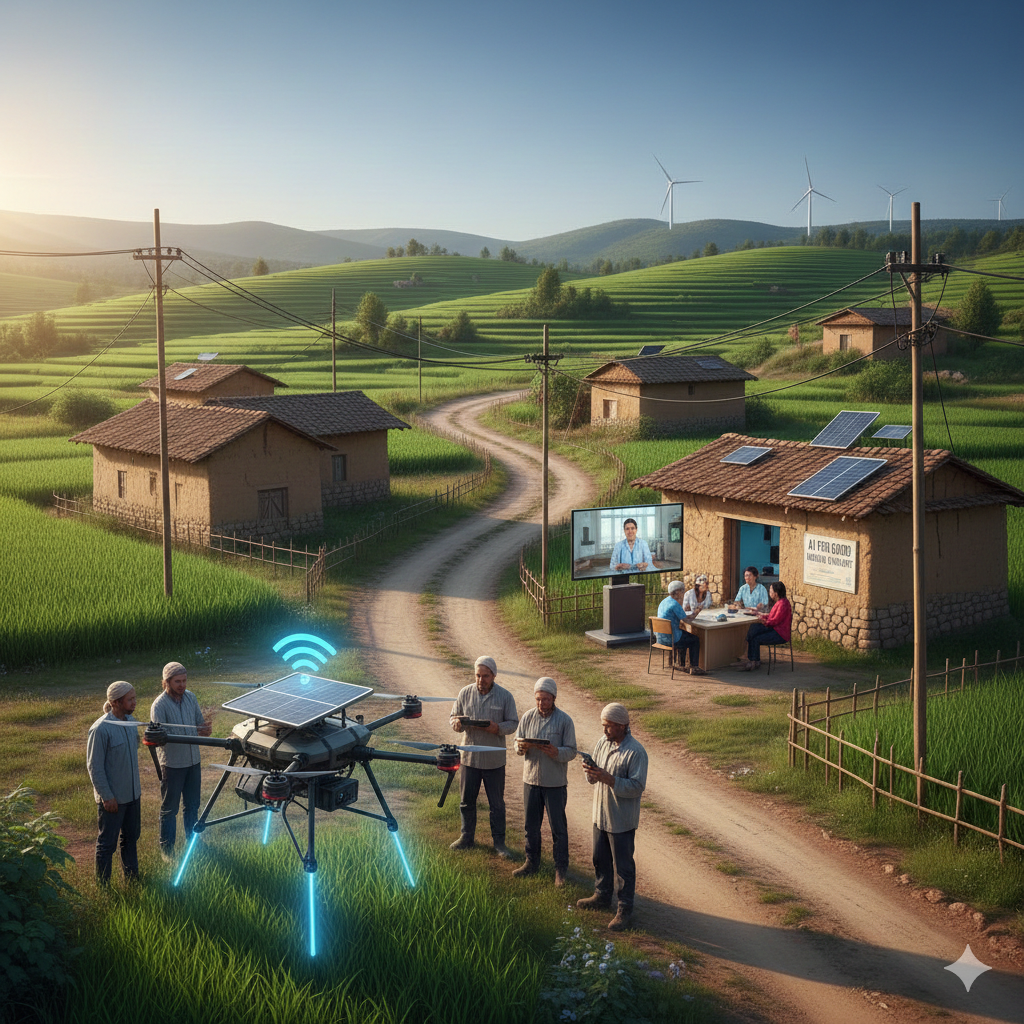
We often imagine technological disruption as a sudden, seismic event—a flashy launch event in California, a viral demo, a stock market surge. We fixate on the moment a new AI model is released, watching the buzz ripple through tech forums and news headlines. But that’s not where the real transformation begins. That’s merely the first echo. The true earthquake, the one that reshapes landscapes and lives, travels slowly. It follows undersea cables and bargain-rate licensing deals, finally washing ashore in places we too often ignore: the third world.
Here, far from the gleaming server farms and venture capital pitches, AI doesn’t arrive as a novelty. It arrives as a lifeline, a blunt instrument, a revolution in a box. In the West, AI might refine a marketing email or recommend a song. In a Nairobi neighborhood, a Kampala clinic, or a Manila sari-sari store, the same underlying technology becomes something else entirely. It becomes the doctor.
In regions where one physician might serve tens of thousands, diagnostic AI isn’t just a helper, it’s the first and only line of defense. A smartphone app scanning for diabetic retinopathy or signs of tuberculosis in an X-ray doesn’t augment a system; it creates a system where none existed. The disruption isn’t about efficiency; it’s about the abrupt and jarring introduction of capability where capability was a scarce commodity.
It becomes the teacher. In a classroom with a hundred students and few textbooks, an AI tutor, running offline on a cheap tablet, doesn’t just personalize learning. Literacy and numeracy can now propagate peer-to-peer.
Crucially, AI becomes the economic leveller. A young entrepreneur in Lagos no longer needs a massive loan for market research, translation services, or legal aid to start a business that can compete globally. AI tools provide that scaffolding for pennies. This is empowering. Yet, it also means that jobs once considered “safe” from offshore outsourcing such as basic graphic design, copywriting, and customer support can now be performed by someone with a smartphone and a starlink connection for a fraction of the cost. The global labor market isn’t just being connected; it’s being fused overnight.
This is the double-edged nature of the real disruption. In the developed world, change is mediated by layers of regulation, legacy industries, and social safety nets. It’s slow and contested. But when AI hits an environment with minimal friction, a lot of roles are streamlined and automated.
AI’s arrival in the third world is a social, economic, and political event. It will create millionaires and displace thousands. It will save lives and dismantle traditions. It will empower the marginalized and entrench new, unelected powers in the form of the corporations who control these tools.
So, watch the keynotes if you must. But to see the future being written, look beyond them. Look to the farmer in Bihar using a voice-AI to navigate crop prices, to the midwife in Honduras consulting a diagnostic chatbot, to the teen in a Sudanese refugee camp learning coding from an LLM. The tremors start in the valley, but the ground truly moves where the ground was already unstable. The real disruption isn’t the spark of inventiom; it’s the wildfire of adoption burning far from the original flame, transforming everything it touches in ways we can only imagine.