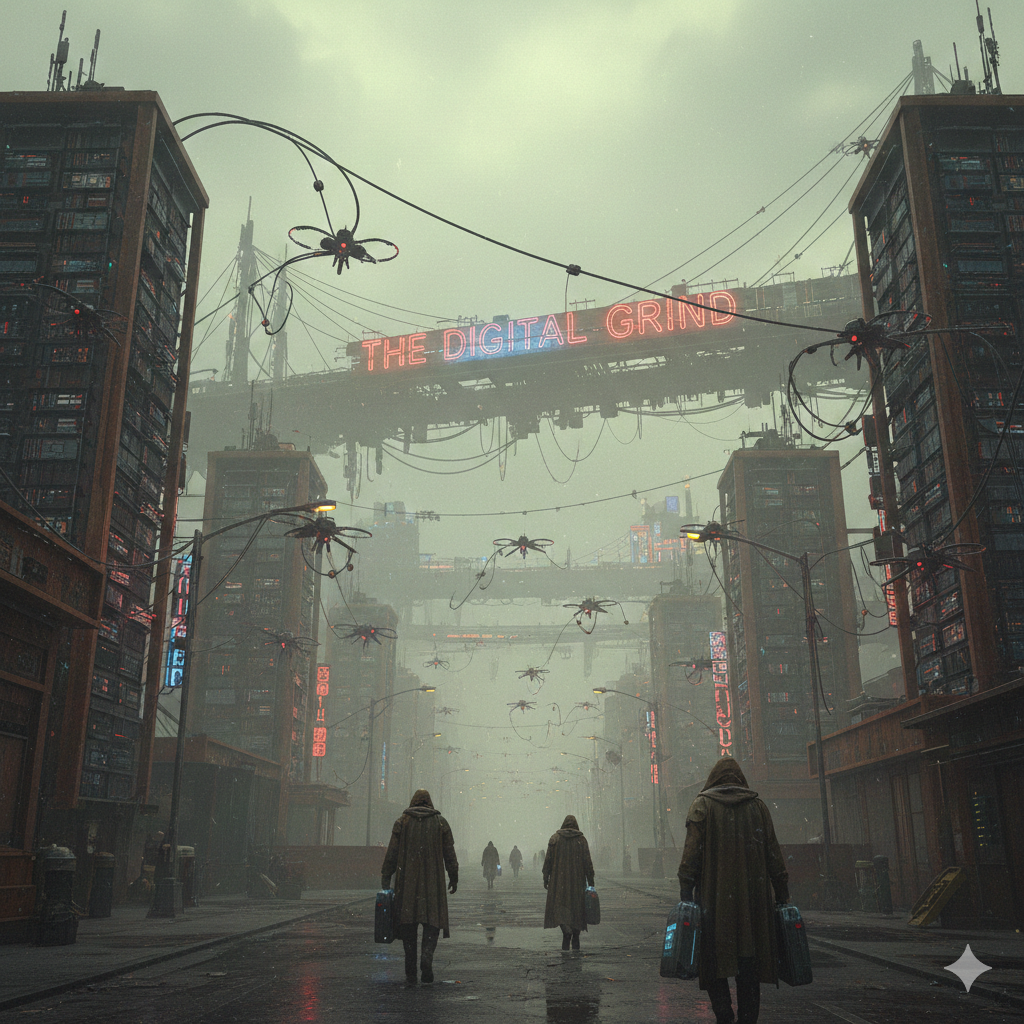
There comes a moment, usually unnoticed at first, when the work you do begins to feel like something happening to you rather than something you are doing. You sit before the same interface each morning, fingers finding their positions on the keyboard with the automatic precision of ritual. The tasks vary in their particulars, new names attached to familiar processes, but the essential motion remains unchanged. You are tapping buttons, and in exchange for this repetitive physical act, money appears in your account. For a time, this arrangement seems almost miraculous, a modern alchemy that transforms minute gestures into security and comfort. The efficiency of it feels like progress, like the realization of promises made by generations who labored with their bodies in fields and factories.
But efficiency, pursued without examination, begins to hollow out the spaces where meaning once gathered. The work that once felt like a fair exchange gradually reveals itself as something more troubling. You notice that the hours pass differently now, not in the flow of absorbed attention but in the endurance of waiting. You complete your responsibilities with competence, perhaps even with excellence, yet the completion brings no satisfaction, only the temporary relief of obligation discharged. The money continues to arrive, sometimes in increasing amounts, and this should matter more than it does. You remind yourself of your good fortune, of the precarity that others endure, of the historical rarity of such comfort. These reminders help, for a while, but they do not restore what has been quietly lost.
What disappears first is the sense of consequence. When your work consists primarily of manipulating symbols on screens, sending communications that trigger other communications, adjusting figures that determine other figures, the connection between your effort and any tangible outcome becomes abstract to the point of vanishing. You know intellectually that your actions contribute to larger systems, that somewhere downstream your work affects material reality, but you do not feel this connection. The feedback loop is too long, too mediated by layers of process and personnel. You tap the buttons and the system responds, but the response feels automated, predetermined, empty of genuine exchange. You are not making anything you can touch, solving any problem whose resolution you can witness, helping any person whose gratitude you can receive. You are simply maintaining the operation of a machine that would continue turning without your particular presence, your unique sensibility, your irreplaceable judgment.
This abstraction of labor from outcome creates a peculiar form of exhaustion. The body is not tired in the way of physical exertion, the satisfying weariness that comes from visible effort spent toward visible results. Instead, a different fatigue accumulates, one that sleep does not resolve and weekends only temporarily interrupt. It is the exhaustion of meaninglessness, of pouring the finite resource of your attention into tasks that do not seem to require it, that could be performed equally well by someone else or perhaps by no one at all. You begin to understand that the problem is not the difficulty of the work but its insignificance, not the hours required but the quality of presence they demand. You are present physically, attentive enough to avoid error, but some essential part of you remains unengaged, watching from a distance as your hands execute their practiced movements.
The money, when it arrives, fails to compensate for this absence. You spend it on experiences designed to remind you that you are alive, on possessions that promise to reflect your identity, on services that spare you from the tedious labor you have begun to recognize as the dominant texture of your existence. These expenditures bring pleasure, certainly, but pleasure of a particular kind, thin and fleeting, unable to accumulate into the deeper satisfaction that comes from knowing your efforts have mattered. You return to your screen each Monday, the memory of the weekend’s distractions already fading, and resume the tapping. The cycle repeats with a regularity that begins to feel like evidence of something wrong, though you struggle to name exactly what.
What you are experiencing is the separation of means from ends in its most personal form. The buttons you tap are means, efficient and reliable, connecting your time to money with minimal friction. But the ends, the purposes toward which this efficiency is directed, have become obscure. You are not building anything that reflects your values, developing any capability that feels essential to your nature, contributing to any community that knows you as a particular person rather than a functional role. You are simply converting time into currency, a transaction that leaves no residue of growth or connection. The fulfillment that humans have historically found in work, the sense of competence, of contribution, of becoming through doing, has been engineered out of the process in the name of optimization.
This is not a complaint against technology or modernity, though both are implicated. It is an observation about the conditions under which human beings thrive, conditions that include challenge matched to capability, visible impact on the physical or social world, and recognition from others who understand the nature of the contribution. When work is reduced to button-tapping, however sophisticated the interface or lucrative the compensation, these conditions are difficult to satisfy. You may become expert at the tapping, faster and more accurate than your peers, but expertise without purpose eventually curdles into cynicism or despair.
The recognition of this hollowness does not immediately suggest a solution. The money remains necessary, the alternatives unclear, the risk of change substantial. But recognition itself is a beginning, the restoration of a question that efficient systems prefer to keep suppressed. What would it mean to work in a way that engaged your whole self, that connected your efforts to outcomes you could see and value, that allowed you to feel the passage of time as accumulation rather than depletion? The answer will be different for each person, shaped by circumstance and temperament and the particular form of your capabilities. But the question must be asked, repeatedly, with honesty, until the gap between the life you are living and the life you could recognize as your own becomes too wide to ignore.
There is no simple escape from the button-tapping economy, no return to an imagined past of unmediated labor. But there are choices within it, and choices about how much of yourself to surrender to its logic. You can seek work that preserves some connection to material reality, some trace of your individual judgment in its outcomes. You can cultivate relationships and practices outside of work that provide the meaning your employment withholds. You can gradually, carefully, build toward a different arrangement, one in which your economic survival and your need for purpose are not permanently opposed. These are slow solutions, uncertain and demanding, but they offer something that efficient compensation cannot purchase: the possibility of a life that feels like your own, spent in activities that matter to you, producing results that you can claim with genuine pride.