Feudalism was a social and political system that shaped much of medieval Europe after the fall of the Roman Empire. It was not designed in a single moment, nor was it written down as a clear blueprint. Instead, it emerged gradually as a practical solution to instability, invasion, and the collapse of centralized authority. At its core, feudalism was about land, loyalty, and protection.
When Rome fell, Europe fragmented. Strong central governments disappeared, and local regions were left to defend themselves. In a world where travel was dangerous and communication was slow, power became local. People needed protection from raiders, rival kingdoms, and lawlessness. Those who could provide security—usually powerful landowners or warriors—became the center of political life.
Land was the primary source of wealth. There were no large industrial economies, no global corporations, and limited trade compared to earlier Roman times. Whoever controlled land controlled food production, and whoever controlled food held power. A powerful lord would own large estates and offer portions of that land to lesser nobles or knights. In return, those men pledged loyalty and military service. This exchange created a chain of obligations that tied society together.
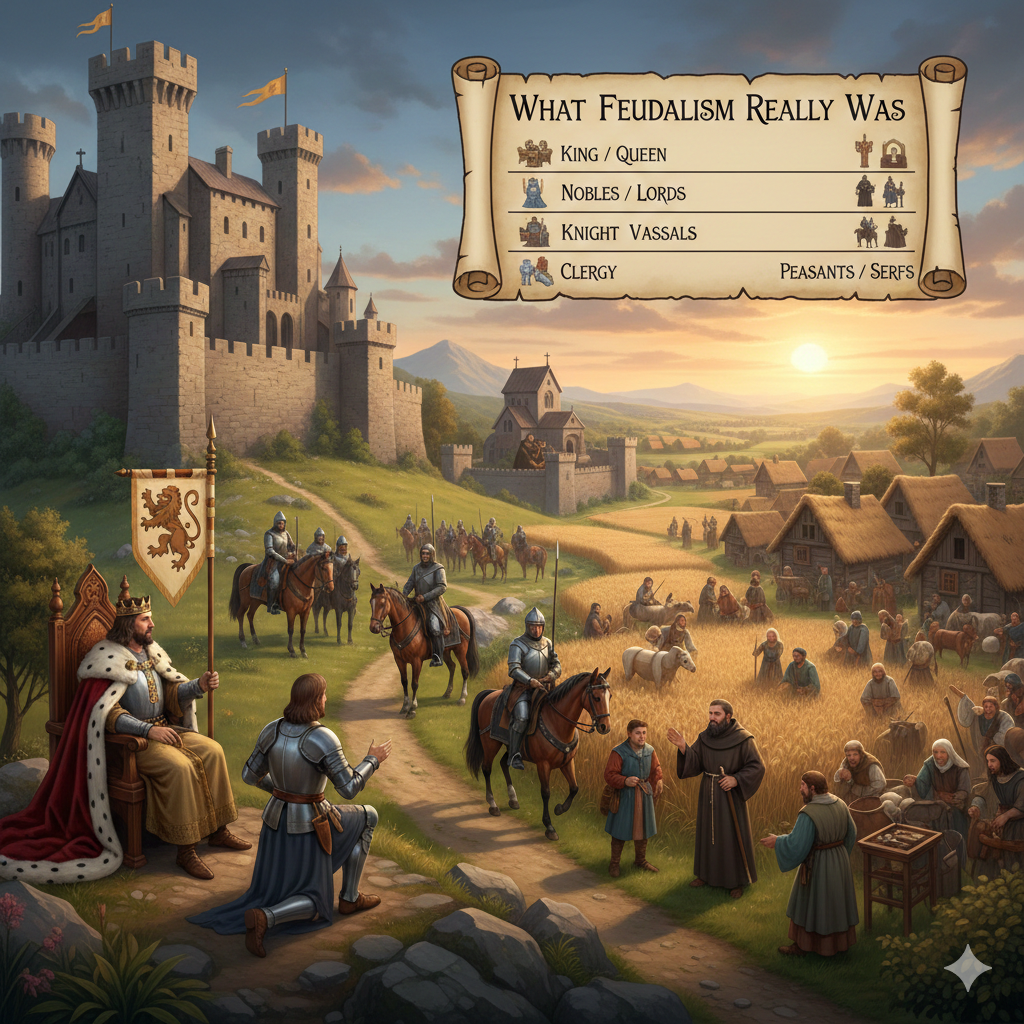
At the top of this structure stood the king, at least in theory. The king granted vast territories to powerful nobles in exchange for allegiance and soldiers. Those nobles then granted portions of their land to knights under similar agreements. Each level depended on the one above it for land and legitimacy, and the one below it for service and defense. Loyalty was personal and often sworn through formal ceremonies. Promises mattered because survival depended on them.
Below the nobles and knights were the peasants, who made up the majority of the population. Many of them were serfs, meaning they were legally bound to the land they worked. They were not slaves in the traditional sense, but they were not fully free either. They farmed the lord’s land, gave a portion of their crops as rent, and relied on the lord’s protection in return. In a violent and uncertain world, protection was not a small thing. It could mean the difference between survival and destruction.
Feudalism was not purely about oppression, though it certainly limited mobility and freedom for most people. It was also a system of mutual dependence. Lords needed peasants to produce food. Kings needed nobles to raise armies. Knights needed land to sustain themselves. Every level relied on the others to function. The system endured for centuries because it addressed the realities of the time, even if it created deep inequalities.
Over time, feudalism began to weaken. Trade expanded, cities grew, and money became more important than land alone. Kings developed stronger centralized governments and professional armies, reducing their dependence on local nobles. The Black Death disrupted labor systems by drastically reducing the population, giving surviving peasants more bargaining power. Gradually, the rigid structure of feudal obligations gave way to more modern forms of economic and political organization.Today, feudalism is often used metaphorically to describe systems where power and resources are tightly controlled by a small elite. But historically, it was a specific response to a fractured world. It was a way of organizing society when trust had to be personal, security had to be local, and land was the foundation of wealth.
Understanding feudalism helps explain how Europe moved from ancient empires to modern nation-states. It reveals how deeply economic structures shape political power and how societies adapt when old systems collapse. Feudalism was not simply a medieval curiosity. It was a bridge between worlds.