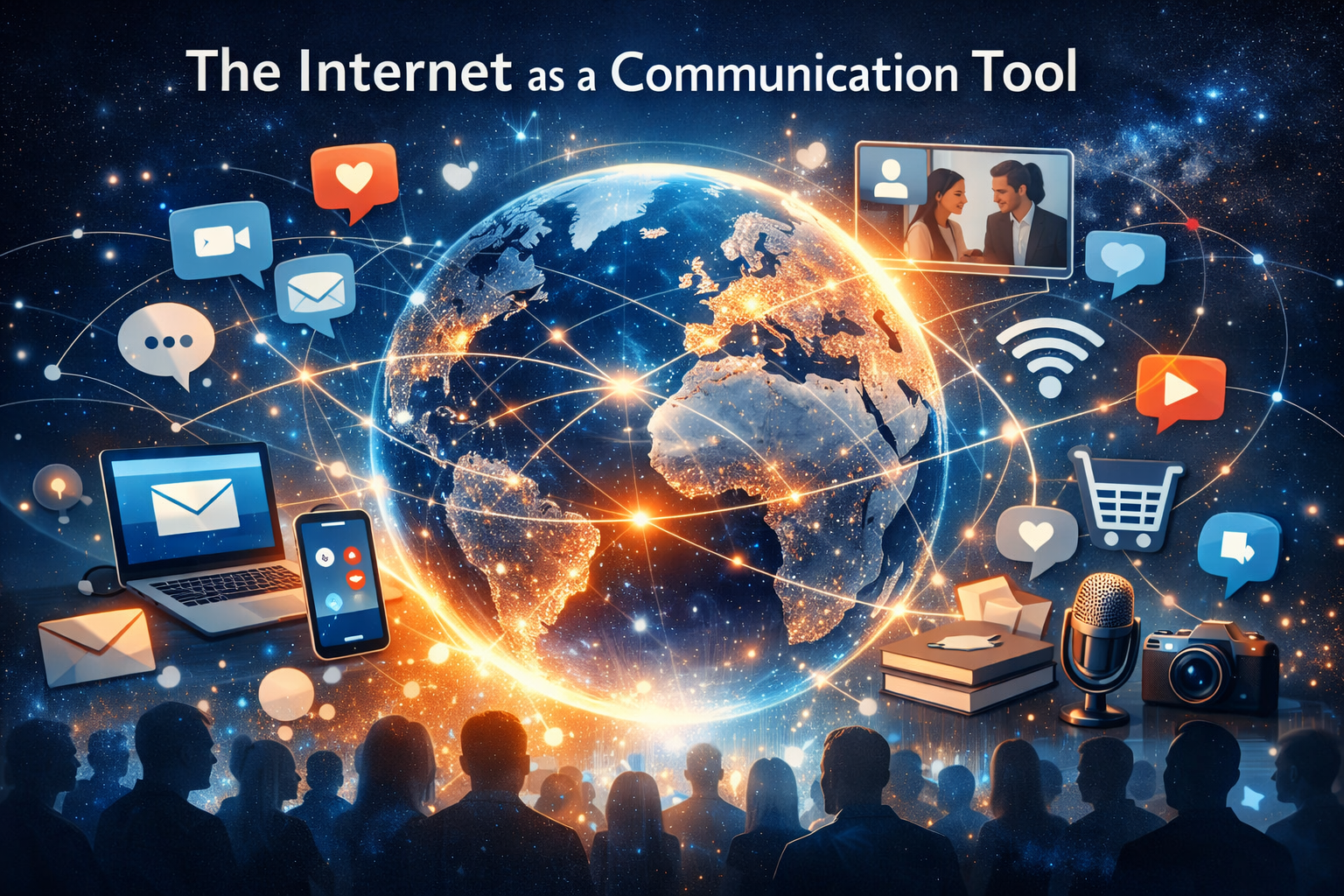
When people talk about the internet, they often describe it as a marketplace, a library, a media platform, or a technological revolution. All of these descriptions are partially true, but they miss something more fundamental. At its core, the internet is a communication tool. Everything that happens online, from social media to e-commerce to streaming services, ultimately exists because it allows people to communicate with one another more efficiently.
Before the internet, communication across distance was slow, expensive, or limited in reach. Letters took days or weeks to arrive. Phone calls were expensive, especially internationally. Publishing information required printing presses, distribution networks, and significant capital. Broadcasting to large audiences was reserved for television networks, radio stations, and newspapers.The internet changed this by collapsing the cost and speed of communication. A single person with a laptop can now send a message to millions of people instantly. Information can move across the world in seconds. Conversations that once required institutions and infrastructure can now happen between individuals.
This is why so many different industries were transformed once they moved online. Retail changed because buyers and sellers could communicate directly through digital storefronts. Entertainment changed because creators could distribute their work and reach audiences without relying entirely on traditional gatekeepers. Education changed because teachers and students could exchange knowledge instantly across continents.
Even something as simple as a website is ultimately a form of communication. A blog post communicates ideas from a writer to readers. A product page communicates the value of an item to a potential customer. A landing page communicates why someone should sign up, subscribe, or buy.This perspective also explains why traffic matters so much in online business. Traffic is simply attention, and attention is the prerequisite for communication. If no one sees your message, the communication never happens. The internet does not reward the existence of information. It rewards the successful transmission of information from one person to another.
Social media platforms are another clear example of the internet’s role as a communication system. Although they are often described as entertainment platforms, their primary function is still the exchange of messages between people. Posts, comments, likes, shares, and direct messages are all forms of digital conversation. These platforms thrive because they make communication faster, more visible, and more interactive than ever before.
Businesses that succeed online usually understand this principle intuitively. They do not see the internet merely as a place to display products. Instead, they treat it as a channel for conversation with potential customers. Marketing becomes communication about problems and solutions. Customer service becomes communication about satisfaction and trust. Branding becomes communication about identity and values.
The rise of content marketing also reflects this shift. Companies publish articles, videos, podcasts, and guides not simply to fill space on the internet but to communicate expertise and authority. When done well, content creates a relationship between creator and audience. Over time, this relationship builds trust, and trust eventually leads to transactions.
Affiliate marketing follows the same logic. An affiliate is simply someone who communicates a product recommendation to an audience that trusts them. The technology that tracks the referral may be sophisticated, but the underlying mechanism is straightforward. One person tells another person about something useful.
Even modern tools like artificial intelligence and automation still operate within this framework. AI can generate content, summarize information, or respond to messages, but the purpose remains the same. These tools help people communicate ideas, knowledge, and value more efficiently.Understanding the internet as a communication tool also simplifies how to think about building an online presence. Instead of chasing every new platform or trend, the real question becomes simple. What message are you trying to communicate, and who needs to hear it?
A blog communicates long-form ideas. Short videos communicate quick insights or entertainment. Email communicates directly with an audience that has already shown interest. Search engines connect people who have questions with people who have answers. Each platform is simply a different channel for the same fundamental activity.
When people struggle online, it is often because they forget this basic principle. They focus on technical tricks, algorithms, or growth hacks without thinking about the clarity and usefulness of the message itself. But technology cannot compensate for poor communication. If the message is weak, no amount of optimization will make it compelling.
On the other hand, a clear and valuable message can travel far even with minimal resources. Many successful creators started with nothing more than a simple blog, a social media account, or a newsletter. What made them successful was not complicated technology but the ability to communicate ideas that resonated with people.
The internet feels complex because it connects billions of devices and hosts unimaginable quantities of data. Yet beneath that complexity lies something very simple. It allows humans to talk to each other at scale.
Every email sent, every article published, every video uploaded, and every product sold online is part of this enormous web of communication. The tools may continue to evolve, but the underlying purpose remains unchanged.The internet is not just technology. It is conversation.