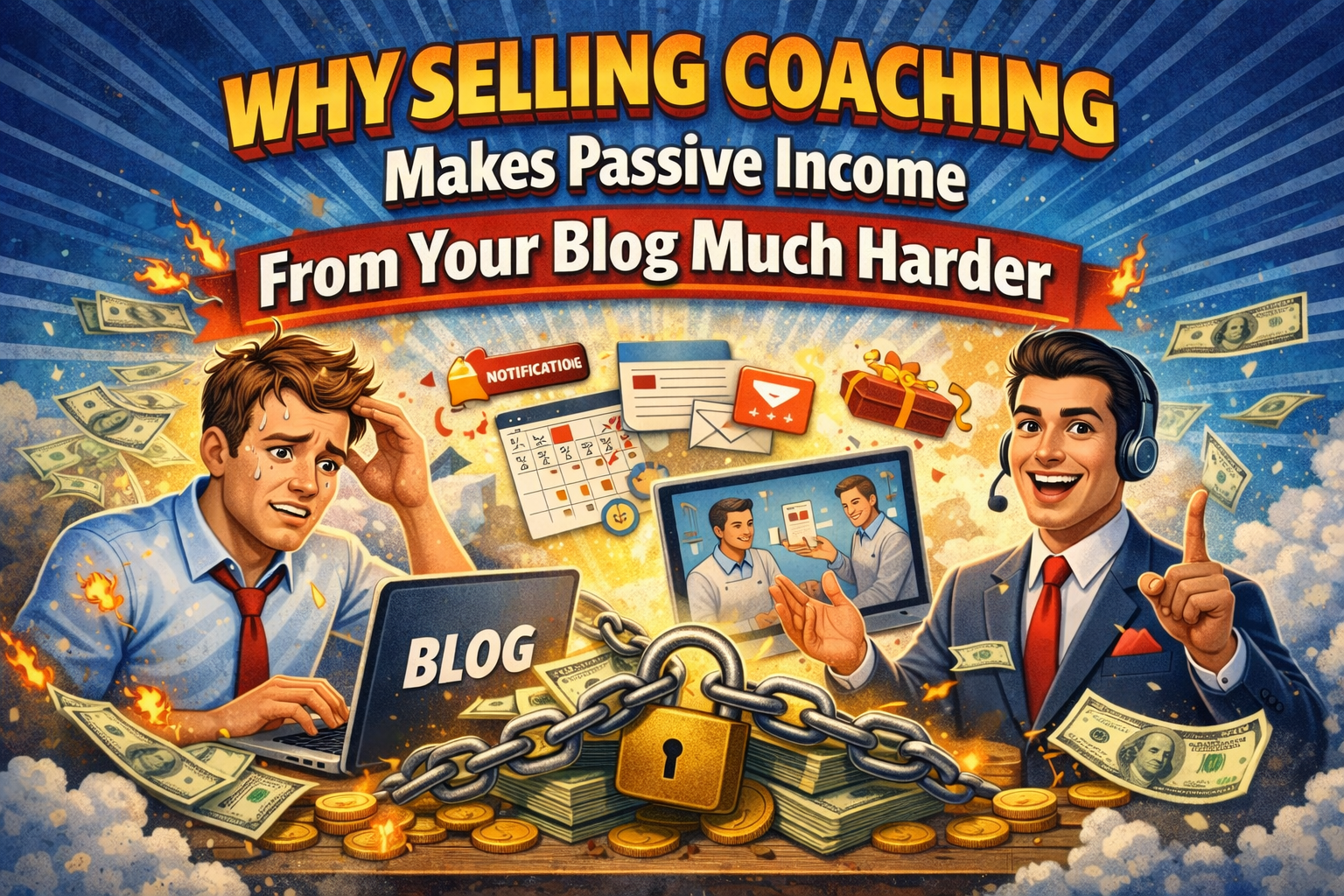
Many bloggers eventually discover that the easiest thing to sell is coaching. If you write about business, productivity, mindset, or entrepreneurship, readers naturally begin asking for advice. Some will want calls, consulting sessions, or one-on-one guidance. Charging for that help feels like an obvious next step. It creates immediate revenue and validates that people value your knowledge.But while coaching can produce income quickly, it often works against the long-term goal of building passive income from a blog.The reason is simple. Coaching ties your revenue directly to your time.
A blog that earns passive income operates very differently. The ideal model is that a reader arrives, consumes the content, and purchases something that does not require your personal involvement. The product might be a book, a course, a piece of software, or a digital tool. Once it exists, the blog can sell it repeatedly without requiring additional hours from you.
Coaching breaks that structure. Every sale requires a new block of your time. If ten people buy coaching, you must schedule ten conversations. If fifty people buy coaching, your calendar becomes full. The revenue might grow, but it grows alongside your workload.This dynamic creates a ceiling. There are only so many hours in a day. At some point the blog stops being a scalable asset and becomes a lead generator for your personal labor.
Another issue is how coaching changes the behavior of your audience. When readers know they can simply pay to speak with you, many will skip trying to solve problems on their own. Instead of purchasing products or tools that scale, they default to asking for your direct attention. Over time the blog begins attracting readers who want access to you rather than readers who want solutions they can apply independently.
This shifts the economics of the entire platform. Instead of building a system where thousands of visitors generate income automatically, you end up managing a pipeline of conversations. The blog may still bring traffic, but that traffic converts into meetings rather than scalable sales.
There is also a psychological shift that happens when coaching becomes the main offer. The writer begins thinking about content differently. Instead of building complete resources that solve problems, there is a subtle incentive to leave some gaps. If everything is explained clearly within the articles and products, fewer people may feel the need to book a call. The business slowly drifts toward selling access instead of selling solutions.This is why many successful bloggers eventually move away from heavy coaching models. They may still offer limited consulting at a premium price, but the core of the business becomes products that work without them. Books, digital guides, software, memberships, and other scalable assets allow the blog to earn income from thousands of readers without requiring thousands of conversations.
Passive income from a blog is fundamentally about leverage. One piece of work should be able to serve many people at once. Coaching does the opposite. It converts each reader into a new commitment of time.
That does not mean coaching is bad. It can be extremely valuable for the person receiving it and profitable for the person providing it. But it is important to understand the tradeoff. Coaching is a service business, even when the leads come from a blog.If the goal is true passive income, the focus must eventually shift away from selling hours and toward building assets that deliver value without requiring your presence every time someone buys.