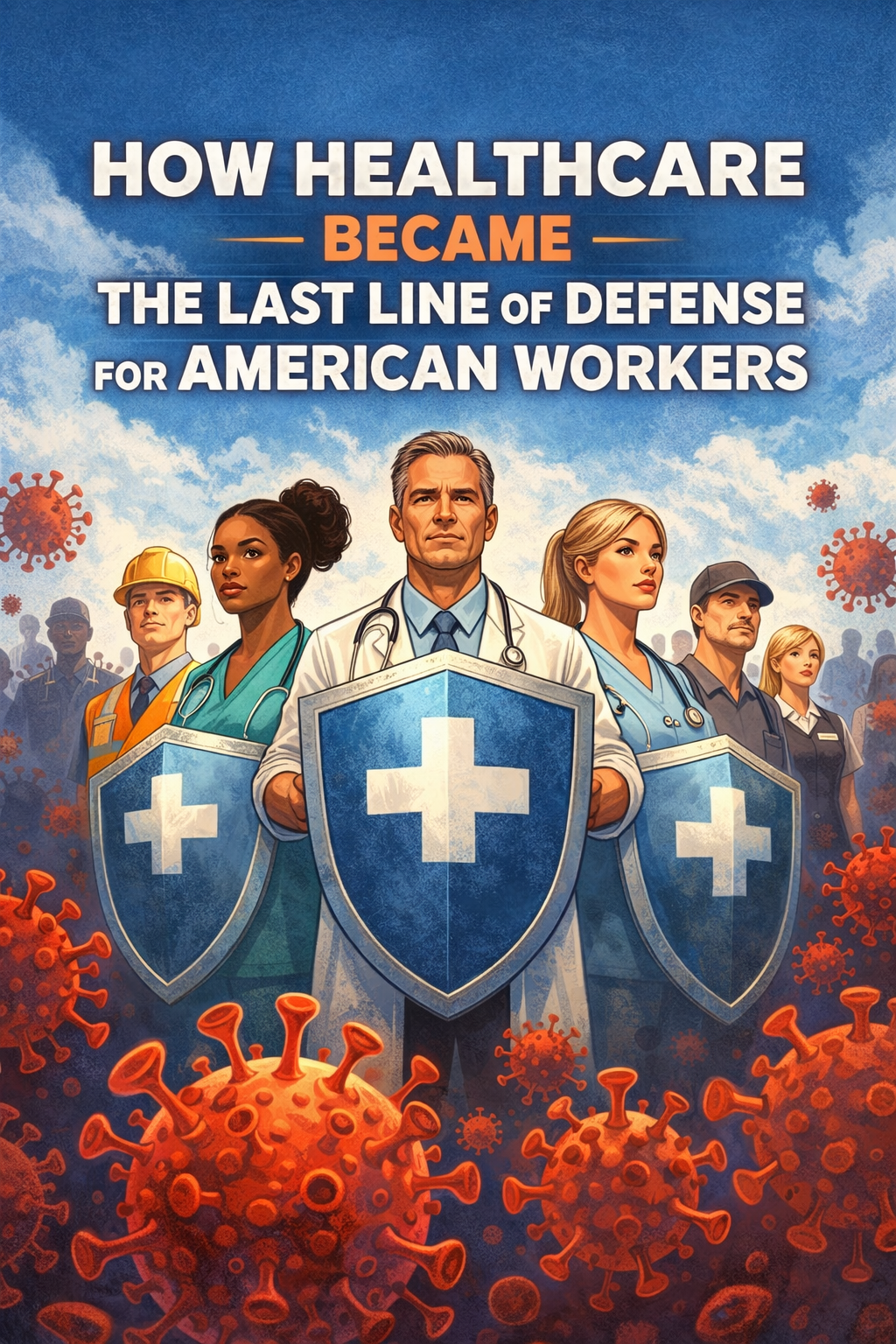
Walk through any downtown corridor in America this year and the evidence is unavoidable. The storefronts that once housed retail chains now sit dark behind plywood boards. Office buildings stand half-empty, their parking garages collecting dust where commuters once jostled for spots. The manufacturing plants that anchored small towns for generations have been automated into silence, their skeleton crews of technicians maintaining robots that never call in sick and never demand raises. Yet amid this economic hollowing-out, one sector continues to expand with almost defiant energy. Hospital construction cranes dot skylines from Phoenix to Pittsburgh. Urgent care centers colonize suburban strip malls. Job fairs for nursing positions draw crowds that spill into parking lots.
Healthcare has become the great absorber, the single industry capable of soaking up the workers displaced by every other transformation reshaping the American economy. In 2026, it is no longer merely a sector among many. It has become the structural pillar preventing total labor market collapse.The arithmetic is stark and unforgiving. Artificial intelligence systems have eliminated an estimated four million administrative and white-collar positions since 2022, with customer service, data entry, and middle management roles evaporating faster than retraining programs can adapt. E-commerce consolidation and automated warehouses have compressed retail employment to levels not seen since the early 1990s. The energy transition, while creating some technical roles, has net-destroyed more positions in fossil fuel extraction than renewable infrastructure has replaced. Manufacturing continues its decades-long trajectory toward capital-intensive production requiring minimal human intervention. Even the technology sector itself, once the promised land for displaced workers, has contracted as AI coding assistants and automated development platforms reduce engineering headcounts.Against this backdrop of generalized contraction, healthcare employment has grown by nearly three million positions since 2020. The sector now accounts for one in every eight American jobs, up from one in twelve just six years prior. More significantly, it represents the only major employment category adding positions across all educational levels simultaneously. PhD researchers map protein folding for pharmaceutical companies while certified nursing assistants lift patients in rehabilitation wards. Both find entry points into an industry that seems structurally incapable of reducing its labor intensity regardless of technological advancement.The reasons for this resilience illuminate something fundamental about the nature of care itself. Healthcare, at its core, involves the manipulation of fragile human bodies through space and time. It requires physical presence, emotional intelligence, and split-second judgment in situations where the cost of error is measured in mortality. Robots can assist with surgery and algorithms can flag anomalies in imaging, but the fundamental work of nursing, rehabilitation, mental health support, and chronic disease management stubbornly resists full automation. The aging population ensures that demand for these labor-intensive services grows faster than productivity improvements can offset them. Every year, more Americans require assistance with the basic activities of daily living, and each of those requirements represents hours of human attention that cannot be compressed or digitized.
This dynamic has created a peculiar economic dependency. The healthcare sector now functions as a massive employment program disguised as a medical system. Hospital systems in rural areas have become the largest employers by default, often accounting for twenty or thirty percent of local payrolls in regions where mining, manufacturing, and agriculture have collapsed. Urban academic medical centers operate as city-states unto themselves, anchoring regional economies with payrolls that ripple through construction, hospitality, and retail sectors that survive primarily on healthcare worker spending. The industry has absorbed workers with backgrounds in declining fields, offering retraining pathways that convert displaced retail managers into clinic administrators and former factory workers into medical equipment technicians.The wages tell a complicated story. Healthcare employment offers genuine economic security for those with advanced credentials. Physicians and specialized nurses command compensation that places them firmly in the upper middle class, creating the consumption patterns that support surrounding businesses. For those without specialized training, the picture is more ambiguous. Home health aides and nursing assistants often earn little more than minimum wage, their economic precarity masked by the professional aura of their institutional settings. The sector has become bifurcated between a highly credentialed elite and a vast workforce of care laborers whose compensation does not reflect the essential nature of their work. Yet even these lower-tier positions offer something increasingly rare in the contemporary economy: stability. Healthcare jobs resist offshoring and automation in ways that manufacturing and administrative work cannot match.The fiscal implications of this arrangement are approaching critical mass. Healthcare spending now consumes nearly twenty percent of gross domestic product, a figure that would have seemed catastrophic to policymakers a generation ago. Medicare and Medicaid expenditures grow faster than tax revenues, creating pressure for cost containment that conflicts directly with the sector’s role as employer of last resort. Every efficiency gain, every successful automation of billing or scheduling, every reduction in length of hospital stay, threatens the employment base that supports entire communities. The American economy has backed itself into a paradox where the most wasteful and expensive sector has become the most economically indispensable.Policy responses have been incoherent, reflecting the fundamental tension between competing imperatives. Efforts to control healthcare costs run aground on the reality that spending reductions translate directly into job losses in regions with no alternative employment base. Proposals to expand coverage through public programs face opposition not merely from ideological opponents but from communities that recognize their economic survival depends on the continued flow of healthcare dollars. The industry has become too big to fail in the most literal sense, its collapse would trigger unemployment on a scale not seen since the Great Depression.
The psychological dimensions of this dependency deserve attention. Young people entering the workforce in 2026 face a labor market where healthcare represents the only certain path to middle-class security. The cultural prestige once attached to technology entrepreneurship or financial services has partially migrated to medical credentials. Medical school applications have reached historic highs. Nursing programs carry waitlists measured in years. The children of displaced workers see in white coats and scrubs the only reliable protection against the economic volatility that consumed their parents’ careers. This concentration of talent has consequences for innovation in other sectors, as the brightest minds gravitate toward an industry that promises stability rather than disruption.
The geographic implications are equally profound. Healthcare employment clusters in ways that reinforce existing regional inequalities. Major medical centers concentrate in metropolitan areas with research universities and affluent patient populations. Rural healthcare facilities struggle with recruitment and retention, creating medical deserts even as they remain the primary economic engines for their communities. The result is a healthcare economy that simultaneously supports urban prosperity and rural dependence, exacerbating the political and cultural divides that characterize contemporary America.
Looking forward, the sustainability of this arrangement remains deeply uncertain. The demographic pressures driving healthcare demand will intensify for another two decades as the baby boom generation ages into its most medically intensive years. Yet the fiscal capacity to support this employment base faces absolute constraints. At some point, the contradiction between healthcare as economic pillar and healthcare as fiscal burden must resolve, likely through some combination of productivity breakthroughs, payment system collapse, or political transformation that decouples employment from insurance coverage.
For the present moment, however, healthcare stands alone as the guarantor of economic participation for millions of Americans who would otherwise face obsolescence. It has become the unintended consequence of technological progress, the sponge absorbing workers displaced by every other efficiency gain the economy generates. The hospital has replaced the factory as the iconic institution of working-class stability. The nurse has become the occupation that promises what assembly line work once delivered: a paycheck, a community, a recognizable future.
This is not the healthcare system anyone designed. It is the healthcare system that emerged when every other employment foundation proved incapable of withstanding the pressures of automation and globalization. Whether it can bear this weight indefinitely, or whether it will eventually crack under the strain of impossible expectations, remains the central economic question of the decade. For now, the heart monitors beep and the construction cranes swing, and the job market stays alive on life support.