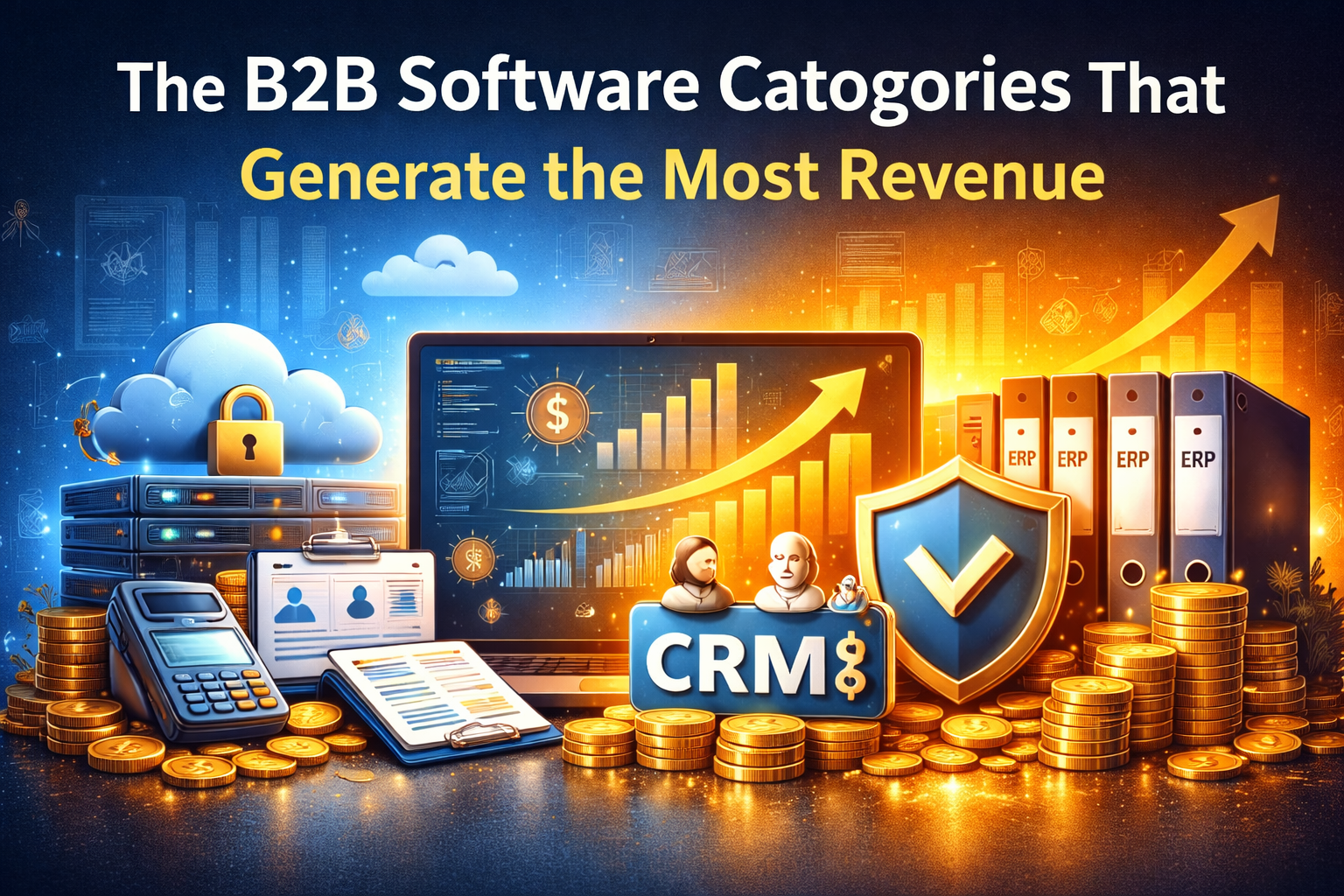
The global market for business-to-business software has grown into one of the largest sectors in the technology industry. According to multiple industry reports, the global enterprise software market now exceeds $700 billion annually, and it continues to expand as more companies digitize their operations. Within that massive market, a few specific categories dominate revenue generation because they sit at the center of how businesses operate.
Cloud infrastructure software is one of the largest and most profitable segments. Companies rely on cloud platforms to run their applications, store data, and power internal systems. Amazon Web Services alone generates more than $90 billion in annual revenue, while Microsoft Azure and Google Cloud together produce tens of billions more each year. These platforms charge businesses based on computing power, storage, and usage, which means revenue scales directly with the size of the customer. Large enterprises often spend millions of dollars per year on cloud infrastructure, making this category one of the most lucrative in all of software.
Customer relationship management software is another enormous revenue generator. CRM platforms help companies manage leads, track customers, and automate sales pipelines. Salesforce, the largest CRM company in the world, produces more than $34 billion in annual revenue. Industry analysts estimate that the global CRM software market alone is worth over $80 billion, and it continues to grow rapidly as businesses focus more on customer data and sales automation. Many mid-sized companies spend $10,000 to $100,000 per year on CRM systems, while large enterprises often pay far more.
Financial software also represents a major source of B2B revenue. Accounting systems, payment processors, payroll platforms, and financial compliance tools handle the flow of money inside organizations. The global fintech and financial software market generates hundreds of billions in revenue annually. For example, payment processing companies such as Stripe and PayPal each process hundreds of billions of dollars in payments per year, earning revenue through transaction fees. Enterprise accounting platforms and payroll systems can cost businesses thousands to tens of thousands of dollars annually, depending on the size of the company.
Cybersecurity software has become one of the fastest-growing sectors in B2B technology. As businesses move more data and operations online, protecting digital systems has become a priority. The global cybersecurity market is expected to exceed $200 billion in annual spending, with projections suggesting it could reach $300 billion within the next decade. Security companies such as Palo Alto Networks, CrowdStrike, and Fortinet generate billions in yearly revenue by providing threat detection, network monitoring, and vulnerability protection. Large organizations frequently spend hundreds of thousands or even millions of dollars per year on cybersecurity tools.
Enterprise resource planning software is another category that produces massive revenue. ERP systems help businesses manage operations such as supply chains, inventory, manufacturing, and workforce planning. Companies like SAP and Oracle dominate this market. SAP alone generates more than $30 billion in annual revenue, largely from enterprise software subscriptions and support services. ERP systems often cost companies tens of thousands to hundreds of thousands of dollars annually, particularly when implemented across large organizations.
Across all of these categories, the same economic pattern appears repeatedly. The software that generates the most revenue tends to sit closest to the most important functions inside a business. Infrastructure software runs the systems companies depend on every day. Financial software controls the movement of money. CRM platforms help generate sales. Security software protects valuable data. Operational software coordinates complex internal processes.
Because these systems are deeply embedded in how companies function, businesses are willing to pay substantial recurring fees to maintain them. This is why the largest B2B software companies routinely generate tens of billions of dollars in annual revenue and why enterprise software has become one of the most profitable sectors in the global technology economy.