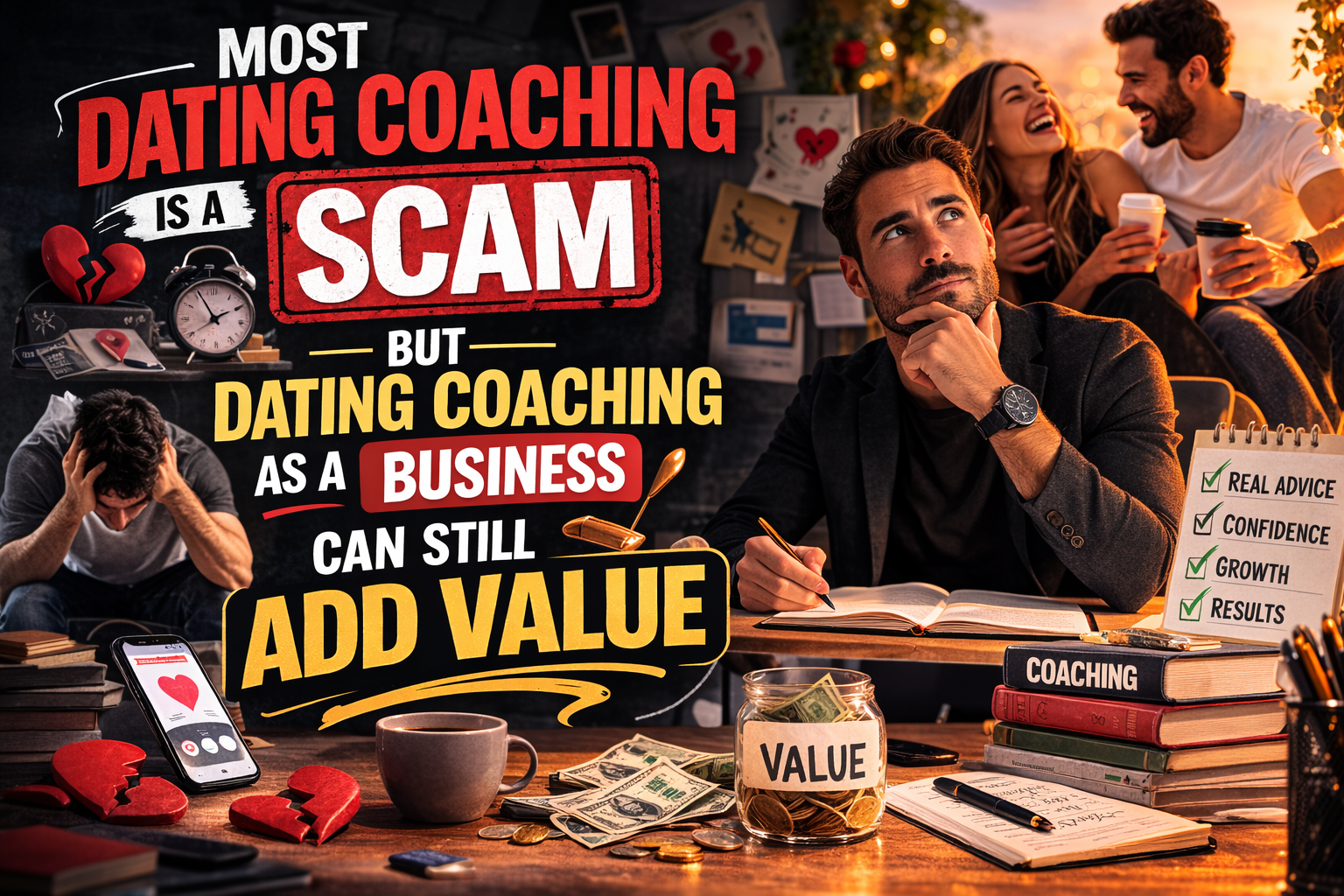
The dating coaching industry has grown rapidly over the past decade. Thousands of videos, courses, and paid consultations promise to teach people how to attract partners, improve their confidence, and build better relationships. On the surface, this might seem like a valuable service. Relationships are important, and many people struggle with dating. It would seem logical that professional guidance could help.
Unfortunately, much of the dating coaching industry does not deliver the value it promises.
A large portion of dating advice that is sold online simply repackages very basic ideas. Concepts like improving your confidence, communicating clearly, taking care of your appearance, and being socially active are often presented as if they are secret techniques. These ideas are not wrong, but they are rarely worth the high prices many coaches charge for them. When someone pays hundreds or thousands of dollars expecting hidden strategies or transformational insights, they are often disappointed to discover that the advice is mostly common sense.
Another reason dating coaching often fails to deliver is that relationships are highly individual. Human attraction is influenced by personality, culture, timing, life goals, and countless other factors. Because of this complexity, there is no universal formula that guarantees success in dating. Many coaches market their programs as if they have discovered a system that works for everyone. In reality, dating outcomes depend on variables that cannot easily be controlled or standardized.
This does not mean the business itself has no value.
The real benefit of dating coaching is not secret techniques or psychological tricks. The value lies in accountability, perspective, and encouragement. Many people struggle with dating not because they lack knowledge, but because they lack confidence, feedback, or motivation. A coach can provide an outside perspective that helps someone see patterns in their behavior, improve their communication, and approach dating with a healthier mindset.
In this sense, dating coaching is much closer to life coaching than it is to a technical skill. The goal is not to teach a rigid system but to help people reflect on their behavior and make adjustments that improve their social interactions. For some clients, simply having someone to talk to about their experiences can make a meaningful difference.
From a business perspective, this explains why the industry continues to exist despite the criticism it often receives. The demand for guidance in relationships is enormous. People want reassurance, clarity, and confidence when navigating one of the most emotionally complicated parts of life. A coach who approaches the work honestly and avoids exaggerated promises can still provide real value.
The problem arises when dating coaching is marketed as a guaranteed path to romantic success. When the service is framed as a set of secret tactics that can reliably produce attraction, it crosses into misleading territory. Relationships are not machines that can be manipulated with the right sequence of steps.
A more honest approach recognizes that dating coaching cannot control outcomes. What it can do is help people communicate better, understand themselves more clearly, and approach relationships with a healthier mindset. Those improvements may increase the chances of forming meaningful connections, but they are not guaranteed formulas.
In the end, most dating coaching fails because it sells illusions instead of guidance. Yet the idea of coaching itself is not inherently flawed. When practiced responsibly, it can help people reflect on their habits, build confidence, and navigate social situations more thoughtfully.
The difference between a scam and a valuable service is honesty. Coaches who promise guaranteed attraction are selling fantasies. Coaches who focus on perspective, growth, and communication are offering something far more realistic.