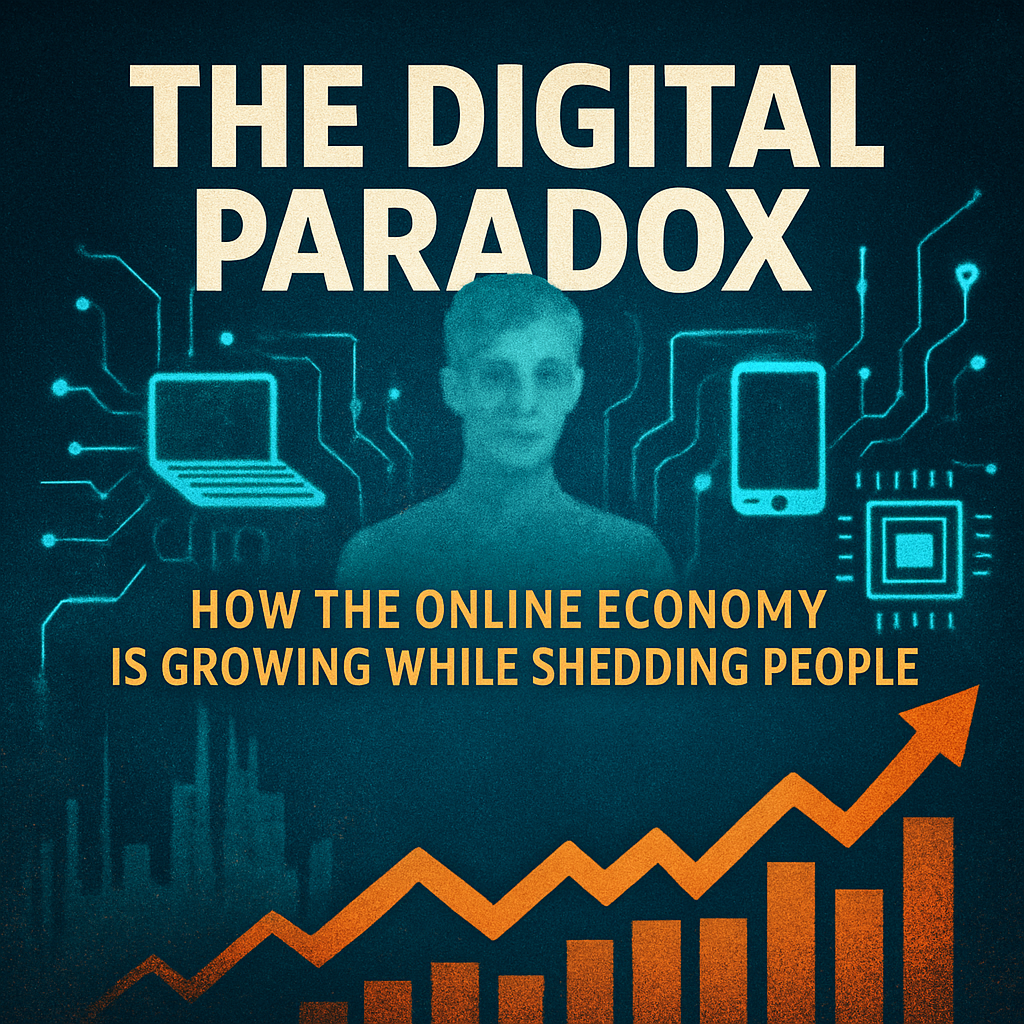
We often hear about the booming digital economy, with headlines touting record e-commerce sales, explosive growth in cloud computing, and the rise of AI-driven businesses. The digital economy now accounts for roughly a quarter of the U.S. GDP and continues to expand globally. Online services, streaming platforms, fintech, and e-commerce giants generate trillions in revenue and reshape entire industries. Yet beneath the surface of this financial success lies a less visible, more troubling reality: the digital economy is growing while shedding people.
At first glance, this seems contradictory. How can an economy expand and create value while employment contracts? The answer lies in the nature of digital work itself. Unlike traditional industries, which rely heavily on labor, digital businesses scale efficiently with minimal human input. A single software program or AI model can perform tasks that previously required entire teams. An e-commerce warehouse, powered by robotics and automated logistics, can fulfill tens of thousands of orders with fewer employees than a physical store network of comparable revenue. Online platforms like social media networks or streaming services can reach millions of users without proportionally increasing staff. In other words, the digital economy can generate immense value with fewer people than traditional sectors.
This efficiency is both a strength and a source of disruption. Industries that once employed millions are shrinking as digital alternatives take over. Physical stores close while online marketplaces flourish. Automated chatbots replace customer service agents. Algorithms perform tasks that accountants, analysts, and clerks used to do manually. Even as companies report record profits and GDP figures rise, the total number of available jobs in these areas stagnates or declines. For many workers, the economy is booming in theory but hollow in practice. The digital economy rewards skill, technical knowledge, and adaptability, while leaving behind those whose jobs are easily automated or displaced.
The pace of this transformation accelerated during the COVID-19 pandemic. Lockdowns forced consumers online, pushing e-commerce, streaming, and digital services to unprecedented levels. Many businesses adopted automation and remote tools to remain competitive. The result was a surge in digital revenue, but not a proportional increase in employment. Retail stores closed permanently, routine office roles were eliminated, and companies optimized operations to run leaner than ever. By the time the world reopened, it was clear that the digital economy had permanently shifted the labor landscape. While total GDP continued to climb, millions of workers struggled to find roles that matched their previous pay or status.
One of the more striking elements of this trend is how unevenly it affects different segments of the workforce. High-skill tech roles, such as software development, AI engineering, data science, and digital marketing, have seen steady growth. Workers in these roles benefit from a booming sector, higher wages, and the ability to work remotely. Meanwhile, mid-skill and routine positions—administrative assistants, warehouse associates, retail clerks, and some service roles—are shrinking. The digital economy is not just automating manual labor; it’s also replacing repetitive intellectual work. AI systems that can draft reports, analyze data, or answer customer inquiries are increasingly common, displacing workers who once performed these functions. The net effect is a bifurcated labor market: a small segment of highly valued, high-paying digital workers, and a much larger group of workers whose skills are being devalued by technology.
This structural shift has broader social and economic implications. As the digital economy expands, wealth and income become increasingly concentrated among those who can thrive in it. Investors, entrepreneurs, and skilled tech workers capture a growing share of profits, while displaced workers face stagnant wages, underemployment, or unemployment. The perception of economic growth as universal prosperity becomes misleading. For many, the world looks richer on paper, but personal opportunity is shrinking. The disconnect between GDP growth and employment health creates tension and dissatisfaction, fueling debates about inequality, automation, and the future of work.
It is also worth noting that the shedding of workers is not necessarily the result of malicious intent. Digital businesses are optimizing for efficiency and profitability. Automation and AI reduce costs, improve speed, and enhance customer experiences. Companies are incentivized to deploy technology wherever it can replace human labor, because labor is expensive and technology is scalable. The problem arises when society fails to provide pathways for displaced workers to transition into new roles. Without investment in reskilling, education, and social support, the economic benefits of the digital economy accrue to a shrinking subset of the population, leaving many behind.
The paradox becomes even more pronounced when considering global dynamics. Developed economies experience labor displacement in sectors like retail and administration, while emerging economies face a different set of pressures. Outsourcing and digital platforms can concentrate digital work in countries with high technical skill levels, leaving low-skill labor markets vulnerable. Even as global digital GDP grows, the distribution of its benefits remains uneven, reinforcing existing inequalities between countries and social classes.
Despite the challenges, there are opportunities to address this digital paradox. Policymakers, educators, and businesses can work together to prepare the workforce for the demands of a digitally dominated economy. Training programs focused on technology, critical thinking, and creative problem-solving can equip workers with skills that are resistant to automation. Hybrid models that combine human judgment with machine efficiency may create new roles that did not exist a decade ago. The key is recognizing that the digital economy’s growth does not automatically translate into broad-based employment gains. Without deliberate action, the trend of expansion alongside labor shedding is likely to continue.
In essence, the digital economy illustrates a fundamental tension between growth and inclusivity. On one hand, digital businesses drive GDP, innovation, and global competitiveness. On the other, they displace workers, concentrate wealth, and create inequality. Success in the digital age requires acknowledging both sides of this paradox. Economies can thrive in monetary terms while failing to deliver widespread opportunity. Workers and societies must adapt, not by rejecting technology, but by reshaping education, policy, and labor practices to ensure that growth in dollars is accompanied by growth in opportunity.
The story of the digital economy is not just one of technology and profits, it is a human story. It challenges assumptions about work, value, and prosperity. As online commerce, cloud computing, AI, and digital platforms continue to expand, the question society must answer is not whether the digital economy will grow, but whether it can grow in a way that includes people rather than leaving them behind. Without intentional strategies, the paradox will deepen: the economy may get richer, but the workforce will get leaner.
The digital economy embodies both opportunity and disruption. Its growth demonstrates the incredible potential of technology to create value, efficiency, and innovation. At the same time, it exposes the fragility of traditional employment structures and the uneven distribution of prosperity. Recognizing that the economy can expand while shedding people is the first step toward addressing the human cost of digital transformation. Only by pairing technological growth with human-centered strategies can we ensure that the digital economy delivers not just higher GDP, but a society where more people can thrive alongside it.