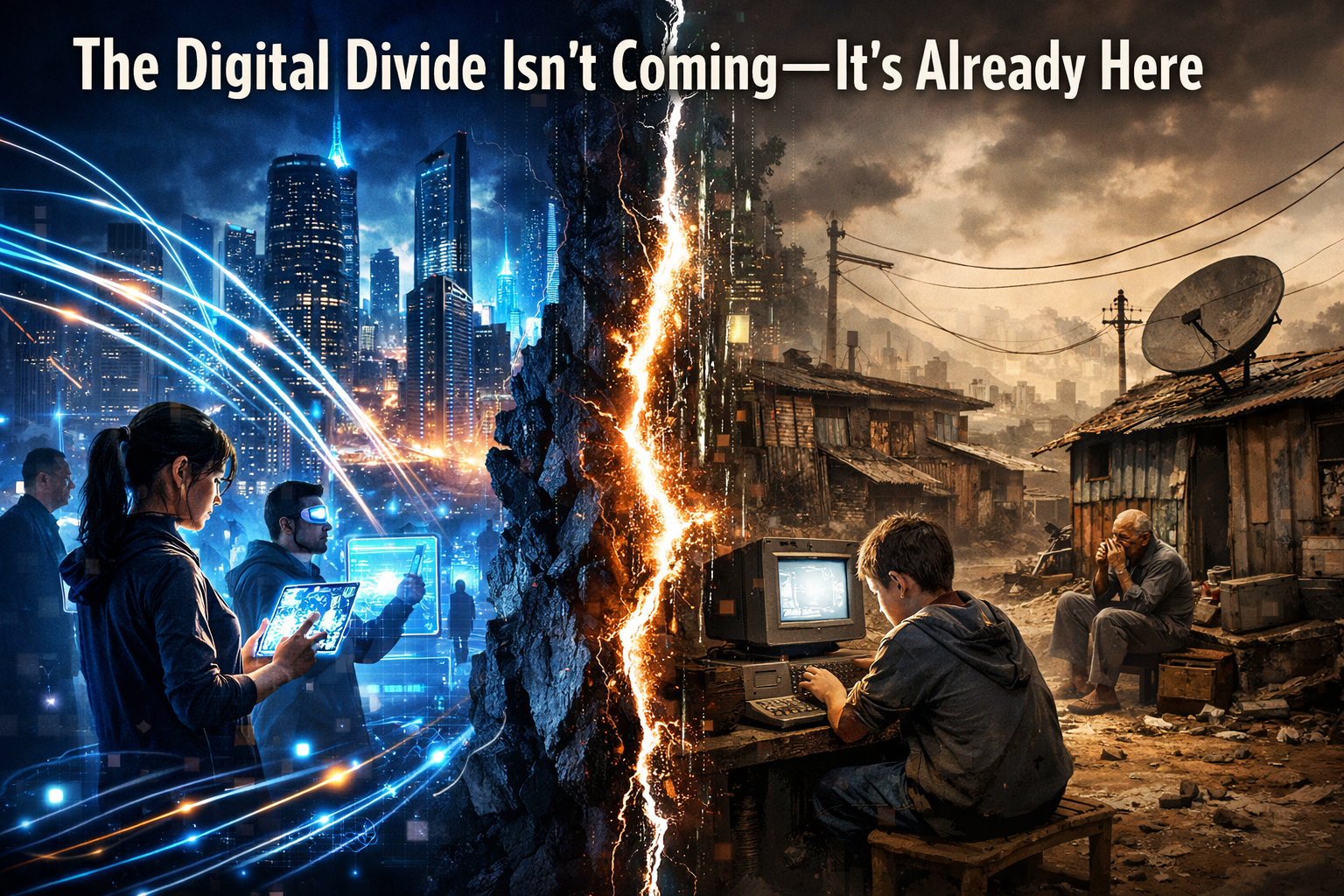
The digital economy is often described as a rising tide that lifts all boats. It sounds optimistic and comforting. The idea is that as technology advances, opportunities expand, and more people can participate in wealth creation than before. Anyone with a phone and an internet connection can, in theory, build something meaningful. But this narrative hides a more uncomfortable truth. The digital economy is not just creating opportunity. It is also accelerating inequality at a scale the world has rarely seen.
To understand why, you have to look at how wealth is actually created online. In the traditional economy, wealth was often tied to physical labor, local businesses, or roles that required presence. A factory could only produce so much. A store could only serve so many customers in a day. There were limits, and those limits acted as a kind of natural ceiling. Even the most successful businesses had friction that slowed them down.
The digital economy removes that friction. A single product can be duplicated infinitely at almost no cost. A piece of content can reach millions overnight. A platform can scale globally without needing to build physical infrastructure in every country. This creates a situation where the winners don’t just win slightly more than everyone else. They win exponentially more.
When one person builds a successful app, writes a piece of software, or creates content that captures attention, they are no longer competing within a small local market. They are competing globally, and if they succeed, they can dominate globally. The result is that a small percentage of people capture a massive share of the rewards, while the majority are left competing over what remains.
This is why the digital economy naturally produces inequality. It rewards leverage, not effort alone. Leverage means that your work can impact a large number of people without requiring a proportional increase in time or energy. Someone who understands how to use leverage can create systems that generate income even when they are not actively working. Someone who does not understand leverage is often trading time for money in a system that is becoming less and less forgiving.
The gap between these two groups is widening. It is not just about income differences. It is about access, knowledge, and positioning. Those who learn how to build, distribute, and monetize digital assets are positioning themselves on the side of exponential growth. Those who do not are often stuck in environments where competition is intense and rewards are limited.
There is also a psychological component to this divide. The digital world amplifies visibility. You can see the success of others more clearly than ever before, but what you don’t see is the structure behind that success. It is easy to assume that wealth online is random or based on luck. While luck plays a role, the reality is that many of the people benefiting from the digital economy are deliberately building systems that scale. They are thinking in terms of audiences, distribution, and long-term compounding.
At the same time, many people are using the same digital tools in a completely different way. Instead of building, they are consuming. Instead of creating leverage, they are giving their attention to those who already have it. Attention is one of the most valuable currencies in the digital economy, and those who control it are in a position to convert it into income repeatedly.
This creates a feedback loop. The people who have attention gain more attention. The people who understand monetization generate more income. That income can then be reinvested into better tools, better marketing, and more visibility. Over time, the gap becomes harder to close.
It is important to be clear about something. Saying that the digital economy will increase inequality is not the same as saying it is bad. It is simply recognizing how the system works. Every economic system has its own rules, and the digital economy rewards a specific set of behaviors and skills. Ignoring those rules does not make them disappear. It just makes it more likely that you will end up on the losing side of them.
There is a tendency to frame discussions about inequality in purely moral terms. People talk about fairness, redistribution, or systemic issues. While those conversations matter, they often distract from a more immediate and practical question. Given the system that exists, where do you want to be positioned within it?
The digital economy does not treat everyone equally, but it does offer the possibility of moving between positions. That is what makes it different from many older systems. You are not locked into a single path. However, that mobility is not automatic. It requires intention, focus, and a willingness to learn skills that are often uncomfortable at first.
Being on the wealthier side of the digital economy is not just about having more money. It is about having more control over your time, your environment, and your opportunities. It means being able to make decisions based on long-term thinking rather than immediate necessity. It means having a buffer against uncertainty.
On the other side, the experience is very different. When you are constantly trading time for money in a competitive environment, your margin for error is small. You are more exposed to sudden changes, whether it is job loss, economic shifts, or rising costs. The stress of that position is not just financial. It affects how you think, the risks you are willing to take, and the opportunities you feel you can pursue.
This is why it is better to aim for the side of the system that offers leverage and scalability. Not because it guarantees success, but because it aligns with how the modern economy actually distributes rewards. Trying to ignore this reality or hoping that things will balance out on their own is not a reliable strategy.
There is also a timing element that people often overlook. The earlier you start understanding and participating in the digital economy in a productive way, the more time you have for your efforts to compound. Compounding is not just about money. It applies to skills, audience growth, and reputation. Small advantages, repeated consistently, can turn into significant differences over time.
Waiting has a cost. The longer you delay learning how to operate in this environment, the more ground you have to make up later. Meanwhile, others are building momentum. They are refining their processes, growing their reach, and strengthening their position. By the time you decide to take it seriously, you are not starting from zero. You are starting behind.
None of this means that the path is easy. Building something that generates meaningful income in the digital world takes effort, patience, and resilience. There are periods where progress feels slow or uncertain. There are times when things do not work as expected. But those challenges exist on both sides of the divide. The difference is that on one side, your efforts have the potential to scale and compound, while on the other side, they often reset every day.
The digital economy is not a future event. It is the current reality. It is shaping how money is made, how value is created, and how opportunities are distributed. The inequality it produces is not an accident. It is a direct result of how scalable systems work.
You can choose to see that as discouraging, or you can see it as a signal. A signal that the rules have changed and that adapting to those rules is not optional if you want to improve your position. The people who understand this early are not necessarily more talented or more deserving. They are simply more aligned with the structure of the system.