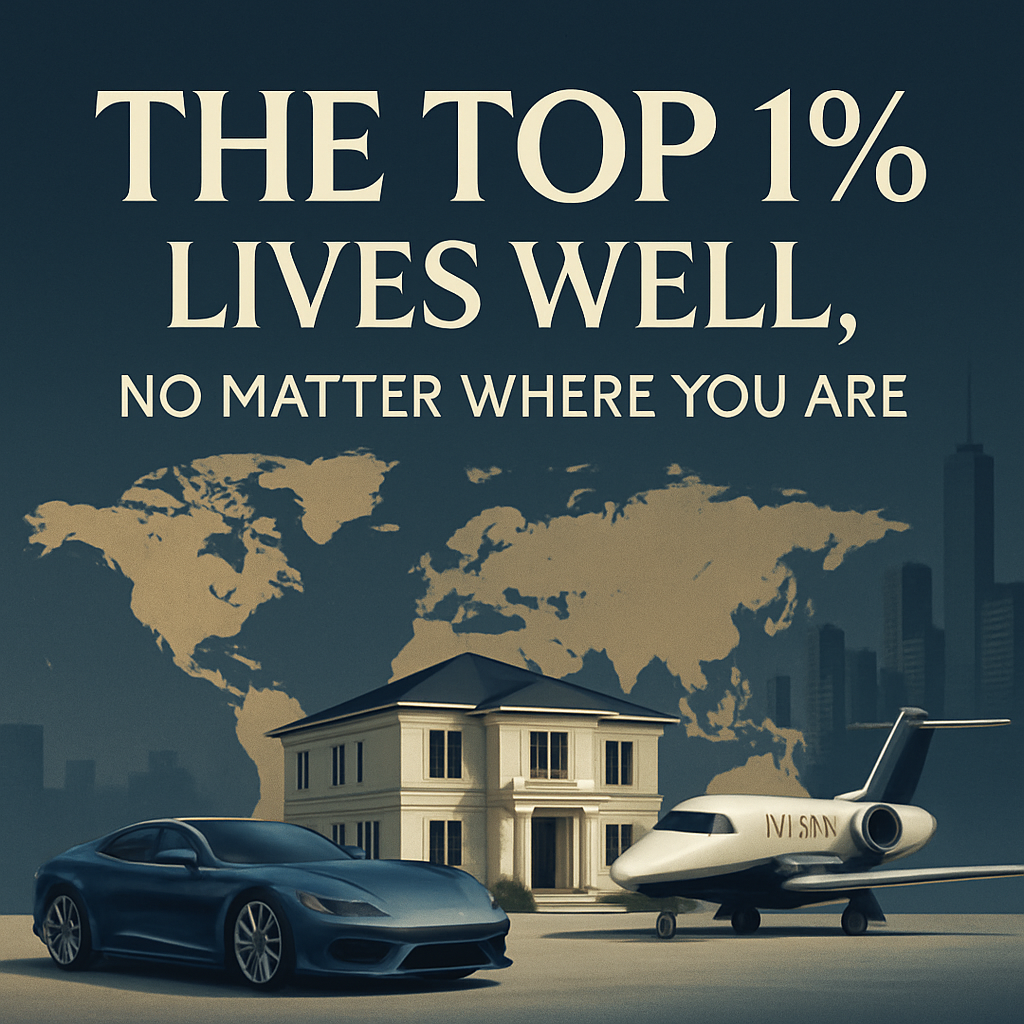
No matter where you find yourself in the world, whether in a bustling city or a quiet town, there is one constant: the top 1% of earners live a life that looks completely different from the rest. Their wealth is not just about numbers on a bank statement; it is a lifestyle, a freedom, and a level of comfort that is largely immune to location. You can be in a country where the average person struggles to make ends meet, and yet the top 1% enjoy luxuries that make scarcity almost irrelevant to them.
The reason is simple. Wealth brings choice. The top 1% can choose where to live, what to eat, which schools to send their children to, and how to spend their time. Their money creates a buffer against nearly every problem that affects the majority. Even in a country with poor infrastructure or limited services, they can hire solutions—private security, personal drivers, private medical care, and elite education. The systems that frustrate most people simply do not touch them in the same way.
Their lifestyle is also defined by opportunities rather than limitations. Where most people work jobs dictated by local conditions, the top 1% often have businesses, investments, or assets that grow regardless of geography. Their wealth is portable, flexible, and scalable. They live in a different economic layer, where borders, political instability, and local crises affect them far less than the average citizen.
This is not to say that all wealth guarantees happiness or that every member of the top 1% is immune to challenges. But in practical terms, money amplifies freedom and reduces friction. It allows people to pursue passions, hobbies, and experiences without being constrained by necessity. A wealthy person in a small or underdeveloped country still has access to international markets, private education, luxury goods, and global travel in a way the majority cannot even imagine.
The key takeaway is that the top 1% lives well not because of their environment, but because of their resources. Location matters less than access to wealth and the choices that come with it. This is why, whether you are in New York, Nairobi, or Manila, the top 1% are living a version of life that feels almost untouchable to everyone else. Their well-being is insulated from the daily struggles that define the experience of the majority.
In the end, this is a reality that is often invisible but unavoidable: no matter where you are, the top 1% lives well, and they will continue to do so. They have the tools, the access, and the financial freedom to create a life that most can only dream of. Understanding this fact is not about envy—it is about perspective. It reminds us that true comfort and security are not determined by geography alone, but by the resources and choices that wealth affords.