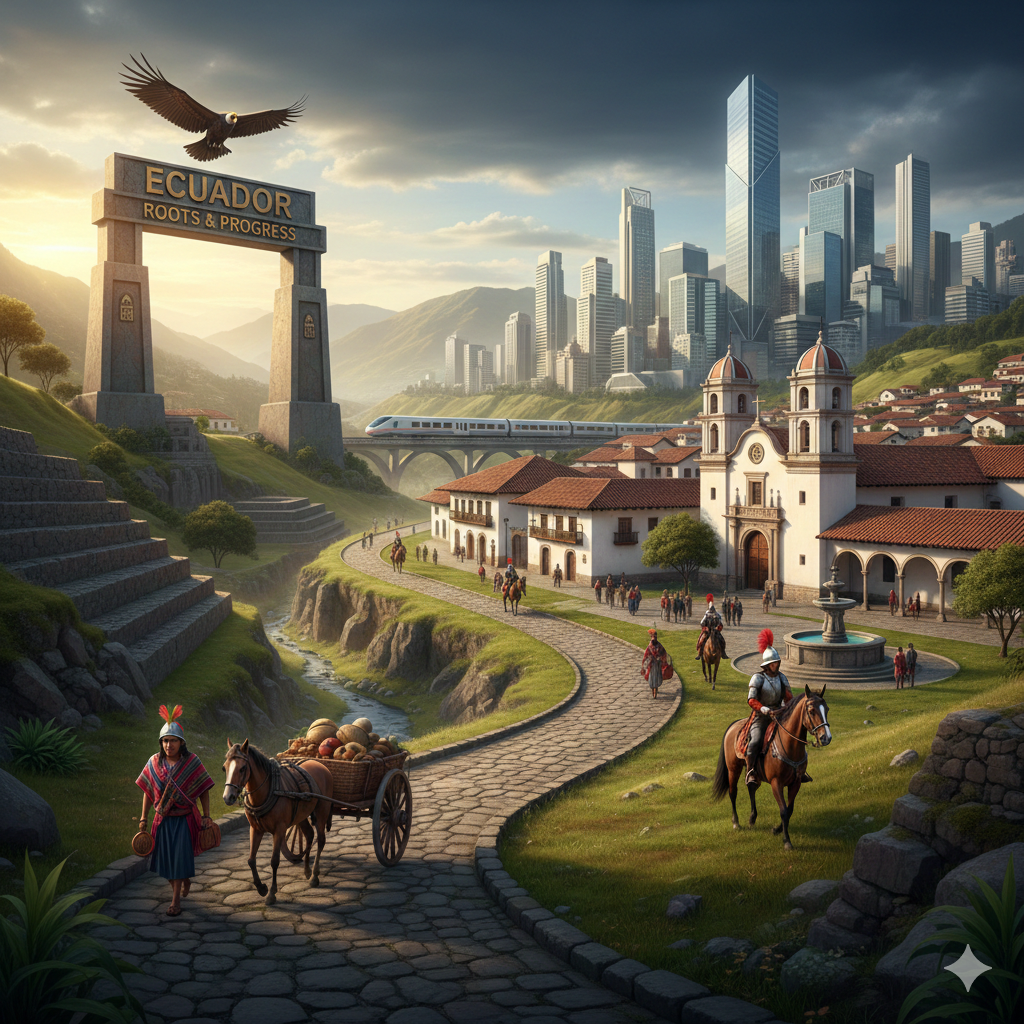
To understand Ecuador is to understand a story of converging worlds, carved by glaciers, volcanoes, and the relentless flow of human ambition. Its history is not a linear tale but a layered one, where ancient kingdoms, global empires, and fractured modern dreams are all compressed within a nation no larger than the state of Nevada.
Long before the concept of a country existed, this land was a cradle of advanced cultures. In the verdant highlands, the Valdivia culture flourished along the coast, creating some of the Americas’ oldest pottery. Millennia later, the Quitus people gave their name to the future capital. But the defining pre-Columbian power was the Kingdom of Quito, eventually absorbed into the vast Inca Empire in the late 15th century. This integration was brutal and brief, but it left an indelible mark, weaving Quechua into the land’s linguistic tapestry and setting the stage for a monumental clash.The arrival of the Spanish in the 16th century turned this Andean realm into a pivotal piece of a global monarchy. Conquistador Sebastián de Benalcázar founded San Francisco de Quito in 1534 atop the ruins of the Inca settlement. For nearly three centuries, Ecuador was the Royal Audience of Quito, a vital administrative node in the Spanish Viceroyalty of Peru and later New Granada. It became a complex society of layered castes, where indigenous, Spanish, and African legacies (the latter brought through the enslaved labor on coastal plantations) began a slow, painful fusion. The Catholic Church planted profound roots, its artisans creating breathtaking schools of art and architecture in Quito, a city that gleamed as a colonial jewel.
The spirit of independence, stirred by revolutions abroad and local discontent, finally ignited on May 24, 1822. On the muddy slopes of the Pichincha volcano, just outside Quito, the rebel forces of Marshal Antonio José de Sucre, under the visionary banner of Simón Bolívar, secured a decisive victory. This moment tied Ecuador’s destiny to Bolívar’s dream: it first joined the short-lived Republic of Gran Colombia, a union of modern-day Ecuador, Colombia, Venezuela, and Panama.
By 1830, regional particularism dissolved the dream, and Ecuador became a sovereign nation, taking its name from the equator that divides it. The 19th century was a turbulent baptism, defined by a deep-seated rivalry between the conservative highlands of Quito, with its landed estates and clerical power, and the liberal, mercantile port city of Guayaquil. This conflict between the altar and the port, between tradition and modernization, fueled constant instability. The era was punctuated by the remarkable 15-year rule of the liberal Eloy Alfaro (1895-1906, 1906-1911), who finally cemented secular reforms, built the formidable Guayaquil-Quito railway, and enshrined the separation of church and state.
The 20th century brought new actors and new wealth. The discovery of vast oil reserves in the Amazonian region in the 1970s transformed the economy overnight, funding infrastructure but also fostering boom-and-bust cycles and environmental cost. It shifted political gravity and created a rentier state vulnerable to global price swings. The latter half of the century saw a slow, fitful return to democracy after periods of military rule, marked by a growing voice for the nation’s powerful indigenous movements, who demanded recognition and rights.
Recent decades have been a testament to both resilience and fragility. Economic crises, populist waves, and profound social mobilization have continued to shape its path. From the dollarization of the economy in 2000 to the decade-long rule of leftist Rafael Correa, Ecuador has sought its place in a globalized world while grappling with the timeless challenges of inequality, environmental preservation in its unparalleled Galápagos Islands and Amazon rainforest, and the search for a cohesive national identity.
Ecuador’s history, therefore, is a microcosm of the Americas. It is a story of imperial integration, painful birth, ideological civil war, and a perpetual quest to balance its incredible geographic and human diversity within a single, sovereign idea. To stand in its Andean capital, on its Pacific coast, or in its Amazonian communities is to stand in different worlds—worlds that have been negotiating a shared existence for over five hundred years, forever united by the invisible line that gives this courageous, complicated country its name.