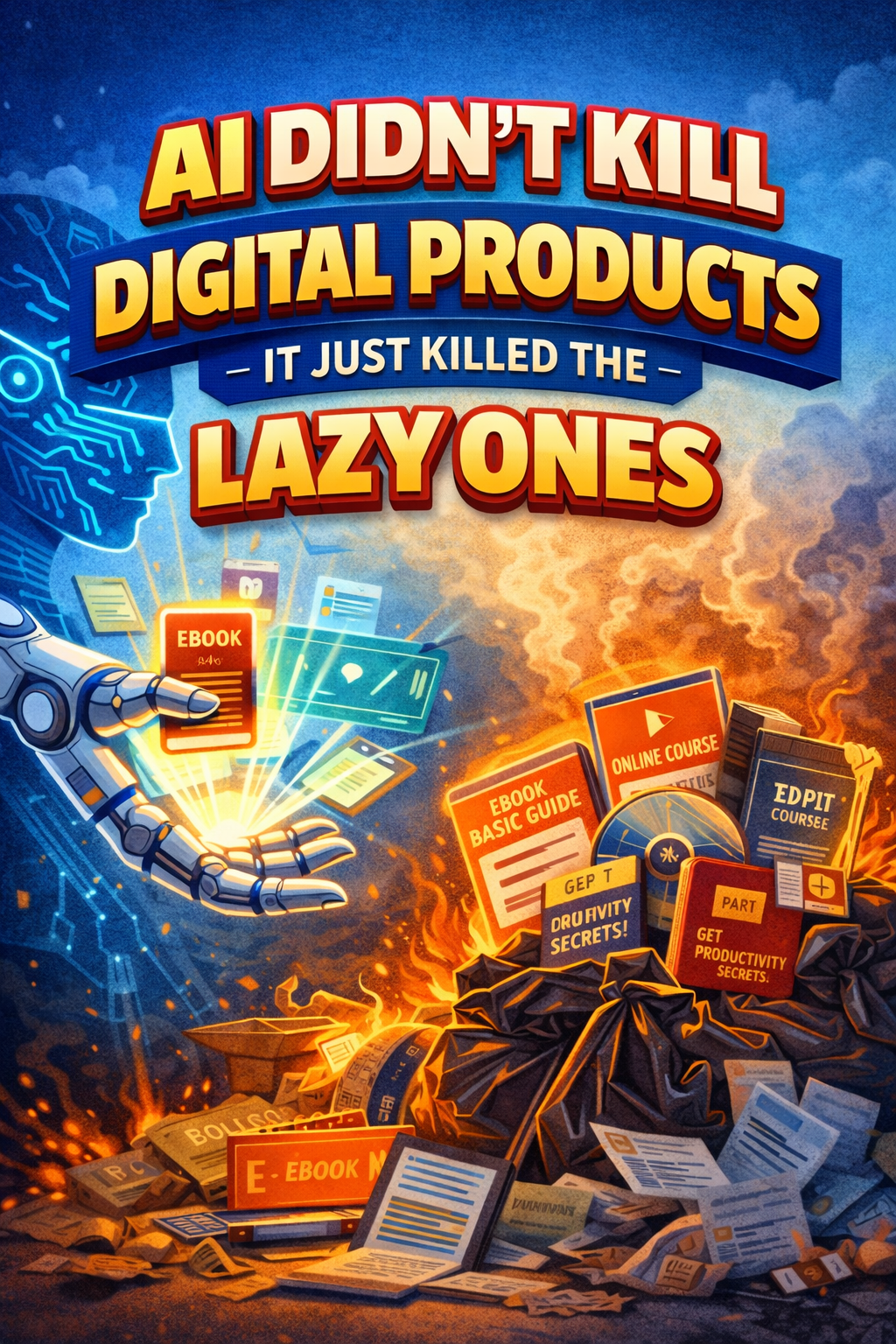
In the early days of the internet economy, digital products were often valuable simply because they packaged information. If someone spent enough time researching a topic, organizing what they learned, and presenting it in a guide or ebook, there was a good chance people would pay for it. Information itself had scarcity. Finding the right answers required time, effort, and sometimes specialized knowledge.Artificial intelligence has dramatically changed that reality.
Today, anyone can ask an AI system to explain complex topics, summarize ideas, draft guides, or generate large amounts of written content within seconds. The cost of producing informational material has collapsed. When something becomes extremely easy to produce, the market quickly fills with it. As supply rises dramatically, the price people are willing to pay naturally falls.
This is why many digital creators feel that AI has devalued digital products. In a sense, that perception is correct. Many of the products that once sold well were built around information that is now easily generated on demand. A short ebook explaining marketing basics, a simple productivity guide, or a lightweight online course can now be replicated almost instantly by anyone with access to modern AI tools.
However, what AI has really done is expose a deeper truth about the digital economy. Information alone was never the most valuable product. It was simply the easiest product to create.
The real value in digital products has always come from structure, expertise, and outcomes. People do not ultimately pay for information. They pay for progress. They pay for solutions to problems that matter to them. They pay for guidance that helps them move from where they are to where they want to be.AI can generate explanations, but it cannot easily replace trust. It cannot instantly replicate years of experience. It cannot automatically build a reputation with an audience that believes you understand their challenges. These things still require time, credibility, and consistent effort.
As a result, the digital product landscape is not disappearing. Instead, it is becoming more polarized. Low-effort informational products are becoming cheaper and harder to sell because they are now abundant. At the same time, high-quality products that combine expertise, clear frameworks, and real-world experience can still command strong prices.
This shift is also making distribution more important than ever. A blog, website, or audience that trusts your perspective becomes the real asset. When people believe you understand a problem deeply, they are far more willing to purchase tools, courses, services, or software that you recommend.
In many ways, artificial intelligence is forcing digital creators to become more thoughtful about what they produce. Instead of selling information alone, successful creators increasingly focus on helping people achieve tangible results. They provide guidance that goes beyond what a machine can instantly generate.
What we are witnessing is not the death of digital products. It is the end of a period where shallow information products could succeed simply because information was difficult to obtain.AI has lowered the value of generic knowledge, but it has not reduced the value of insight, experience, and trusted guidance. If anything, those qualities may become even more valuable in a world where content itself is limitless.
The creators who adapt to this reality will still find enormous opportunity online. The difference is that the winners will no longer be the people who simply package information. They will be the people who help others achieve meaningful outcomes.