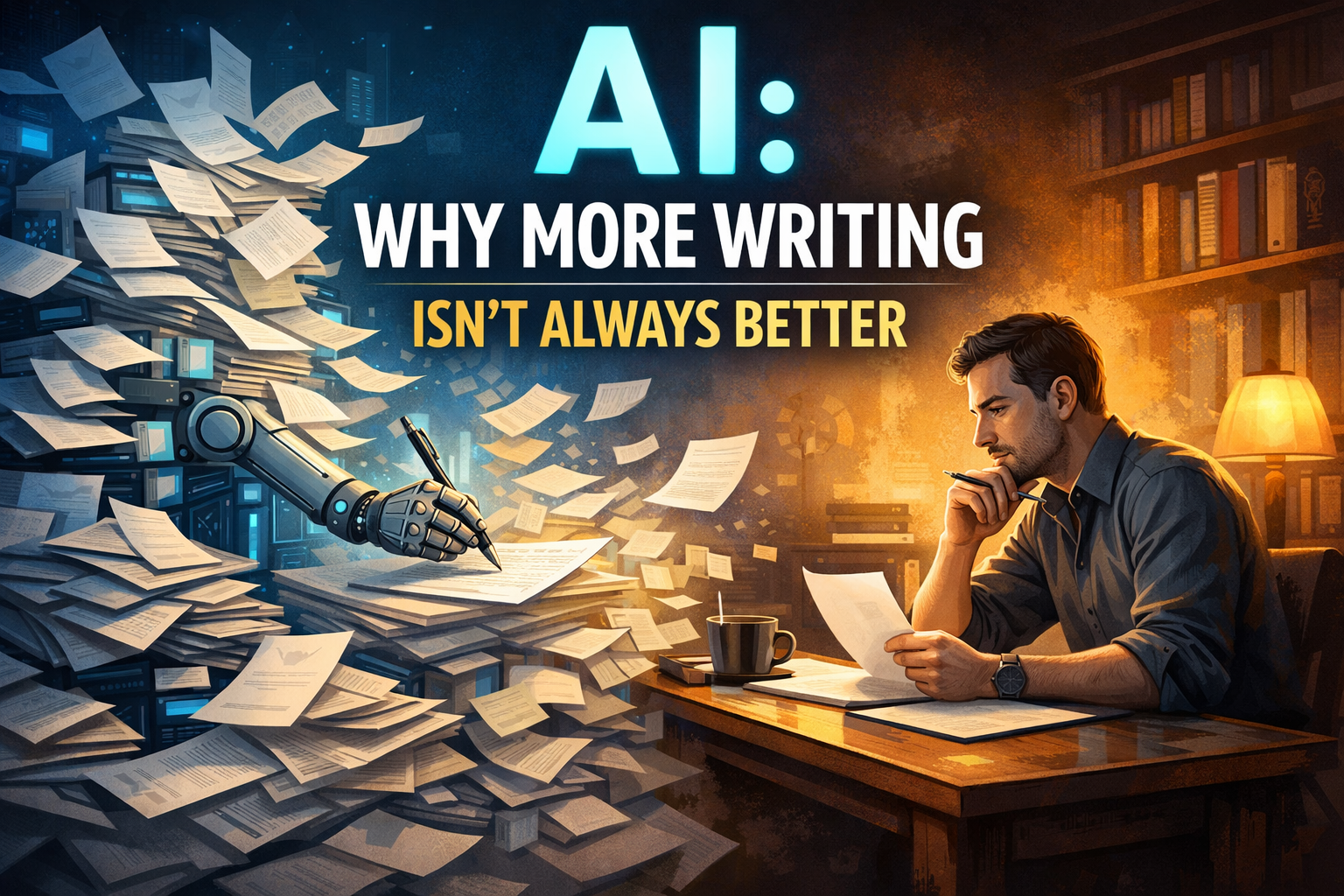
Artificial intelligence has changed the economics of writing. Tasks that once took hours can now be completed in minutes. Entire articles can be drafted, rewritten, and optimized at scale. For bloggers, marketers, and online entrepreneurs, this shift has created an entirely new reality. Content production, once constrained by time and mental energy, can now be industrialized.
At first glance, this seems like a clear advantage. If writing drives traffic, authority, and revenue, then producing more content should logically lead to better results. AI makes that possible. Instead of publishing one article a week, a motivated creator could publish one every day. Some attempt to publish several per day.Yet the ability to produce more writing does not necessarily mean that doing so is the best strategy.
The internet has always rewarded useful information, but it also punishes excess noise. As AI-generated writing becomes more common, the difference between meaningful content and filler becomes more important than ever. Simply flooding a website with articles does not automatically create authority, readership, or revenue.In many cases, it can do the opposite.When creators focus primarily on volume, the quality of ideas often declines. Writing becomes repetitive. Topics become stretched beyond their natural depth. Instead of publishing something valuable, the writer begins publishing content simply because they can.
Readers notice this quickly. People may click on a headline, but if the article feels empty or redundant, they leave. Over time, this erodes trust. A website that publishes ten mediocre posts will rarely outperform a website that publishes one truly insightful one.Search engines have begun to reflect this reality as well. Algorithms increasingly evaluate usefulness rather than simply counting keywords or page count. A smaller site that consistently publishes thoughtful, well-structured content can easily outrank a larger site filled with generic articles.
AI does not change this fundamental rule. It only changes the speed at which content can be produced.This creates an interesting paradox for modern writers. The technology that allows for massive output also makes restraint more valuable. When everyone has access to tools that generate endless content, the real competitive advantage becomes judgment.The most successful creators will not necessarily be the ones who publish the most articles. They will be the ones who publish the most meaningful ones.This is especially important for independent bloggers and entrepreneurs who are building authority in a niche. A reader visiting a site for the first time is not evaluating how many articles exist. They are evaluating whether the ideas are worth their time.A website with twenty thoughtful articles can feel far more authoritative than a website with two hundred shallow ones.
Another hidden danger of unlimited writing is distraction. When content creation becomes effortless, it becomes easy to spend all day producing material instead of thinking about what actually matters. Business strategy, audience understanding, and product development often get pushed aside in favor of producing “just one more post.”The result is activity without progress.
Writing should support a broader objective. It should attract the right audience, communicate useful ideas, and move readers toward a meaningful outcome. When writing becomes an end in itself, the connection between effort and results begins to weaken.
AI should therefore be viewed as a tool for refinement rather than simply amplification. It can help organize thoughts, accelerate drafts, and improve clarity. It can make the writing process more efficient. But the most important step still happens before any words are generated.The writer must decide what is actually worth saying.
This is where human judgment remains irreplaceable. AI can generate text, but it cannot determine which ideas truly matter. It cannot fully understand the context of a specific audience or the long-term direction of a brand. Those decisions still belong to the person using the tool.When used thoughtfully, AI can elevate writing. It can help a blogger produce polished, structured articles more quickly than ever before. It can allow entrepreneurs to communicate their ideas without spending endless hours editing sentences.But when used carelessly, it simply multiplies noise.
The future of online writing will likely reward those who understand this distinction. As the internet becomes saturated with AI-generated material, readers will increasingly gravitate toward clarity, originality, and genuine insight.In other words, the value of writing will not disappear. It will become more concentrated.The creators who succeed will not be those who produce the most words. They will be those who produce the most worthwhile ones.