Posted on

Don’t Be Afraid to Pivot In Your Business

There is a peculiar mythology surrounding entrepreneurship that celebrates the singular vision—the founder who, against all odds and advice, stubbornly clings to an idea until the world finally catches up. We love these stories because they feel heroic, almost romantic. But this narrative obscures a more complex and ultimately more valuable truth: that the most successful entrepreneurs are not those who refuse to bend, but those who recognize when the wind has shifted and adjust their sails accordingly.

The word “pivot” has become something of a cliché in startup circles, often thrown around to describe minor tactical adjustments or desperate attempts to stay afloat. Yet genuine pivoting represents something far more profound. It is the willingness to question your most fundamental assumptions, to acknowledge that the map you have been following does not match the territory you have discovered, and to chart a new course based on what you have learned rather than what you once believed. This requires a particular kind of courage—the courage to admit uncertainty in a culture that demands confidence, to embrace humility when everyone expects bravado.

Consider the early days of any business venture. The entrepreneur begins with a hypothesis: a problem they believe exists, a solution they think will resonate, a market they assume is ready. These are educated guesses at best, informed by experience and research but untested by reality. The moment the business enters the world, it begins generating information that either validates or contradicts these initial assumptions. The critical question is not whether the founder was right from the start—almost no one is—but how they respond when reality diverges from their expectations.

Too many entrepreneurs treat their original vision as sacred, interpreting any evidence of its flaws as temporary obstacles to be overcome rather than signals to be understood. They pour more resources into marketing a product no one wants, convinced that the problem is visibility rather than value. They dismiss customer feedback that contradicts their assumptions, attributing negative responses to the customers’ failure to understand the brilliance of the concept. They watch their runway shrink while insisting that persistence will eventually be rewarded. This is not determination; it is denial, and it has destroyed more promising ventures than any market downturn ever could.The alternative is to approach the business as a continuous experiment, where every customer interaction, every sales conversation, every piece of usage data provides information about what actually works. This mindset transforms the fear of being wrong into the excitement of learning something new. When the data suggests that customers are using your product in ways you did not anticipate, the pivoting entrepreneur sees opportunity rather than confusion. When market feedback indicates that the problem you set out to solve is less urgent than the one customers keep asking you to address, they follow the demand rather than forcing the supply.

History offers countless examples of this principle in action. Twitter began as a podcasting platform called Odeo before its founders recognized that the short messaging feature they had built as a side project held more promise than their original concept. Slack emerged from the internal communication tool built by a gaming company that realized its game was failing but its infrastructure was brilliant. YouTube started as a video dating site before pivoting to general video sharing when the dating angle failed to gain traction. In each case, the founders could have clung to their initial plans, convinced that success was just around the corner if only they pushed harder. Instead, they allowed themselves to be surprised by their own creations and had the flexibility to follow where those surprises led.

The psychological barriers to pivoting are substantial and deserve honest examination. There is the sunk cost fallacy—the irrational weight we give to resources already expended, as if continuing a failing course will somehow justify past investments rather than compound the losses. There is identity attachment, where the founder has so thoroughly conflated themselves with their original idea that changing course feels like a personal failure rather than a strategic evolution. There is the fear of appearing inconstant to investors, employees, and customers, the worry that changing direction signals weakness rather than wisdom. And underlying all of these is the simple discomfort of uncertainty, the human preference for the known path even when it leads nowhere over the unknown terrain that might lead somewhere better.

Overcoming these barriers requires a fundamental reorientation of how we understand entrepreneurial success. The goal is not to prove that your initial insight was correct; it is to build a sustainable, valuable enterprise. The former is about ego, the latter about outcome. When framed this way, pivoting is not an admission of defeat but an assertion of commitment—to the ultimate goal rather than to any particular means of achieving it. The entrepreneur who pivots is not abandoning their mission; they are pursuing it more effectively based on better information.

This does not mean that every challenge should trigger a complete strategic overhaul. There is a difference between productive persistence and destructive stubbornness, and discerning between them is perhaps the most important judgment call a founder must make. The key is to distinguish between obstacles that can be overcome with better execution and fundamental mismatches between your offering and market reality. The former calls for renewed effort; the latter demands honest reassessment. Developing this discernment requires maintaining a certain critical distance from your own plans, regularly asking not “how can I make this work?” but “should this work at all?”

The most effective pivots are often not dramatic reversals but evolutionary adaptations. They preserve the accumulated knowledge, relationships, and capabilities of the business while redirecting them toward more promising opportunities. The technology you built for one purpose finds application in another. The expertise you developed serving one customer segment proves valuable to a different one. The insights you gained about a particular problem illuminate an adjacent space you had not previously considered. In this way, pivoting is less about starting over than about building upon foundations that are stronger than any single idea.Creating an organization capable of pivoting requires intentional cultivation of certain cultural elements. There must be psychological safety for team members to raise concerns and challenge assumptions without fear of retribution. There must be systems for gathering and analyzing feedback that are independent of the founder’s biases. There must be financial discipline that preserves optionality rather than committing all resources to a single trajectory. And perhaps most importantly, there must be a shared understanding that the company’s loyalty is to creating value, not to any particular plan for doing so.

The current business environment, characterized by rapid technological change, shifting consumer preferences, and global uncertainty, makes pivoting capability more essential than ever. The strategies that succeeded yesterday may become obsolete tomorrow. The markets that seemed stable may be disrupted overnight. In this context, the entrepreneur’s greatest asset is not any specific knowledge or capability but the meta-skill of adaptation itself—the capacity to learn quickly, to unlearn when necessary, and to translate that learning into new action.

For those standing at the threshold of a pivoting decision, wrestling with doubt and uncertainty, it may be helpful to remember that every major success story contains chapters that never made it into the press releases. Behind the polished narrative of inevitable triumph lies a messier reality of false starts, course corrections, and moments when the future of the company hung in the balance. The founders we celebrate as visionary were often, in the moment, simply trying to survive, making the best decisions they could with incomplete information, and being willing to change their minds when the evidence demanded it.

The fear of pivoting is ultimately the fear of acknowledging that we do not have all the answers, that our carefully constructed plans are provisional, that the future is genuinely uncertain. This fear is understandable but misplaced. Uncertainty is not a temporary condition to be endured until certainty arrives; it is the permanent context in which all business decisions are made. The entrepreneur who embraces this reality, who treats their business as a hypothesis to be tested rather than a doctrine to be defended, is not weaker than their more stubborn counterparts. They are more aligned with how innovation actually happens, more resilient in the face of inevitable surprises, and more likely to find the path that leads from promising concept to thriving enterprise.

In the end, the measure of an entrepreneur is not the perfection of their initial vision but the wisdom of their evolution. The businesses that shape our world were rarely built in straight lines. They emerged through iteration, through response to feedback, through the willingness to let go of what was not working in pursuit of what might. To pivot is not to fail; it is to refuse to fail by refusing to remain stuck. It is the ultimate expression of entrepreneurial agency—the recognition that while we cannot control what the market will reward, we can control our response to its signals, and in that responsiveness lies our greatest power to create something that matters.


Posted on

It Takes 10,000 Hours

There is a number that has worked its way into our collective understanding of expertise. Ten thousand hours. It arrives in conversation with the weight of scientific authority, cited by coaches and parents and ambitious professionals as the threshold that separates the competent from the masterful. The idea is seductive in its simplicity. Dedicate this specific quantity of time to deliberate practice, and mastery will follow as surely as compound interest accrues in a savings account. The promise is democratic. Anyone can log the hours. Anyone can achieve greatness. But the reality of skill acquisition is more complex than this tidy formula suggests, and understanding its complexity matters for anyone undertaking the long journey toward excellence.

The origin of this particular number lies in research conducted by psychologist Anders Ericsson and popularized by Malcolm Gladwell in his book Outliers. Ericsson studied violinists at a music academy in Berlin and found that the most accomplished performers had accumulated significantly more hours of solitary practice than their less accomplished peers by the age of twenty. The average for the best group was approximately ten thousand hours. Gladwell seized upon this figure, extending it into a broader claim about the nature of success across domains. The number became cultural shorthand for the price of mastery. What began as an observed average in a specific context transformed into a universal prescription.

This transformation involves several distortions worth examining. First, the original research concerned deliberate practice, not mere exposure or repetition. Deliberate practice is a specific activity designed by a teacher or coach to address particular weaknesses, performed with full concentration, and immediately followed by feedback. It is mentally exhausting and emotionally demanding. Ten thousand hours of casual engagement, of going through the motions, of practicing what you already know, does not produce the same results. The quality of the hour matters more than the count. Someone who practices mindlessly for ten thousand hours may simply become very good at their mistakes.

Second, the ten thousand hour figure described an average across a group of already talented individuals at a single institution. It was never intended as a guarantee or a minimum. Some violinists in the study achieved elite performance with fewer hours. Others failed to achieve it despite exceeding the average. The number described a correlation observed in retrospect, not a requirement that could be applied prospectively. Yet in popular discourse, it hardened into a rule. People speak of putting in their ten thousand hours as if expertise were a vending machine that dispenses mastery after sufficient coins have been inserted.

The domain specificity of expertise also complicates any simple hour count. Ten thousand hours accumulated in one field does not transfer wholesale to another. A master chess player does not become a master pianist by logging the same duration of practice. The cognitive and physical demands differ. The patterns to be recognized and the movements to be automated bear no necessary relationship. Even within related fields, transfer is limited. Expertise in contract law does not automatically produce expertise in criminal law, though both fall under the umbrella of legal practice. The ten thousand hour framework, when applied universally, ignores these boundaries. It suggests a fungibility of skill that experience does not support.

Age and developmental timing introduce further variables. The violinists in the original study were young adults who had begun their training in childhood. The brain’s plasticity, the body’s adaptability, the freedom from competing responsibilities all contributed to their capacity to accumulate concentrated practice. An adult beginning a new discipline faces different constraints. Neural pathways are less malleable. Established habits interfere with new patterns. Professional and personal obligations fragment available time. The same number of hours spread across decades of intermittent attention produces different results than the same number concentrated in years of intensive study. The ten thousand hour rule, applied to adult learners without modification, sets expectations that reality may not fulfill.

There is also the question of what mastery actually means. The original research concerned performance that could be evaluated against clear standards. Violinists could be ranked by expert judges. Their technical proficiency could be measured. But many domains lack such consensus. What constitutes mastery in entrepreneurship, in leadership, in creative writing? There is no panel of judges, no standardized repertoire. The goal itself shifts as you approach it. What seemed like mastery from a distance reveals itself as mere competence up close, with new horizons of possibility continually emerging. In these contexts, ten thousand hours may mark not arrival but a particular stage of ongoing development, a point where you finally understand how much remains to learn.

The motivational implications of the ten thousand hour framework deserve scrutiny as well. For some, the number provides a useful benchmark, a way to conceptualize the scale of commitment that excellence requires. It transforms an overwhelming aspiration into a manageable project. Log the hours. Trust the process. Results will follow. But for others, the same number induces paralysis. The distance between current ability and ten thousand hours of practice seems impassable. The requirement feels exclusive rather than democratic, reserved for those with early starts and abundant resources. The framework that promises universal access to mastery can inadvertently discourage those who begin later or progress slower than the average the number describes.

What the research actually supports, beneath the popular simplification, is more modest and more useful. Expertise requires substantial investment of time and effort. There are no shortcuts. The investment must be structured and intentional, not passive. Feedback is essential. Coaching accelerates progress. Individual differences in starting points and learning rates are real and significant. These principles, applied with flexibility rather than rigidity, offer better guidance than any specific hour count.

The deeper truth about mastery is that it resists quantification. It is not a destination reached at a measurable point but a relationship that evolves. The master musician continues to find new dimensions in familiar pieces. The master physician encounters cases that challenge everything they thought they knew. The master craftsperson discovers subtleties in materials they have handled for decades. This ongoing transformation is not captured by accumulation of hours. It is captured by the quality of attention brought to those hours, the openness to being changed by the practice itself.

So the appropriate response to the ten thousand hour concept is neither rejection nor reverence but translation. Understand it as a heuristic rather than a law. A reminder that expertise is expensive, that it requires sacrifice of other possibilities, that it cannot be rushed. But also recognize its limitations. Your particular path may require more or less time. Your definition of mastery may differ from those who established the benchmarks. Your circumstances may demand adaptations that the research did not anticipate.The question is not whether you have logged sufficient hours on some universal ledger. The question is whether you are practicing in ways that challenge you, whether you are seeking feedback that stings, whether you are remaining in the difficult space between what you can currently do and what you aspire to do. The count will take care of itself if these conditions are met. And if they are not met, no accumulation of time will compensate.

Mastery, in the end, is not a prize awarded for endurance. It is a way of being in relationship with a discipline, characterized by deepening sensitivity and expanding capability. The ten thousand hours, properly understood, are not the cause of this relationship but one of its possible symptoms. The symptom is easier to measure than the condition, which explains its cultural prominence. But the wise practitioner attends to the condition. They practice not to accumulate hours but to transform themselves. They trust that sufficient investment, properly directed, will produce results without needing to predict exactly when or what form those results will take.

The journey toward expertise is longer than we wish and more unpredictable than we hope. The ten thousand hour framework offers an illusion of predictability that can comfort or confound depending on temperament. Better to release the fixation on number and embrace the reality of process. Show up. Pay attention. Do the work. Let the hours accumulate without making them the point. Mastery, if it comes, will arrive not as a certificate of completion but as a changed way of seeing and being, recognizable only in retrospect, earned through engagement that was its own reward.

Posted on

Networking Always Has Value

We live in an age that worships individual mastery. The lone genius working in isolation, the self-taught programmer who builds something extraordinary, the entrepreneur who trusts only their own instincts. These narratives captivate us because they simplify success into a story of personal will. But they obscure something fundamental. Most of what we know, we learned from other people. Not from books or courses or solitary contemplation, though these have their place. From conversation. From the casual exchange that sparks a new direction. From the question we never thought to ask until someone else asked it first. Networking, stripped of its transactional reputation, is simply the practice of remaining open to these moments of unexpected learning.

The knowledge we need most is rarely the knowledge we know we lack. We search for answers to questions we can articulate, but our greatest blind spots are invisible to us. They are the assumptions we have never examined, the approaches we have never considered, the possibilities we have filtered out without realizing. A network functions as a mirror held at different angles, reflecting back aspects of our situation that we cannot see from our single perspective. Someone in a different industry faces analogous challenges with entirely different tools. Someone at a different career stage has either forgotten constraints we accept as permanent or has not yet learned limitations we treat as inevitable. These differences are not obstacles to overcome in pursuit of common ground. They are the very source of value. Learning happens at the edges where perspectives collide.

There is a particular quality to knowledge gained through personal connection that distinguishes it from other forms of education. When you read a book, you receive information shaped by the author’s intention, organized for a general audience, stripped of context that might help you apply it. When you learn from a person, you receive information shaped by your specific question, adapted to your circumstance, enriched by the speaker’s immediate sense of what you need to understand. You can interrupt. You can push back. You can ask the follow-up question that reveals the gap between theory and practice. This interactivity makes networked learning efficient in ways that self-study rarely achieves. A twenty-minute conversation can correct months of misdirected effort, simply because someone who has walked the path before can warn you about the turn you are about to miss.

The resistance many feel toward networking stems from a misunderstanding of what it requires. We imagine forced attendance at industry events, the awkward exchange of business cards, the calculation of what we might extract from each encounter. This is not networking. This is performance, and it is exhausting because it is fundamentally inauthentic. Genuine networking is simply curiosity about other people and willingness to be known by them. It is the question asked not to advance an agenda but because the answer genuinely interests you. It is the story shared not to impress but to illuminate. When approached this way, networking does not deplete energy. It generates it. Conversation becomes exploration rather than transaction. Connection becomes discovery rather than obligation.

The learning that happens through networks operates on multiple timescales simultaneously. There is the immediate insight, the answer to a specific problem that you carry back to your work the same day. There is the gradual education that happens as you absorb how different people approach similar challenges, building a mental library of strategies you can deploy when your own circumstances shift. And there is the delayed revelation, the connection that seems incidental at the time but proves crucial years later when your path unexpectedly converges with theirs. Networks are not maps of current utility. They are reservoirs of potential relevance. The person you meet today whose work seems unrelated to yours may hold the key to a door you do not yet know you will need to open.

What makes networked learning particularly valuable in the current environment is the acceleration of change across every field. The half-life of technical knowledge grows shorter. The skills that ensured success five years ago may be obsolete or automated in five more. In this context, the ability to learn continuously matters more than any particular thing you have learned. And the fastest way to learn is to surround yourself with people who are learning different things. A network becomes a distributed intelligence, a way of processing more information than any individual could manage alone. Each person you know well becomes a filter for their domain, alerting you to what matters and sparing you what does not. This is not outsourcing your judgment. It is expanding your inputs so that your judgment can operate on better information.

There is also something irreplaceable about learning through relationship that concerns not facts but sensibility. How to handle a difficult negotiation. How to know when persistence becomes stubbornness. How to balance ambition with contentment. These are not subjects that yield to formal instruction. They are transmitted through example, through the observation of how someone you respect navigates their own challenges. A network of diverse practitioners becomes a living curriculum in judgment, offering models of how to be in the world that you can adapt rather than adopt. You learn not just what to do but how to think about what you are doing. This formation of sensibility may be the deepest educational function of professional relationships.The cultivation of a learning network requires certain disciplines that are easy to neglect. It requires showing up, physically or virtually, in spaces where you are not already expert, where you will be the least knowledgeable person in the room. This vulnerability is the price of admission. It requires maintenance, the regular reconnection with people not because you need something but because the relationship itself has value. Networks decay without attention, and the cost of rebuilding is far higher than the cost of sustaining. It requires generosity, the willingness to share what you know without immediate expectation of return. Reciprocity in networks operates over long horizons, and those who calculate too precisely find themselves excluded from the flow of information that sustains the community.

Perhaps most importantly, effective networking for learning requires the courage to admit ignorance. To ask basic questions. To confess that you do not understand something others seem to take for granted. This is difficult because it contradicts the image we wish to project of competence and readiness. But it is essential because ignorance is the precondition of learning, and concealment of ignorance is the barrier. The people most worth knowing are rarely impressed by the pretense of knowledge. They are impressed by the genuine desire to understand. Your questions signal your interests more clearly than your statements ever could. They invite others to share what they know best, which is the foundation of meaningful connection.

The ultimate value of a network is not measured in opportunities accessed or deals completed, though these may follow. It is measured in the quality of your understanding, the breadth of your vision, the sophistication of your judgment. A well-developed network makes you smarter than you could be alone, not by flattering your existing views but by complicating them. It introduces productive friction into your thinking, forces you to account for perspectives you would prefer to ignore, demands that you defend or revise your assumptions. This is uncomfortable. It is also growth. The person who emerges from years of genuine engagement with diverse others is not the same person who entered. They have been educated by encounter, transformed by the accumulation of small revelations that no single source could have provided.

In the end, networking is not a separate activity to be scheduled alongside your real work. It is integral to the work itself, the medium through which you remain current, the method by which you test and refine your ideas. To neglect it is to accept intellectual isolation, to trust only what you can discover independently, to limit your development to the pace of your solitary exploration. To embrace it is to participate in a collective intelligence larger than any individual contribution, to accept that your growth depends partly on the generosity of others and partly on your willingness to be generous in return. The conversation continues whether you join it or not. The question is whether you will be present to learn what it has to teach.

Posted on

Entrepreneurship Is About Having Courage

There is a persistent myth that business success belongs to the brilliant, the connected, or the lucky. We imagine entrepreneurs who possess some secret knowledge, some innate advantage that separates them from the rest of us. But spend any real time in the trenches of building something—anything—and you discover a humbler, harder truth. The single greatest determinant of success is not intelligence. It is not capital. It is not timing, though these things matter. The key is bravery. The willingness to continue when every signal suggests you should stop.

Bravery in business does not look like the movies. It is rarely dramatic. There are no slow-motion montages of decisive moments, no swelling orchestral scores when you sign a contract or launch a product. Real courage is far more mundane and far more grueling. It is the courage to wake up again after a night of no sleep, to face another day of problems that yesterday seemed insurmountable. It is the courage to have the difficult conversation you have been avoiding, to admit you were wrong about a strategy you championed, to ask for help when your pride demands silence. This is the texture of entrepreneurial life. Not heroism, but endurance. Not genius, but grit.

The early stages of any venture are particularly cruel in this regard. You have left behind the security of employment, the clarity of a defined role, the comfort of knowing what each day will demand. In its place, you have uncertainty stacked upon uncertainty. Will customers come? Will the product work? Will the money last? These are not questions you answer once and move on from. They are questions you face every morning, and the answers change constantly. The market shifts. A competitor emerges. A key team member leaves. The courage required is not the courage to make one bold decision. It is the courage to make thousands of small decisions, day after day, without the assurance that any of them are correct.

What makes this courage so difficult is that it must be sustained in the absence of feedback. We are trained by school and by early employment to expect immediate results. Study hard, get a good grade. Work efficiently, receive praise. Business offers no such contract. You can work harder than you ever have and see no visible progress for months. You can make the right strategic choice and watch it fail because of factors entirely outside your control. The silence of the market is deafening. The temptation in these moments is to interpret the lack of response as judgment. To believe that because no one is buying, no one will ever buy. That because an investor said no, all investors will say no. That because you feel exhausted, you must be failing. Bravery is the refusal to accept these interpretations. It is the discipline to continue acting in the face of ambiguous evidence.

There is a particular kind of courage required to persist through the middle period of building something, after the initial excitement has faded but before real traction has arrived. This is the most dangerous time. The beginning carries natural energy. The end, if you reach it, carries the validation of success. But the middle is a desert. The problems are no longer novel, so they do not stimulate. They are simply hard, and they repeat. The financial pressure has mounted but not yet broken. The vision that once felt inspiring now feels like a burden, a promise you are struggling to fulfill. Many quit here, not because the venture was impossible, but because they mistook the difficulty of the middle for evidence of failure. The brave recognize this phase for what it is. A test of commitment rather than capability. They continue not because they are certain of victory, but because they understand that certainty is not a prerequisite for action.

The courage to continue also requires the courage to change. This is where the concept of bravery becomes subtle. Persistence is not stubbornness. The entrepreneur who refuses to adapt, who clings to a failing model out of pride or fear, is not brave but trapped. True courage includes the willingness to question your own assumptions, to kill projects you have poured yourself into, to pivot when the evidence demands it. This is harder than simple persistence because it requires admitting fallibility. It demands that you separate your identity from your current strategy, that you hold your plans lightly enough to release them when necessary. The brave entrepreneur is not the one who never doubts, but the one who doubts and continues anyway. Who holds the possibility of failure in one hand and the necessity of action in the other, and chooses to move forward.

We should also speak of the courage that business requires in human relationships. Building something inevitably involves other people. Co-founders whose visions diverge. Employees whose lives depend on decisions you make. Customers whose trust you must earn and keep. Investors whose money carries expectations. Navigating these relationships demands a constant bravery. The courage to be transparent about difficulties when concealment feels safer. The courage to deliver bad news promptly rather than delaying and hoping conditions improve. The courage to fire someone who is not working out, knowing the conversation will be painful. The courage to receive criticism without collapsing into defensiveness. Business is fundamentally a social endeavor, and the social dimension requires as much bravery as the strategic or financial ones.

Perhaps the deepest form of courage is the courage to maintain your own standards in an environment that constantly pressures you to compromise them. The market rewards speed, and speed can tempt you to cut corners on quality. Competition drives down prices, and low prices can tempt you to squeeze suppliers or staff. Growth demands capital, and capital can tempt you to accept investment from sources whose values conflict with your own. Each of these pressures is real. Each has destroyed businesses that refused to adapt, and corrupted businesses that adapted too readily. The brave path is neither rigid nor spineless. It is the path of conscious choice, of knowing what you will not do even when doing it would be easier, and of being willing to pay the price for that choice.

The final element of bravery is the courage to begin again. Most entrepreneurs, if they stay in the game long enough, will experience genuine failure. Not the romanticized failure that Silicon Valley celebrates, but the real kind. The kind that costs money you cannot afford to lose, damages relationships you valued, and leaves you questioning your judgment and your worth. The courage to continue in business often means the courage to start over after such an experience. To analyze what happened without being paralyzed by it. To carry the lessons forward without being defined by the loss. This is perhaps the rarest courage of all, because it must be summoned when you have already proven that courage is not sufficient guarantee of success. When you know, from experience, how much continuing can cost.

Yet this is where the argument for bravery as the key to business becomes most convincing. Because if courage does not guarantee success, its absence virtually guarantees failure. The brilliant strategy that is never executed because of fear. The perfect market timing that is missed because of hesitation. The talented team that never forms because no one was willing to make the first approach. These are the real casualties of business, far more common than ventures that tried and failed. The market does not primarily test intelligence or resources. It tests the capacity to act repeatedly in conditions of uncertainty. It tests the willingness to continue.

So the advice for anyone considering a business venture, or currently inside one, is simpler than the complexity of the task would suggest. Do not wait for confidence. Confidence is a byproduct of action, not a prerequisite for it. Do not wait for certainty. Certainty is a luxury that rarely arrives in time to be useful. Instead, cultivate the habit of continuing. Of showing up each day and doing what the situation demands, regardless of how you feel about your chances. This is bravery made practical. Not the elimination of fear, but the decision that fear will not determine your behavior.

The businesses that endure, that create real value and outlast their competitors, are rarely those that made perfect decisions from the start. They are the ones that made enough good decisions, corrected enough bad ones, and simply remained in operation while others fell away. Survival is underrated as a strategy. The courage to continue is underrated as a virtue. But in the end, business rewards those who stay in the room when others have left. Who continue the conversation when it becomes difficult. Who keep building when the applause has stopped and only the work remains.

This is the bravery that matters. Not the dramatic gesture, but the daily choice. Not the absence of doubt, but the persistence through it. The key to business is not having the best idea. It is having the courage to find out what your idea actually requires, and to supply that requirement for as long as it takes.

Posted on

Stop Counting Visitors, Start Counting Value: Why Lead Generation is Your Website’s Superpower

If you have a website, you’ve likely celebrated a high-traffic day. Maybe you hit a record number of visitors last month. It feels good to see those numbers climb on your analytics dashboard. But here is a tough question for you: How many of those visitors actually turned into customers? If the answer is “not many,” you aren’t alone. Many website owners fall into the trap of “vanity metrics”—focusing on views rather than value. Traffic is great, but without lead generation, your website is just a digital brochure. It looks nice, but it isn’t working for you. To turn your website from a passive asset into an active revenue driver, you need to understand the art and science of lead generation.

What is Lead Generation, Really?

In simple terms, lead generation is the process of attracting strangers to your website and converting them into someone who has shown interest in your product or service. Usually, this happens when a visitor trusts you enough to give you their contact information—whether that’s an email address, a phone number, or a social media connection. It’s the bridge between “just looking” and “ready to buy.”

Why Lead Generation is Crucial for Website Owners

If you aren’t prioritizing lead generation, here is why you need to start today. Firstly, you own the relationship. Relying on walk-ins or social media algorithms is risky. If Instagram goes down or Facebook changes its algorithm, your reach disappears overnight. However, when you generate a lead via your website, you capture an email address or a phone number, giving you direct access to that person. You aren’t renting an audience; you own the means to contact them again.

Furthermore, it is vital to recognize that most people aren’t ready to buy right now. Did you know that only about 3% of your website traffic is ready to make a purchase immediately? The other 97% are in research mode, browsing, comparing, and learning. Lead generation allows you to capture that 97%. By offering a discount code in exchange for an email, a free PDF guide, or a consultation booking, you can stay top-of-mind. When they are ready to buy, they will come back to you instead of your competitor.

Additionally, lead generation builds trust and authority. When someone gives you their email address, they are giving you a small piece of their privacy, which is a psychological commitment. By providing valuable content in exchange, such as a newsletter or an ebook, you begin a relationship built on value. Over time, this turns a cold lead into a warm prospect who sees you as an authority in your field. Finally, it provides a huge return on investment. Paid advertising is expensive; you pay for every click, and once the visitor leaves your site, they are often gone forever. Lead generation makes your marketing spend efficient because you capture the visitor data. Even if they leave your site today, you can market to them for free tomorrow via email, making it the most cost-effective way to maximize your budget.

How to Get Started with Lead Generation

You don’t need a massive budget to start generating leads; you simply need to give your visitors a reason to stick around. Start by creating a “lead magnet,” which is an incentive you offer to potential buyers in exchange for their email address. This could be a checklist, a discount code, a free chapter of your book, or a webinar. You should also use clear calls-to-action. Don’t assume your visitors know what to do; tell them with buttons and banners that say things like “Get My Free Guide” or “Book a Free Consultation.” Lastly, optimize your forms by not asking for too much information right away. The more fields you have in your form, the fewer people will fill it out, so it is best to start with just a name and email address.

Your website is the hardest-working employee in your business. It never sleeps. But if it isn’t generating leads, it’s leaving money on the table 24 hours a day. Stop measuring success by how many people pass through your digital front door. Start measuring how many are willing to sit down and have a conversation. Focus on lead generation, and you turn anonymous traffic into a loyal community—and a thriving business.

Posted on

Why Entrepreneurship Is Easier With a Mentor

Entrepreneurship is often portrayed as a solo journey. The lone founder working late nights, figuring everything out through trial and error, building something from nothing through sheer willpower. While independence and resilience are important traits, the reality is that entrepreneurship becomes significantly easier when you have a mentor.

Starting and growing a business requires constant decision-making. Pricing, positioning, hiring, marketing, partnerships, cash flow, product development, and customer service all compete for attention. Every decision carries consequences. Without experience, it is easy to waste time solving problems that someone else has already solved. A mentor shortens that learning curve.

Experience is the primary reason mentorship matters. A good mentor has already navigated many of the challenges you are facing. They have made mistakes, absorbed losses, and adjusted their strategy accordingly. Instead of discovering every lesson the hard way, you benefit from their hindsight. What might take you years to understand can sometimes be clarified in a single conversation.

Mentorship also reduces emotional volatility. Entrepreneurship is not just a strategic challenge. It is a psychological one. Revenue fluctuations, client issues, uncertainty, and comparison to competitors can create doubt. When you are alone, small setbacks can feel overwhelming. A mentor provides perspective. They remind you which problems are normal and temporary, and which ones actually require action. That emotional stability allows you to make better decisions.

Clarity is another advantage. New entrepreneurs often chase too many ideas at once. They experiment constantly but struggle to focus. A mentor can help you identify what truly matters. They ask better questions. They challenge assumptions. They redirect energy toward activities that generate real results. This clarity prevents burnout and improves momentum.

Networking becomes easier as well. Established mentors often have relationships, partnerships, and industry insight that would take years to build independently. Even if they do not directly introduce you to opportunities, they can guide you toward the right rooms, communities, or conversations. Entrepreneurship thrives on proximity to experience and influence.

Accountability plays a powerful role. When you are building alone, it is easy to delay difficult tasks. A mentor creates subtle pressure to execute. Knowing that someone will ask about your progress encourages follow-through. This structure increases discipline without removing autonomy.

Mentorship does not eliminate failure. It does not guarantee success. What it does is reduce unnecessary mistakes and accelerate growth. Instead of stumbling in the dark, you move forward with informed guidance. The path is still yours to walk, but the direction becomes clearer.Importantly, mentorship does not mean dependency. A strong mentor does not make decisions for you. They help you sharpen your own thinking. Over time, you become more confident and capable. The goal is not to rely on them forever but to grow faster because of their insight.

Entrepreneurship will always require courage, adaptability, and persistence. Those qualities cannot be outsourced. But the journey does not need to be isolating. With the right mentor, challenges feel more manageable, decisions feel more grounded, and progress feels more deliberate. Instead of learning everything the hard way, you build with guidance, perspective, and a clearer vision of what is possible.

Posted on

The Real Key to Blogging: Finding the Most Valuable Visitors

Most people approach blogging with the same goal: get more traffic. They chase page views, obsess over impressions, and measure success by how many visitors land on their site each month. But traffic alone is not the point. The real key to blogging is not attracting the most visitors. It is attracting the most valuable visitors.

A valuable visitor is someone whose problems, goals, and purchasing power align directly with what you offer. They are not casually browsing. They are looking for answers, solutions, and guidance. They are closer to making decisions. When these people find your content, your blog stops being a hobby and starts becoming an asset.

High traffic with low relevance rarely converts into meaningful results. You can write broad, trending articles that pull in thousands of readers from around the world, but if those readers have no intention or ability to buy from you, the numbers become vanity metrics. They may boost your analytics dashboard, but they will not grow your business.

When you focus on valuable visitors, everything changes. Your topics become sharper. Your language becomes more specific. Your examples become more practical. Instead of writing for everyone, you write for a clearly defined audience with a clearly defined need. That clarity makes your content more persuasive and more useful.

Consider the difference between writing about “how to save money” and writing about “tax strategies for high-income real estate investors in California.” The first topic may attract a wide audience. The second will attract fewer people, but those people are far more likely to require specialized services. In many cases, one highly aligned reader is worth more than a thousand random ones.

Finding valuable visitors begins with understanding who you actually want to serve. What industries do you work best with. What income levels or business stages make the most sense for your services. What problems do these people urgently want solved. Once you answer these questions, your blog becomes a magnet for the right audience instead of a net cast into the ocean.

Search intent plays a critical role in this process. When someone types a detailed, specific question into a search engine, they reveal what they care about. By creating content that directly answers those high-intent questions, you position yourself in front of readers who are already thinking about action. This is far more powerful than writing generic thought pieces that attract passive interest.

The financial impact of valuable visitors is dramatic. A blog that attracts ten thousand casual readers per month might generate little to no revenue. A blog that attracts two hundred highly targeted readers could generate significant income if those readers represent ideal clients. The difference lies in alignment, not volume.This approach also changes how you measure success. Instead of focusing only on traffic numbers, you begin to track inquiries, consultations, qualified leads, and conversions. You care less about how many people visited and more about who visited. Over time, your content library becomes a collection of targeted entry points that guide the right people toward your services.

Blogging is not about shouting into the void. It is about building authority in a specific space. When the right readers consistently find your insights helpful, trust grows. When trust grows, business follows. The compounding effect of attracting valuable visitors month after month is far more powerful than temporary spikes in attention.

In the end, blogging is a strategic tool. If your goal is influence, revenue, or client acquisition, then relevance matters more than reach. The most successful blogs are not the ones with the biggest audiences. They are the ones with the most aligned audiences. When you focus on attracting the most valuable visitors, your blog stops being content for its own sake and becomes a growth engine for your business.

Posted on

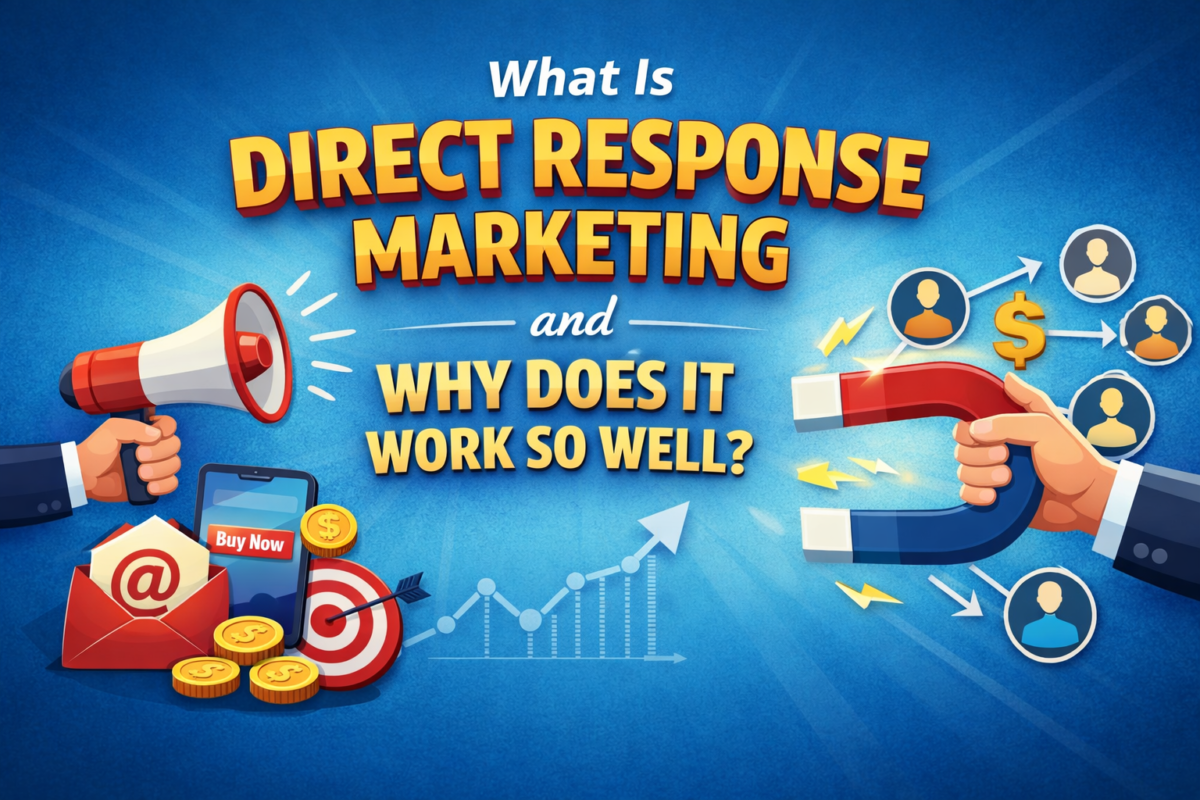
What Is Direct Response Marketing and Why Does It Work So Well

Most marketing is an act of faith. A company buys a billboard, runs a television commercial, sponsors a podcast, or plasters their logo on the side of a stadium and hopes that somewhere down the line, some portion of the people who saw it will eventually become customers. There is no way to know which exposure led to which sale, no mechanism for measuring what worked and what did not, and no direct line between the money spent and the revenue generated. This kind of marketing is called brand advertising, and for large companies with enormous budgets and the patience to play a very long game, it can be justified.

For everyone else, there is direct response marketing — and it operates on an entirely different philosophy.

The Core Idea

Direct response marketing is any form of marketing designed to elicit an immediate, measurable action from a specific audience. The name says exactly what it is. You send a message. You want a direct response. You measure whether you got one.That response might be a phone call, a form submission, a click, a purchase, a reply to an email, or a visit to a specific page. The exact action varies depending on the campaign and the business. What does not vary is the requirement that the marketing piece itself contains a clear call to action, targets a defined audience, and produces results that can be tracked, measured, and evaluated against the cost of generating them.This is the fundamental distinction between direct response marketing and brand advertising. Brand advertising asks you to remember a name. Direct response marketing asks you to do something right now — and it knows whether you did.

Where It Came From

Direct response marketing did not begin on the internet. Its roots go back well over a century, to the era when mail order catalogs were the dominant form of commerce for rural Americans who could not easily reach a city. Entrepreneurs like Richard Sears understood early that a well-written letter sent to a targeted mailing list, with a specific offer and a clear mechanism for responding, could generate predictable revenue in a way that general awareness advertising could not.Claude Hopkins, one of the founding figures of modern advertising and the author of the 1923 classic Scientific Advertising, articulated the philosophy that would define direct response for generations to come. He believed that advertising should be judged by the sales it produced, not by the attention it attracted. He tested headlines, offers, and copy relentlessly, keeping what worked and discarding what did not. He insisted on measurability at a time when most of his contemporaries were satisfied with vague notions of brand prestige.

David Ogilvy, who built one of the most celebrated advertising agencies of the twentieth century, described direct response as his secret weapon and the discipline that had taught him more about what actually works in marketing than any other. Gary Halbert, Dan Kennedy, and a generation of direct mail copywriters built entire careers — and made fortunes for their clients — by applying the same principles Hopkins had articulated decades earlier.The internet did not invent direct response marketing. It simply gave it new channels and made its defining feature — measurability — more precise and immediate than ever before.

What Makes a Direct Response Campaign

Every effective direct response marketing piece shares a set of structural characteristics that distinguish it from general awareness advertising.It speaks to a specific person with a specific problem. Rather than broadcasting a message to the widest possible audience and hoping some percentage of them are relevant, direct response begins by defining precisely who the ideal respondent is and crafting a message designed to resonate with that person in particular. The more specifically a piece of marketing can describe the reader’s situation — their frustrations, their goals, their fears, the exact problem they are trying to solve — the more powerfully it tends to perform.

It makes a clear and compelling offer. Direct response does not invite vague interest. It presents something specific — a product, a service, a free consultation, a downloadable resource, a discount — and explains in concrete terms what the reader will get, why it is valuable, and what it will cost them. Ambiguity is the enemy of response. The reader should never finish a direct response piece uncertain about what they are being asked to do or why they should do it.It creates urgency. Human beings are inclined toward inaction. Given the option to decide later, most people will choose later, and later has a way of becoming never. Effective direct response marketing gives the reader a reason to act now rather than setting the piece aside and forgetting about it. A deadline, a limited quantity, a price that increases, or a bonus available only to early responders all serve this function.

It includes a specific call to action. Not a general suggestion to get in touch sometime, but an explicit instruction: call this number, visit this page, reply to this email, scan this code. The call to action removes any ambiguity about what the next step is and makes taking it as frictionless as possible.

And critically, it is measurable. Every direct response campaign is designed from the beginning with measurement in mind. Different headlines are tested against each other. Different offers are compared. Different audiences are evaluated. The question at the center of every direct response campaign is not “did people see this?” but “did people respond to this, and was the cost of generating that response justified by the value it produced?”

Why It Matters for Small and Mid-Sized Businesses

For businesses without the budget to saturate a market with brand advertising and wait years for it to produce returns, direct response marketing is not just a useful tool — it is the only rational approach. It produces results that can be measured within days or weeks rather than years. It allows a business to test a message with a small investment before scaling it up. It creates accountability for every marketing dollar spent, because every dollar can be traced to a specific campaign with a specific outcome.

A law firm that runs a direct response campaign — targeting a specific type of client, with a specific offer and a specific call to action — knows within a defined period whether the campaign generated inquiries, how many of those inquiries converted to clients, and what the average revenue from those clients was relative to the cost of the campaign. That information is enormously valuable. It allows the firm to make informed decisions about where to invest their marketing budget going forward, doubling down on what works and eliminating what does not.

This is in sharp contrast to the firm that sponsors a local event, takes out a full-page ad in a regional magazine, and has no meaningful way to determine whether either investment produced a single new client.

Direct Response in the Digital Age

Email marketing is direct response. A well-constructed email campaign targets a specific audience, makes a specific offer, includes a specific call to action, and can measure open rates, click rates, and conversion rates with precision. Search advertising is direct response. An ad that appears when someone types a specific phrase into Google, takes them to a page designed to convert their interest into an inquiry, and tracks exactly how many of those inquiries resulted in sales is direct response marketing in its purest digital form.

Social media advertising, when done with direct response principles in mind — a targeted audience, a specific offer, a clear call to action, rigorous tracking — is direct response. Even content marketing, when built around capturing leads and moving them through a defined sequence toward a specific action, borrows heavily from direct response thinking.

The channels have multiplied. The principles have not changed at all.

What makes direct response marketing valuable is not any single tactic or channel. It is the underlying discipline of treating marketing as an investment that should produce a measurable return rather than an expense whose value is taken on faith. It is the commitment to testing and learning rather than assuming. It is the insistence on clarity — a clear audience, a clear offer, a clear call to action, a clear measure of success.These disciplines make marketers better regardless of which channel they are using. A professional who understands direct response thinks differently about every piece of communication they produce — every email, every webpage, every social media post, every advertisement. They ask not just whether the message sounds good but whether it is designed to produce a specific result, and whether they will know if it did.

That shift in thinking is worth more than any individual campaign, and it is available to any business willing to adopt it.

Posted on

Any Professional Can Sell Their Services Online

There is a persistent belief among skilled professionals that selling services online is something other people do. Younger people, maybe. Tech-savvy people. People whose work happens to translate naturally to a screen. The attorney who has built a practice through decades of handshakes and referrals, the accountant whose clients have always walked through a physical door, the consultant whose best business came from a chance conversation at a conference — these professionals often look at the internet as a foreign territory with its own rules, its own culture, and its own gatekeepers, and conclude that it is simply not for them.This belief is costing them an enormous amount of money and opportunity, and it is wrong.

The Internet Is Not a Different World

The fundamental dynamics of professional services have not changed because of the internet. Clients still hire people they trust. They still want evidence of expertise before they commit. They still make decisions based on reputation, referrals, and the sense that a particular professional understands their specific situation. The internet did not replace any of these dynamics. It simply created new ways to establish them — ways that are faster, broader, and available to anyone willing to use them.

A potential client who finds a lawyer’s website and spends twenty minutes reading detailed, clearly written articles about estate planning is going through exactly the same trust-building process as someone who was referred by a friend and sat across from that lawyer at a lunch meeting. The medium is different. The psychology is identical. By the time they pick up the phone or fill out a contact form, they have already made a provisional decision that this person knows what they are doing. The internet just let that process happen at scale, without the lawyer having to be present for every moment of it.

Credentials Are Not the Barrier

One of the most common objections professionals raise when the topic of selling online comes up is that their work requires credentials, licensing, or jurisdictional constraints that make internet-based client acquisition complicated. A CPA can only practice in states where they are licensed. An attorney cannot represent clients in courts where they are not admitted to the bar. A therapist must comply with telehealth regulations that vary by state.These are real constraints, but they are not the barriers they appear to be. Plenty of professional services can be delivered remotely within existing regulatory frameworks. Plenty of advisory, consulting, and educational work sits outside the most restrictive licensing requirements entirely. And even for professionals whose hands-on work is genuinely location-specific, the internet can still function as the most powerful client acquisition tool they have — attracting local clients through search, content, and online reputation rather than cold calls and networking events.

A dentist cannot fill a cavity over Zoom. But a dentist who has a website full of genuinely useful content about oral health, who has accumulated dozens of five-star Google reviews, and who shows up at the top of local search results when someone types “dentist near me” is absolutely selling their services online — they are just delivering them in person. The distinction matters.

What Selling Online Actually Requires

It does not require a personal brand with hundreds of thousands of followers. It does not require a podcast, a YouTube channel, a viral social media presence, or any of the other high-visibility content strategies that tend to dominate the conversation about building a business online. Those things can accelerate results, but they are far from the only path.

At its most basic level, selling professional services online requires three things. A clear, professional web presence that communicates who you serve and what you do for them. A way for interested prospects to find that presence, whether through search, social media, referrals, or paid advertising. And a mechanism for converting that interest into a conversation — a contact form, a scheduling link, a phone number, something that makes it easy for the right person to take the next step.That is the whole architecture. Everything else is refinement and amplification of those three elements.

The Professionals Already Doing This Quietly

Across every licensed and credentialed profession, there are practitioners quietly building client bases online that their peers in the same field have no idea exist. Accountants who serve clients in multiple states entirely remotely and have never met most of them in person. Financial advisors who built their practice through a newsletter that grew over several years into a list of thousands of engaged, high-net-worth readers. Attorneys who publish detailed guides about specific legal issues and receive inbound inquiries from prospective clients who found them through a Google search and already trust them before the first call.

These professionals are not unusually technical. They are not especially young or digitally native. They simply decided that the internet was a legitimate place to build a professional practice and acted accordingly. The gap between them and their peers who are still relying entirely on traditional business development methods is growing every year, and it is not primarily a gap in skill — it is a gap in belief.

The Leverage That Did Not Exist Before

What the internet offers professionals that no previous era of business development could match is leverage. A referral from a satisfied client reaches one person, maybe two. An article that ranks well in search results reaches a hundred people a month, then a thousand, then more — and it keeps working without any additional effort. A well-maintained LinkedIn profile is visible to every potential client or referral partner who searches your name, indefinitely, at no cost. A single well-produced explanatory video can answer the same question for ten thousand prospective clients over the course of several years.This is qualitatively different from anything professionals could do before. The ability to build trust and demonstrate expertise at scale — without being physically present, without hiring a sales team, without a large marketing budget — is genuinely new, and most of the professions that could benefit most from it have been slowest to take advantage of it.

The Longer You Wait, the More Ground You Cede

Every profession is experiencing some version of the same shift. The professionals who establish a strong online presence in their niche today are building an asset that compounds. Their content accumulates. Their search rankings improve with age and consistency. Their reputation online grows more established and harder for a newcomer to displace. The professional who starts this process in five years will face a significantly harder competitive environment than the one who starts today.

This is not a reason to panic. It is a reason to begin. The barrier to entry for selling professional services online has never been lower, the tools have never been more accessible, and the upside for a skilled professional who commits to building a digital presence has never been clearer.The question is not whether the internet is a viable place to build a professional practice. Thousands of professionals in every field have already answered that question. The only question left is whether you intend to be one of them.

Posted on

Go Where the Money Is

There is a piece of advice so simple it sounds almost insulting when you first hear it, yet it is consistently ignored. If you want to make money, go where the money is.

That is it. That is the whole idea. And yet the vast majority of people building businesses, choosing careers, or trying to generate income online do the opposite. They go where they are comfortable. They go where their friends are. They go where the content they consume points them. They go where the dream looks prettiest. And then they wonder why the income never matches the effort.

The Invisible Filter Most People Never Apply

When most people decide what kind of work to pursue, they ask themselves a set of reasonable-sounding questions. What am I good at? What do I enjoy? What feels manageable given my current skills and situation? These are not bad questions. But they are missing the most important one, which is: who has money, needs help, and is willing to pay for it?

That question cuts through an enormous amount of noise. It eliminates the romanticized paths that feel compelling from the outside but are structurally incapable of generating meaningful income for most people who pursue them. It redirects attention away from crowded, underpaying markets and toward the places where a skilled, reliable person can command real compensation.The people and businesses with money to spend are not evenly distributed across every niche, industry, or platform. They are concentrated in specific places, and those places are not particularly hard to identify once you start looking for them with the right lens.

What “Going Where the Money Is” Actually Means

It does not mean chasing trends or doing work you hate. It means being deliberate about who your client or customer is before you invest years of your life building something for them.

A freelance writer who decides to serve lifestyle bloggers will spend their career negotiating over $30 articles and competing with hundreds of other writers willing to work for less. A freelance writer who decides to serve B2B software companies, law firms, or financial services businesses will find clients who have real budgets, understand the value of good communication, and are willing to pay accordingly. The work is not dramatically different. The economic reality of the two paths is worlds apart.

The same principle applies across virtually every service business. A web designer who builds sites for local restaurants occupies a fundamentally different market than one who builds sites for medical practices, SaaS companies, or professional services firms. A bookkeeper who serves solopreneurs lives in a different financial reality than one who serves construction companies, e-commerce businesses, or real estate investors. The skill set overlaps significantly. The income potential does not.

Industries and Clients That Actually Have Money

Certain industries are simply wealthier than others, and that wealth creates a more favorable environment for everyone serving them. Finance, law, medicine, technology, real estate, insurance, and engineering consistently rank among the highest-paying fields — not just for the professionals within them, but for the vendors, consultants, and service providers who support them.

A person who positions themselves to serve high-earning professionals or businesses in these industries starts from a fundamentally different place than one who positions themselves to serve industries with thin margins and perpetually tight budgets. This is not a moral judgment about which industries deserve support. It is a practical observation about where the money flows and how much of it is available for the people who show up ready to help.

Businesses that are growing also spend more than businesses that are struggling. A company that just raised a funding round, recently expanded to a new market, or is navigating a period of rapid hiring has problems to solve and money to solve them with. A business that is contracting, fighting for survival, or chronically undercapitalized tends to see every expense as a threat. Choosing which kind of business to serve is one of the most consequential decisions a service provider can make, and most people make it by accident rather than by design.

The Geography Dimension

Going where the money is also has a literal geographic dimension that has become easier to act on in the era of remote work. The median income in San Francisco is not the median income in rural Mississippi. The concentration of high-net-worth individuals, growth-stage companies, and well-funded organizations varies dramatically by location, and for service providers who can work remotely, the entire country — or the entire world — becomes their potential client base.

This does not mean everyone needs to move to a major city. It means that a consultant, writer, designer, accountant, or any other professional who can deliver their work digitally has no logical reason to limit their client search to the economic conditions of their immediate geography. The ability to serve clients in wealthier markets from anywhere is one of the most underutilized advantages available to independent professionals today.

The Discomfort of Upstream Markets

There is a reason more people do not instinctively go where the money is, and it is worth naming honestly. Wealthier clients and higher-stakes markets come with higher expectations. A Fortune 500 company will demand more polish, more reliability, more sophistication, and more accountability than a small local business with a $500 budget. A high-net-worth individual seeking financial advice will ask harder questions and hold their advisors to a higher standard than someone just starting to think about their first investment.

This raises the bar, and raising the bar is uncomfortable. It requires developing real expertise rather than surface-level competence. It requires investing in your own presentation, communication, and professionalism. It requires turning down lower-paying work that feels safe in favor of pursuing higher-paying work that feels like a stretch.

Most people avoid this discomfort by staying in markets where the expectations are lower and the money is scarcer. They tell themselves they are not ready for the bigger clients yet, that they need more experience first, that they will move upstream once they have built more confidence. And then years pass and they are still serving the same underpaying market, still waiting until they feel ready.

The truth is that readiness tends to follow commitment rather than precede it. The decision to go upstream comes first. The capability to deliver at that level develops in response to the decision, not before it.

The Simplest Reframe in Business

If you are working hard and not earning what you expected, the answer is rarely to work harder. It is more often to look honestly at who you are working for and ask whether those people have the resources to pay you what your work is worth — and whether there is a different market, a different client profile, or a different positioning that would put you in front of people who do.The money is out there. It is not hidden. It is not reserved for people with advantages you do not have. It is sitting with people and organizations that have real problems, real budgets, and a genuine willingness to pay someone who can solve those problems reliably and well.The only question is whether you are pointing yourself in their direction.