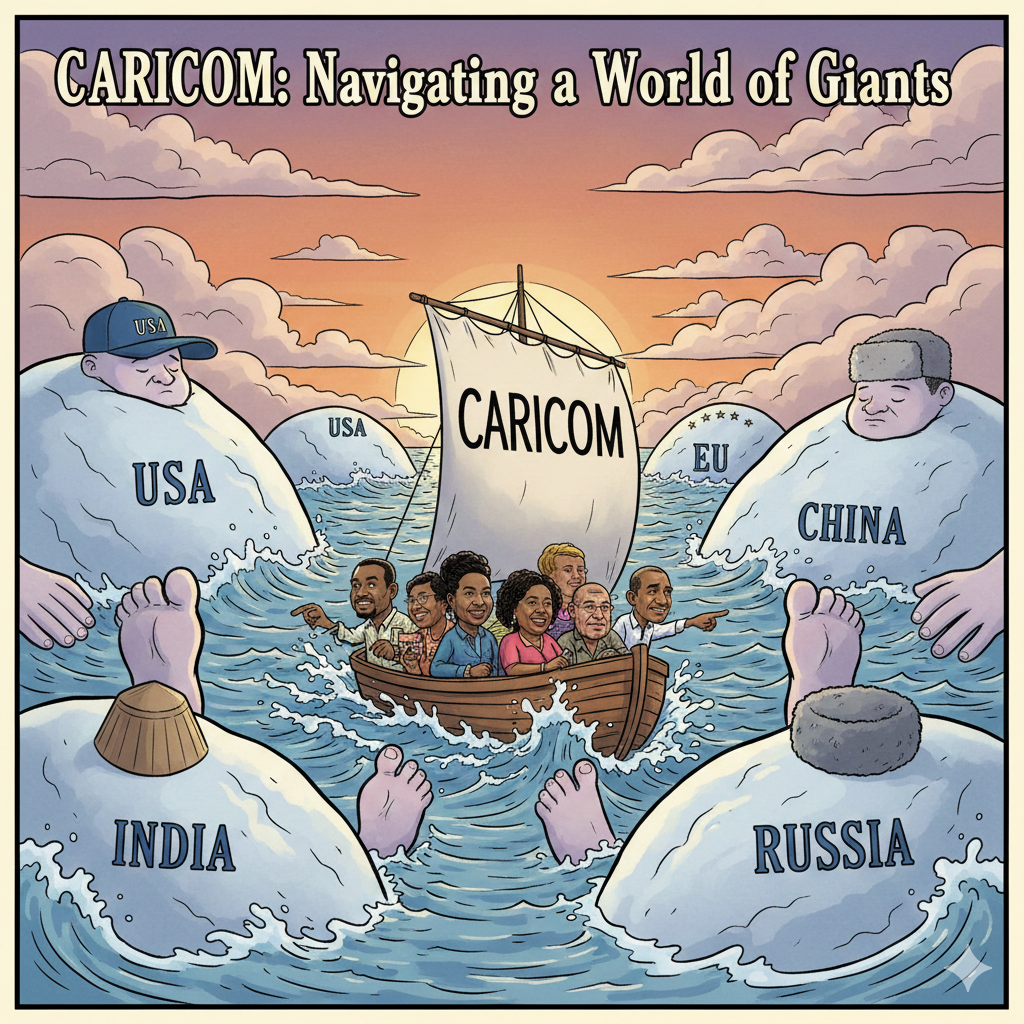
On the world stage, dominated by economic titans, military alliances, and the dense geopolitical maneuvering of superpowers, the Caribbean Community (CARICOM) often appears as a mere footnote. With a combined population smaller than many global megacities and economies vulnerable to the slightest tremor in commodity prices or tourist arrivals, it is easy to dismiss its influence. Indeed, in the traditional calculus of power—measured by troop numbers, GDP rankings, or nuclear arsenals—CARICOM possesses none. Its true currency, however, is not found in hard power but in the persistent, principled, and collective application of soft power, a force it wields with a deftness that belies its size.
CARICOM’s power is the power of voice and vote. In forums like the United Nations, the Organization of American States, and crucial climate summits, fifteen sovereign nations speaking in concert create a bloc that cannot be ignored. This cohesion transforms individual whispers into a resonant chorus. Major powers seeking support for international initiatives must often pause to consider CARICOM’s stance. A block of votes, however small each may be, represents a strategic lever, allowing these nations to punch far above their individual weight in diplomatic negotiations. They trade allegiance for attention, securing a seat at tables that would otherwise be reserved for larger players.
The community’s most potent tool is its moral authority, often derived from its lived experience. On the existential issue of climate change, CARICOM has transitioned from victim to visionary. As nations on the front lines of rising seas and intensifying hurricanes, their advocacy is not abstract policy but an urgent plea for survival. This grants their arguments an undeniable credibility and moral weight that large, industrialized emitters struggle to counter. They have become the conscience of the climate debate, framing it not just as an environmental issue, but as one of justice, reparations, and international responsibility.
Furthermore, CARICOM exercises influence through the power of example and niche expertise. In areas like disaster management, public health innovation for small populations, and the intricate diplomacy of navigating relations with much larger neighbors, these nations have developed a sophisticated body of knowledge. Their experience in building resilient societies amidst constant economic and environmental shocks offers a unique blueprint for other small states worldwide. This expertise makes them sought-after partners and thought leaders in specific, critical domains.
Yet, this reliance on soft power is not a choice but a condition of geography and history. Limited resources preclude massive military spending or large-scale economic coercion. Instead, CARICOM has mastered the art of diplomatic strategy, building bridges across traditional divides. They maintain relationships with the United States and Europe while deepening ties with China, India, and nations of the Global South. This multi-alignment is a survival tactic, ensuring that no single power can claim absolute hegemony in their region.
The limitations are real. Economic vulnerabilities can make member states susceptible to external pressure, and maintaining perfect unity among fifteen diverse nations is a perpetual challenge. Their influence can seem ephemeral when contrasted with the tangible, hard power actions of larger states.
But to see only the limitation is to miss the point. In a world where unilateral force often creates complex blowback, CARICOM’s model of collective diplomacy, moral advocacy, and consensus-building presents a different path. They remind the global community that power is not merely the capacity to compel, but also the ability to persuade, to shame, to build coalitions, and to stand as a beacon of principle. CARICOM may not command armies or dominate markets, but on issues from climate justice to small-state sovereignty, it commands a hearing. And in the intricate, noisy theater of global politics, securing that hearing is the first, and sometimes the most powerful, step of all.