Posted on

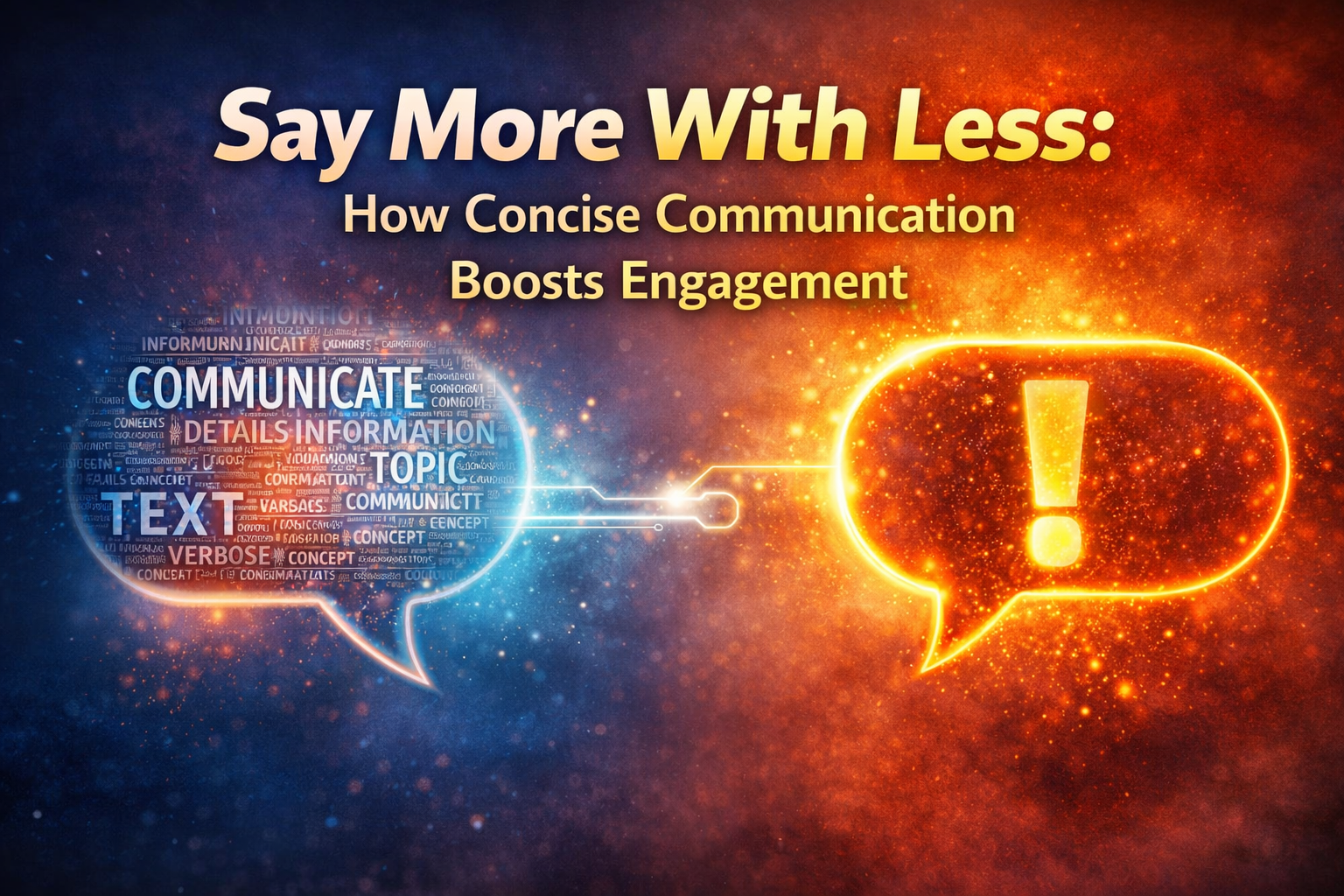
Say More With Less: How Concise Communication Boosts Engagement

In an age where attention spans are shrinking and information overload is the norm, the ability to communicate concisely has become more than a skill—it has become a strategic advantage. Whether in writing, social media, marketing, or even everyday conversation, brevity captures attention in a way that lengthy explanations often cannot. Concise communication is not about dumbing down ideas or oversimplifying complex topics; it is about distilling information to its most essential, impactful form, making it easier for audiences to understand, remember, and act upon.

People are inundated with content from all directions. Social media feeds scroll endlessly, emails pile up, and messaging apps ping constantly. In this environment, long-winded messages are easily ignored, while concise, well-crafted communication stands out. When ideas are expressed clearly and succinctly, the audience experiences less cognitive load, which increases the likelihood that they will fully absorb and engage with the message. Engagement is not merely about capturing attention for a fleeting moment—it is about fostering comprehension, encouraging interaction, and prompting meaningful responses.

Concise communication also signals respect for the audience’s time. A message that gets to the point quickly demonstrates that the communicator values the reader or listener, creating a stronger connection and increasing trust. In professional contexts, leaders who can articulate strategies, objectives, or feedback in a clear, concise manner are more likely to inspire confidence and action among team members. On social platforms, posts that communicate a powerful idea in a few sentences or a single image with minimal text tend to receive higher interaction rates because they are digestible and shareable.

Another key benefit of concise communication is its ability to clarify complex ideas. The process of condensing thoughts forces the communicator to identify the core message and eliminate distractions or unnecessary details. This clarity ensures that the audience grasps the intended point without ambiguity or confusion. A well-chosen word or phrase can carry far more weight than pages of explanation. In marketing, concise messaging often translates directly to higher conversion rates because the audience immediately understands the value proposition without wading through fluff.

Importantly, conciseness does not mean sacrificing style or personality. In fact, carefully chosen words often enhance the voice and tone of a message. Humor, emotion, and persuasive elements can all be conveyed succinctly, making the content both memorable and engaging. Stories can be told in a sentence or two, arguments can be made in paragraphs instead of pages, and ideas can be shared visually alongside minimal text for maximum impact.

Ultimately, the power of concise communication lies in its ability to respect attention, clarify meaning, and create connection. In a world flooded with information, the messages that succeed are those that are distilled to their essence, compelling enough to be read, understood, and shared. By embracing brevity, communicators not only increase engagement but also demonstrate mastery over their ideas, making every word count. Those who can say more with less are not only heard—they are remembered.


Posted on

TikTok’s Hidden Goldmine: Why India’s Absence Makes It Explosive

TikTok has become a global phenomenon, capturing attention across continents and reshaping how content is consumed and monetized. While many analysts focus on its short-form videos, algorithmic magic, and engagement metrics, there’s a subtle factor often overlooked: India. The absence of this massive market may be one of the most significant reasons TikTok is currently so lucrative.

India represents one of the largest populations in the world with a young, tech-savvy demographic hungry for digital content. If TikTok were present there today, the sheer scale of users would demand massive infrastructure investments, content moderation, and compliance with complex regulations. Its exclusion has, paradoxically, allowed TikTok to focus on markets where monetization is easier, user behavior is more predictable, and advertising revenues are higher per user. In essence, TikTok has been able to optimize for profit rather than scale indiscriminately.

Advertisers see enormous value in TikTok because the platform is concentrated in markets with higher disposable incomes, where engagement translates directly into ad dollars. In the United States, Europe, and parts of Southeast Asia, brands are willing to pay a premium to reach the app’s highly engaged audience. Without the distraction of integrating India, TikTok has been able to fine-tune its ad algorithms, creator incentives, and e-commerce features to maximize revenue per user.

Moreover, the perception of scarcity and untapped potential adds to its allure. Investors and marketers alike are fascinated by the thought of India eventually returning to the platform. The idea of adding hundreds of millions of users almost overnight creates a narrative of exponential future growth, increasing current valuations and advertiser confidence. TikTok’s current profitability, therefore, is not just a product of engagement metrics but also a reflection of this highly strategic exclusion.In conclusion, while TikTok’s global success is often attributed to its addictive format and algorithmic prowess, the reality is more nuanced. Its absence from India has allowed the company to concentrate on monetizable markets, increase ad revenue efficiency, and create a perception of untapped opportunity that fuels its valuation. The platform’s current lucrativeness is as much about strategy and timing as it is about viral content.

Posted on

The Spotlight of Wealth: Why Making Money Comes With Attention

When you accumulate significant wealth, whether through business, investments, or other ventures, you enter a world that is far different from the life most people experience. Money has a way of casting a spotlight, drawing eyes and curiosity from people who might not have noticed you before. This attention can be subtle at first: a compliment, a glance, a question about your work. Over time, it can become more pronounced, manifesting in invitations, proposals, or even scrutiny.

Wealth acts as a signal. Humans are naturally curious about success and the people who achieve it. When someone earns a high income or builds a large fortune, others often want to understand how they did it. Friends, acquaintances, and strangers alike may be drawn to the lifestyle that wealth affords. Some are genuinely inspired, seeking advice or mentorship, while others may be motivated by envy, opportunism, or the hope of personal gain. Recognizing this duality is essential for anyone navigating the world of affluence.

The attention that comes with wealth can have both positive and negative effects. On the positive side, it can create opportunities, from networking to business partnerships, because people are naturally inclined to connect with those who demonstrate success. It can open doors that might otherwise remain closed, giving access to ideas, markets, and relationships that can further amplify one’s achievements. On the negative side, attention can attract unwanted scrutiny. Decisions you make, expenditures, and personal choices may suddenly become subjects of interest, judgment, or even criticism. Privacy, once taken for granted, may feel like a luxury.

Managing this attention requires awareness and strategy. Understanding why people are drawn to wealth allows you to interact with them more consciously. It is possible to enjoy the benefits of recognition while protecting yourself from those who might exploit or misjudge your success. Setting boundaries, fostering genuine relationships, and maintaining focus on your goals can help balance the perks of attention with the need for personal security and mental clarity.

Ultimately, the truth is simple: money brings notice. Whether you desire it or not, significant financial success will likely make you visible in ways that impact both your personal and professional life. Being prepared for that visibility, embracing the opportunities it provides, and mitigating the challenges it brings is part of the journey of wealth. Those who master this balance often find that the attention they attract can be a tool for growth rather than a distraction, a resource rather than a burden.Wealth may shine a spotlight, but how you choose to stand in it defines whether the light empowers you or overwhelms you.

Posted on

How ClickFunnels Can Transform Your Business Overnight

Running an online business can feel like trying to solve a puzzle with missing pieces. You have a product you believe in, a vision for growth, and yet, turning visitors into paying customers often feels like an uphill battle. That’s where ClickFunnels comes in — a tool designed not just to make your life easier, but to multiply your sales with minimal hassle.

ClickFunnels is more than a platform for building web pages; it’s a complete system for turning interest into action. Imagine having the ability to create high-converting sales funnels without needing a team of designers, developers, or coders. With ClickFunnels, every element of your customer’s journey — from landing on your page to completing a purchase — is optimized for conversion. You no longer have to worry about whether your checkout is confusing or if your email follow-ups are reaching the right people. ClickFunnels handles it all, letting you focus on what truly matters: growing your business.

What makes ClickFunnels especially powerful is its versatility. Whether you’re selling digital products, coaching programs, or physical goods, you can design funnels tailored to your audience in a matter of hours. And because the platform is built around conversion best practices, you’re not guessing what works — every template, every step of the funnel is designed to get results. That means less trial and error, more sales, and faster growth.

Business owners who use ClickFunnels often see dramatic results. It’s not just about making a website; it’s about creating a system that works for you 24/7, turning cold traffic into loyal customers automatically. The ability to integrate email follow-ups, automated webinars, and even membership programs within one platform gives entrepreneurs the kind of control that used to require multiple software tools, hours of setup, and technical know-how. Now it’s all in one place, simple and streamlined.

If you’ve ever felt frustrated by slow sales, abandoned carts, or marketing efforts that don’t convert, ClickFunnels is your solution. By giving you the tools to craft seamless, persuasive funnels, it allows you to focus on growing your brand while your sales engine works for you around the clock. For anyone serious about taking their business to the next level, ClickFunnels isn’t just helpful — it’s essential

Posted on

Everyone Is the Hero of Their Own Story

Every person you meet is living inside a story where they are the main character. Not a side role, not background noise, but the central figure whose choices, struggles, and victories define the plot. This isn’t arrogance; it’s simply how human consciousness works. You experience life from behind your own eyes, shaped by your memories, your pain, your ambitions, and your sense of right and wrong. In your mind, your decisions make sense, your intentions are justified, and your path feels meaningful. The same is true for everyone else.

This realization can be both humbling and dangerous. It is humbling because it reminds you that people are not villains in their own minds. Even those who hurt others often rationalize their actions as necessary, deserved, or unavoidable. They construct narratives where they are protecting something, correcting a wrong, or simply surviving. Understanding this can make you more patient, more observant, and less quick to reduce people to simple labels.

But it is also dangerous if you take it too far. If everyone is the hero in their own story, then conflicts are inevitable. Heroes clash. Two people can both feel justified and still end up in direct opposition. Entire societies can build competing narratives where each side believes it is defending truth, justice, or survival. When you forget this, you become naive. You expect fairness where there is none, and goodwill where there is only self-interest. You assume that because you mean well, others will respond in kind.That is where the second principle comes in: always prepare for the worst.

Preparing for the worst is not about living in fear or expecting disaster at every turn. It is about recognizing reality as it is, not as you wish it to be. If everyone is the hero in their own story, then you must accept that their goals may conflict with yours, and when they do, they may act in ways that disadvantage you without hesitation. Not because they are evil, but because they are prioritizing their own narrative over yours.Think about how this plays out in everyday life. A business deal falls apart because the other party decides to protect their own interests. A relationship ends because one person chooses their own happiness over the partnership. A friend betrays your trust because, in their mind, they are justified by circumstances you may never fully understand. These situations feel shocking only when you assume that others are operating under the same priorities and moral frameworks as you are.

Preparation changes that.

When you prepare for the worst, you build your life in a way that can absorb shocks. You do not rely entirely on promises, because you understand that people change. You do not assume stability, because you know circumstances can shift quickly. You create buffers, not because you are pessimistic, but because you are realistic. Financially, this might mean saving more than you think you need. Emotionally, it means maintaining a sense of self that does not collapse when others disappoint you. Strategically, it means thinking a few steps ahead instead of reacting only when problems appear.

There is a quiet confidence that comes from this mindset. When you know you have prepared, you are less shaken by unexpected events. You can adapt instead of panic. You can respond instead of react. While others are caught off guard, you are already moving, already adjusting, already protecting what matters to you.

At the same time, understanding that everyone sees themselves as the hero allows you to navigate people more effectively. Instead of trying to force others to see your perspective, you start by understanding theirs. You recognize what they value, what they fear, and what story they are trying to live out. This does not mean you agree with them, but it gives you an advantage. You can anticipate their decisions, avoid unnecessary conflict, and position yourself more intelligently in any interaction.

There is also a deeper layer to this idea that applies to your own life. If you are the hero of your story, then your actions should reflect that. Heroes are not defined by comfort or ease, but by how they respond to difficulty. Preparing for the worst is part of that responsibility. It means taking ownership of your future instead of leaving it to chance. It means accepting that setbacks are not exceptions but inevitabilities.

Many people avoid this mindset because it feels heavy. It is easier to believe that things will work out, that people will be fair, that life will reward good intentions. But reality does not operate on comfort. It operates on cause and effect, on preparation and response. Ignoring that does not make life kinder; it only makes you more vulnerable.

At the same time, preparation should not strip life of meaning or joy. There is a balance to strike. You can acknowledge risk without becoming consumed by it. You can prepare for hardship while still pursuing ambition, relationships, and growth. In fact, preparation often makes these things more sustainable. When you are not constantly exposed to avoidable risks, you have more freedom to focus on what actually matters.

There is also a certain clarity that comes from seeing the world this way. You stop taking things as personally. When someone acts against you, you understand that it is part of their story, not necessarily a direct attack on your worth. This does not excuse harmful behavior, but it helps you process it without losing perspective. You become less reactive and more deliberate.

In the end, these two ideas reinforce each other. Recognizing that everyone is the hero in their own story teaches you how people think. Preparing for the worst teaches you how to protect yourself within that reality. Together, they create a mindset that is both grounded and resilient.

You move through life aware that conflicts will happen, that people will prioritize themselves, and that circumstances can change without warning. But instead of being overwhelmed by that, you are ready for it. You have already considered the possibilities, already built your defenses, already accepted that uncertainty is part of the game.

And in doing so, you become a stronger version of the hero in your own story. Not one who relies on luck or ideal outcomes, but one who is prepared for whatever comes next.

Posted on

Financial Literacy: The Core Concepts You Need to Understand Money and Build Wealth

Financial literacy is often treated like a collection of tips—save more, spend less, invest early—but that approach misses the deeper structure behind how money actually works. To be financially literate is not just to follow advice, but to understand the underlying systems that govern income, spending, risk, and long-term wealth creation. Once those systems are clear, decisions become less about guesswork and more about strategy.

At the core of financial literacy is the concept of cash flow. This is the movement of money into and out of your life, and it matters more than most people initially realize. Income is only one side of the equation. What determines your financial trajectory is the gap between what you earn and what you spend, and more importantly, how consistently that gap exists. Someone earning a moderate income with stable, controlled expenses can build wealth over time, while someone earning significantly more but spending aggressively may remain stuck. Understanding cash flow forces you to see money as a system rather than a series of isolated transactions.

Closely tied to cash flow is the idea of budgeting, though not in the restrictive sense many people imagine. A budget is simply a plan for directing your money toward outcomes that matter. Without it, spending becomes reactive, shaped by impulse, social pressure, or short-term emotion. With it, spending becomes intentional. Financial literacy requires recognizing that every dollar has an opportunity cost, meaning that choosing one use for money automatically excludes another. This realization shifts your mindset from “Can I afford this?” to “Is this the best use of my money right now?”

Another essential concept is the difference between assets and liabilities. While definitions can vary slightly depending on context, the general principle is straightforward. Assets tend to put money into your pocket over time, while liabilities tend to take money out. The financially literate person learns to distinguish between the two not based on labels, but on actual behavior. A house, for example, can function as either depending on its financial impact. The same applies to cars, businesses, or even education. This way of thinking prevents blind assumptions and encourages critical evaluation of every major financial decision.

Debt is another area where surface-level understanding often leads people astray. Debt is neither inherently good nor bad; it is a tool. The key is understanding the cost of borrowing and the purpose behind it. Interest rates, repayment terms, and the expected return from whatever the debt is used for all matter. Borrowing to invest in something that generates greater value over time can be rational, while borrowing for consumption often creates long-term drag on your finances. Financial literacy means being able to evaluate whether debt is working for you or against you, rather than simply avoiding it or embracing it blindly.

Saving is often framed as the foundation of financial stability, but its role goes beyond simply setting money aside. It represents delayed consumption and creates flexibility. An emergency fund, for example, is not just a safety net; it is a form of independence. It allows you to handle unexpected events without falling into high-interest debt or being forced into poor decisions. More broadly, savings give you options. They allow you to take calculated risks, such as starting a business or investing, without putting your entire financial life at risk.

Investing builds on saving by putting money to work. While saving protects your financial position, investing is what grows it. Understanding investing requires grasping the relationship between risk and return. Higher potential returns usually come with higher uncertainty, and there are no guaranteed shortcuts. Financial literacy involves recognizing that markets fluctuate, that losses are part of the process, and that time in the market often matters more than timing the market. Concepts like diversification, compounding, and long-term thinking are essential because they reduce risk and increase the likelihood of steady growth over time.Inflation is another concept that shapes nearly every financial decision, even though it often goes unnoticed. Inflation reduces the purchasing power of money over time, meaning that the same amount of money will buy less in the future. This is why simply holding cash without investing can lead to a gradual loss of wealth in real terms. Financial literacy requires understanding that money must grow at a rate that at least keeps pace with inflation if you want to maintain your standard of living.

Taxes also play a significant role in personal finance, influencing how much of your income you actually keep. A financially literate person understands that different types of income are often taxed differently and that tax planning is not about avoidance, but about efficiency. Structuring your income, investments, and expenses in a way that minimizes unnecessary tax burden can have a substantial impact over time. Even small improvements in tax efficiency can compound into meaningful gains.

Risk management is another critical piece of the puzzle. Life is unpredictable, and financial setbacks can come from many directions, including health issues, job loss, or economic downturns. Insurance is one of the primary tools for managing these risks, but it must be understood properly. The goal is not to insure everything, but to protect against losses that would be financially devastating. This requires evaluating both the likelihood and the impact of potential risks.

Finally, financial literacy includes a strong understanding of behavior and psychology. Many financial mistakes are not caused by a lack of knowledge, but by emotional decision-making. Fear can lead to selling investments at the worst possible time, while overconfidence can lead to excessive risk-taking. Social pressure can drive unnecessary spending, and short-term thinking can undermine long-term goals. Recognizing these tendencies and developing discipline is just as important as understanding the technical aspects of finance.

In the end, financial literacy is not about mastering every detail or predicting the future. It is about building a framework for making informed decisions in an uncertain world. By understanding cash flow, budgeting, assets and liabilities, debt, saving, investing, inflation, taxes, risk, and behavior, you develop the ability to navigate your financial life with clarity and confidence. That foundation, more than any single tactic or shortcut, is what allows wealth to grow steadily over time.

Posted on

The Line Between Lies and Fraud in Business

In business, people like to pretend everything falls into neat moral categories. You’re either honest or dishonest, ethical or unethical, trustworthy or corrupt. Reality doesn’t work that way. There is a difference between telling lies and committing fraud, and understanding that difference is one of the most important things you can do if you plan to operate in the real world rather than an idealized one.

Every business, at some level, is built on persuasion. You highlight strengths, downplay weaknesses, and present your product or service in the best possible light. A restaurant doesn’t describe its food as “decent on a good day.” A fitness brand doesn’t lead with how hard it is to stay consistent. A startup founder doesn’t open a pitch by explaining all the ways the company might fail. There is always a layer of framing, exaggeration, and selective truth. That’s not unique to business. That’s human communication.The problem is that people often confuse this kind of positioning with fraud. They hear “this product will change your life” and treat it as a legally binding statement rather than what it usually is: marketing language. It’s an attempt to create emotion, not a contract. Most customers understand this intuitively, even if they complain about it publicly. They know there’s a difference between being sold to and being scammed.

Fraud begins where misrepresentation turns into measurable harm based on false, material claims. It’s not about tone or exaggeration anymore. It’s about deception that directly influences a transaction in a way that wouldn’t have happened if the truth were known. If someone sells a course claiming it includes mentorship and there is none, that crosses the line. If a company reports fake financials to attract investors, that’s not clever positioning. That’s illegal. The key difference is that fraud removes the buyer’s ability to make an informed decision by hiding or fabricating critical facts.This distinction matters because if you treat all forms of persuasion as fraud, you paralyze yourself. You hesitate to promote, you soften every claim, and you end up invisible in a market full of louder voices. On the other hand, if you ignore the line entirely, you might get short-term wins but you’re building something fragile. Fraud doesn’t just carry legal risk. It destroys reputation in a way that is almost impossible to recover from, especially in a world where information spreads instantly.

The real skill is learning how to operate confidently in the space between silence and deception. You can be bold without being dishonest. You can make strong claims without fabricating reality. You can sell a vision while still delivering something real on the other side. That balance is what separates businesses that grow steadily from those that either stall out or burn down.There’s also a deeper layer to this. Many people don’t fail in business because they lack skill or opportunity. They fail because they are uncomfortable with the idea of selling at all. They associate any form of persuasive language with being a liar, so they default to being overly cautious and overly literal. Meanwhile, someone else who understands how attention works captures the market, even if their product is only marginally better.

Understanding the difference between lies and fraud doesn’t mean you aim to sit right on the edge of what you can get away with. It means you recognize the rules of the game. You communicate value in a compelling way, but you don’t invent reality. You respect the fact that people are making decisions based on what you say, and you don’t take advantage of that trust.In the end, business is not about being perfectly pure. It’s about being effective without crossing the line that turns persuasion into deception. Most people never take the time to understand where that line actually is. The ones who do tend to last longer, build stronger reputations, and create something that doesn’t collapse the moment it’s examined closely.

Posted on

Making Money Is Only Half the Game

There’s a quiet assumption that once you make enough money, everything else sorts itself out. The stress disappears, the future becomes secure, and the details of daily spending stop mattering. It sounds logical. If income is high enough, how could money still be a problem?But that assumption falls apart the moment you look at how people actually live.

There are people earning modest incomes who steadily build stability, and there are people earning large incomes who remain stuck in cycles of pressure, debt, and uncertainty. The difference is not luck. It’s not even opportunity. It’s the ability to manage what comes in.

Making money creates potential. Managing money determines what that potential turns into.When income rises, so do expectations. Expenses expand quietly at first, then all at once. A slightly better apartment becomes a much more expensive one. Occasional convenience becomes constant convenience. Small upgrades stack into a lifestyle that feels normal but costs far more than it should. Nothing feels excessive in isolation, yet the total leaves no room to breathe.

This is how high earners end up living paycheck to paycheck. Not because they don’t make enough, but because they never built the discipline to control what they spend when they finally could.

On the other side, someone who understands how to manage money treats income differently. They don’t see it as something to match with spending. They see it as something to direct. Every dollar has a role, whether that role is covering necessities, building savings, or creating future income. The result is not restriction. It’s control.

Control is what most people are actually chasing when they say they want more money.

Without management, money behaves like water poured into open hands. It flows in and disappears just as quickly. With management, it becomes something you can store, grow, and use deliberately. The same income can lead to completely different lives depending on which approach is taken.

There’s also a deeper problem with focusing only on earning. Income can change. Jobs end, markets shift, businesses slow down. If your entire financial life depends on money continuing to come in at a high rate, then your stability is fragile by definition. Managing money builds a buffer against that fragility. It creates time, options, and resilience.

People often underestimate how much peace comes from simply knowing where their money is going and why. It removes the background anxiety that comes from vague numbers and unclear habits. It replaces guesswork with intention. That shift alone can change how someone experiences their entire financial life.

None of this means earning more doesn’t matter. It does. Increasing your income expands what’s possible. But without the ability to manage it, higher income only amplifies existing habits. If those habits are weak, the outcome doesn’t improve. It just becomes more expensive.The goal isn’t to choose between making money and managing it. The goal is to understand that one without the other is incomplete.

Making money opens the door. Managing it determines whether you actually move forward.

Posted on

Show Your Face: The Uncomfortable Truth About Social Media Growth

If you’ve ever spent hours crafting the perfect aesthetic feed, designing beautiful graphics, or editing polished videos — only to watch your follower count refuse to budge — you’re not alone. And there’s a good chance the problem isn’t your content, your posting schedule, or even the algorithm. The problem is that nobody knows who you are.The data, the anecdotal evidence, and the lived experience of thousands of creators all point to the same conclusion: showing your face on social media dramatically accelerates growth. It’s not a subtle advantage. It’s a fundamental shift in how people connect with your content.

People Follow People, Not Concepts

Instagram and TikTok are social platforms, and the operative word is social. At their core, they were built around human connection. When someone sees your face, something happens neurologically that no logo, flat lay, or voiceover can replicate — they begin to feel like they know you. Psychologists call this parasocial relationships, the sense of familiarity and friendship that develops between an audience and a person they watch regularly. You cannot build a parasocial relationship with a faceless brand. You can build one almost immediately with a real human being who looks into a camera and speaks directly to you.

This is why the comment sections of face-forward creators are so strikingly different from those of anonymous accounts. People aren’t just reacting to the content — they’re talking to the person. They’re invested. And invested audiences share, return, and bring others with them.

The Algorithm Rewards Retention, and Faces Drive Retention

TikTok’s algorithm, and increasingly Instagram’s, cares deeply about how long people watch your videos. A hook can get someone to start watching, but a face is what makes them stay. Research into viewer behavior consistently shows that humans are hardwired to track faces — it’s an evolutionary trait, the same instinct that makes you look up when someone enters a room. When a face is on screen, attention follows. When it disappears, attention is easier to lose.This means that a creator who appears on camera has a structural advantage in the metric that matters most. More watch time signals to the algorithm that the content is worth distributing. More distribution means more eyes. More eyes means more followers. It’s a compounding effect that starts with the simple decision to be visible.

Trust Is Built Through Visibility

There’s a reason that the most successful salespeople, politicians, and teachers in history have all shared one thing: they show up in person. Visibility communicates confidence, and confidence communicates credibility. When you hide behind a graphic or a voiceover, you may be producing excellent content, but you’re also — consciously or not — sending a signal of hesitancy. Audiences pick up on it.When you show your face, you are implicitly saying: I believe in what I’m saying enough to attach my identity to it. That kind of conviction is magnetic. It makes people trust you faster, agree with you more readily, and forgive imperfections that would otherwise be deal-breakers. Nobody expects you to look like a model or speak like a broadcaster. They expect you to be real. And a real, slightly imperfect, genuinely enthusiastic human being on camera will outperform a flawless but faceless account almost every time.

The Fear Is the Whole Point

Most people already know, somewhere in the back of their mind, that showing their face would help. The reason they don’t do it isn’t ignorance — it’s fear. Fear of judgment, of looking foolish, of saying something awkward, of being perceived in a way they can’t control. This fear is completely understandable, and it is also the very thing holding their growth hostage.Here’s the uncomfortable reframe: the discomfort you feel about being on camera is the same discomfort your competitors feel. The creators who are growing aren’t necessarily more talented, more attractive, or more knowledgeable than you. They’re just willing to be uncomfortable. They pressed record anyway. They posted the imperfect video. They showed up, repeatedly, and let the audience find them.The barrier to showing your face isn’t technical. It’s psychological. And that means it’s entirely within your control to overcome it.

You Don’t Have to Be Perfect — You Have to Be Present

The most followed creators on earth are not uniformly beautiful, polished, or eloquent. They are consistent, authentic, and visible. They have bad hair days on camera. They stumble over words. They laugh at themselves and keep going. And their audiences love them more for it, not less, because imperfection is the proof that a real person is on the other side of the screen.

So if you’ve been waiting until you’re more confident, more prepared, or more camera-ready — stop waiting. The confidence doesn’t come before the camera. It comes because of it. Every video you post makes the next one easier. Every comment from a stranger who feels like you’re speaking directly to them is a reminder of what’s possible when you stop hiding and start showing up.Your face is not a liability. It’s your greatest asset. Use it.

Posted on

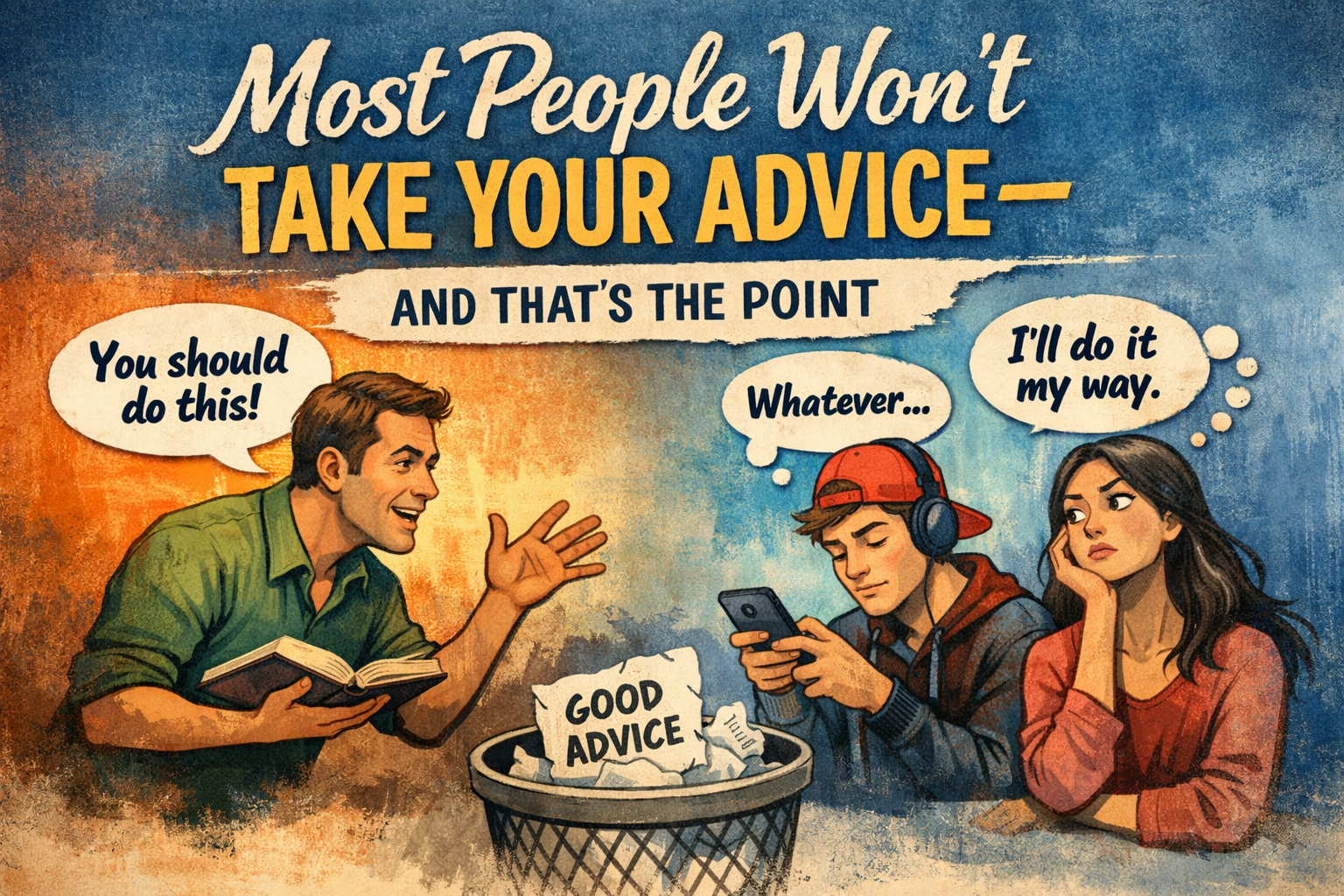
Most People Won’t Take Your Advice—And That’s the Point

There’s a quiet assumption people carry when they give advice: that it will be followed. Not always immediately, not always perfectly, but at least taken seriously. In reality, most advice goes unused. It’s heard, maybe even appreciated, and then set aside while people continue doing what they were already going to do.This isn’t because people are stupid or stubborn. It’s because behavior is anchored far deeper than a single conversation.

When someone asks for advice, they’re rarely starting from a blank slate. They already have habits, identities, fears, social pressures, and emotional investments tied to their current path. Your advice, no matter how logical or well-intentioned, is competing with all of that. And most of the time, it loses.

Think about how often you’ve seen someone ask for guidance, nod along, and then proceed to ignore it entirely. Or how often you’ve done the same. The advice might be correct. It might even be exactly what they need. But correctness alone isn’t enough to override inertia.

There’s also a subtle social dynamic at play. People don’t just want solutions; they want validation. Sometimes asking for advice is less about changing direction and more about feeling understood. When your answer challenges their current behavior too directly, it creates friction. And most people resolve that friction by dismissing the advice rather than changing themselves.

Timing matters too. Advice only works when someone is ready to hear it. You can hand someone the exact roadmap they need, but if they haven’t reached the point where they’re willing to act, it won’t stick. The same words, delivered six months later, might suddenly feel profound. Nothing about the advice changed. The person did.

This is why the most effective people don’t measure their impact by how often they’re obeyed. They understand that influence is probabilistic, not guaranteed. You offer perspective, you plant a seed, and you move on. Some of those seeds grow later, often in ways you’ll never see.

There’s a practical advantage to accepting this. It removes frustration. When you expect people to follow your advice, their inaction feels like rejection. When you understand that most people won’t act on it, their behavior stops being surprising. You can focus on delivering clarity instead of chasing compliance.

It also sharpens how you communicate. Since you can’t rely on being followed, you aim to be memorable. You strip ideas down to their essence. You make them easy to revisit later. The goal shifts from controlling outcomes to increasing the chance that, at the right moment, your words resurface.

On the other side, this idea should make you more self-aware as a listener. If most people ignore advice, there’s a good chance you do too. That doesn’t mean blindly accepting everything you hear, but it does mean recognizing how easy it is to default to your existing patterns while convincing yourself you’re being open-minded.

The uncomfortable truth is that advice competes with identity. People don’t just change because something makes sense. They change when continuing as they are becomes more painful than the effort of doing something different. Until that threshold is crossed, even the best guidance often sits unused.

So if you’re giving advice, give it freely but without attachment. Say what needs to be said as clearly as you can, and then let go of the outcome. Most people won’t take it. A few will. And those few are enough to make it worthwhile.

And if you’re receiving advice, understand that the rare moments where you actually act on good guidance are the ones that quietly reshape your life.