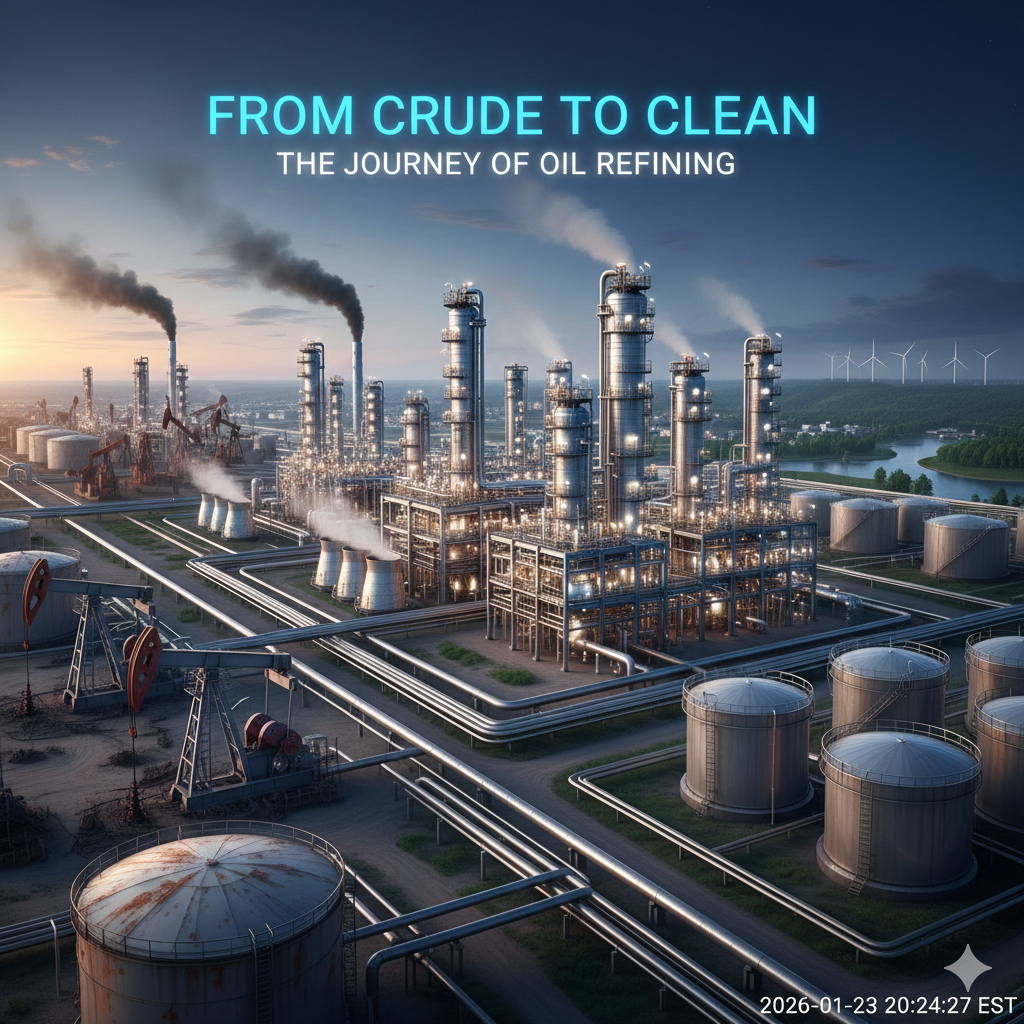
When crude oil first emerges from deep underground, it’s a thick, dark mixture of hundreds of different hydrocarbon molecules all jumbled together. This raw substance is virtually useless in its natural state. The magic of oil refining lies in separating this complex mixture into the specific products we use every day, from the gasoline that powers our cars to the asphalt that paves our roads.
The refining process begins the moment crude oil arrives at the refinery, typically by pipeline, tanker ship, or rail car. The first step is surprisingly simple: removing the junk. Crude oil carries with it salt water, sand, and various minerals picked up during its journey from ancient organic matter to modern commodity. These impurities would wreak havoc on refinery equipment, so the oil passes through a desalting unit where it’s mixed with fresh water and then separated, leaving the contaminants behind.
Now the real work begins with the heart of any refinery: the distillation tower, also called a fractionating column. Picture a tall steel cylinder that can soar over 150 feet high, filled with dozens of horizontal trays stacked at different levels. The desalted crude oil is pumped into a furnace where it’s heated to approximately 750 degrees Fahrenheit, hot enough to vaporize most of the hydrocarbon molecules but not all of them.
This superheated mixture then enters the bottom of the distillation tower, where an elegant principle of chemistry takes over. Different hydrocarbon molecules have different boiling points based on their size and structure. Small, light molecules like those in propane and butane vaporize easily and rise to the top of the tower where it’s cooler. Larger, heavier molecules can’t make it as high before they cool down and condense back into liquid.
As the vapors rise through the tower, they pass through those stacked trays, each one maintained at a specific temperature slightly cooler than the one below it. When a particular type of hydrocarbon reaches the tray that matches its condensation temperature, it liquefies and gets drawn off through pipes leading out of the tower. At the very top, where temperatures might be around 100 degrees Fahrenheit, the lightest gases are collected. Further down, at progressively higher temperatures, refiners extract naphtha (used for gasoline), kerosene (jet fuel), diesel fuel, and gas oil.The heaviest components, those thick, viscous hydrocarbons that never vaporized in the furnace, sink to the bottom of the tower as residuum. This heavy residue gets sent off to specialized processing units because there’s still value to extract from these molecular giants.
But here’s the problem refiners face: the distillation tower gives you whatever proportions nature decided to pack into that particular crude oil. You might get 20 percent gasoline when the market demands 50 percent. You could end up with too much heavy fuel oil when everyone wants diesel. This is where the real ingenuity of refining comes in, through processes that literally crack apart molecules and rearrange them into more useful forms.
Cracking is the process of breaking large hydrocarbon molecules into smaller ones. The most common method is catalytic cracking, which uses both heat and a catalyst, usually a fine powder of zeolite or aluminum silicate. Heavy gas oils from the distillation tower are vaporized and mixed with the hot catalyst in a reactor vessel. The catalyst acts like molecular scissors, snipping the chemical bonds in large molecules and creating smaller ones that can be used for gasoline and diesel.
The spent catalyst, now coated with carbon deposits, travels to a regenerator where air burns off the carbon, heating the catalyst back up in the process. This hot, refreshed catalyst then cycles back to the reactor, making the process continuous and energy efficient. The products from catalytic cracking include high-octane gasoline components, propylene for plastics manufacturing, and lighter fuel oils.
For even more aggressive molecular restructuring, refiners turn to a process called hydrocracking. This combines high pressure, high temperature, hydrogen gas, and a catalyst to break down the heaviest materials that other processes can’t handle. The hydrogen doesn’t just help crack the molecules; it also saturates the resulting compounds, creating cleaner-burning fuels with fewer impurities like sulfur.
Sometimes refiners need to go the opposite direction and build larger molecules from smaller ones. Alkylation takes small, light hydrocarbons from the cracking units and combines them using sulfuric acid or hydrofluoric acid as a catalyst. The products are branched-chain hydrocarbons that make excellent gasoline blending components with high octane ratings and clean combustion characteristics.
Reforming is another crucial process that doesn’t change the size of molecules but rearranges their structure. Catalytic reforming takes low-octane naphthas and, using platinum or similar metal catalysts along with heat and pressure, reorganizes the atoms into different configurations. Straight-chain molecules get converted into ring structures and branched chains, which burn more smoothly in engines and boost octane ratings. A valuable byproduct of reforming is hydrogen, which the refinery uses in other processes like hydrocracking and sulfur removal.
Speaking of sulfur, modern environmental regulations require extensive treatment to remove this element from petroleum products. Sulfur compounds create acid rain when burned and poison catalytic converters in vehicles. Hydrotreating units use hydrogen gas and catalysts to convert sulfur compounds into hydrogen sulfide gas, which can then be captured and converted into elemental sulfur for sale to other industries.
Throughout all these processes, the refinery operates as an interconnected system where the output of one unit becomes the input for another. Light gases from cracking might feed into alkylation. Heavy residues from distillation might go to coking units, where intense heat bakes them into petroleum coke and releases more valuable lighter products. Hydrogen produced in reforming might get used in desulfurization.
Finally, all these various streams need to be blended together to create finished products that meet exact specifications. Gasoline isn’t just one compound but a carefully formulated mixture of dozens of components, each contributing to properties like octane rating, vapor pressure, and seasonal performance. Refiners use sophisticated computer models to optimize these blends, meeting quality standards while maximizing profitability.
The entire refining operation runs continuously, 24 hours a day, 365 days a year. Shutting down and restarting these complex processes is expensive and time-consuming, so refiners keep everything flowing. Computer control systems monitor thousands of variables, adjusting temperatures, pressures, and flow rates to maintain optimal conditions.
From crude oil to finished gasoline, diesel, jet fuel, heating oil, lubricants, asphalt, and petroleum coke, a modern refinery is essentially a massive molecular sorting and rearranging facility. It takes nature’s chaotic mixture and applies heat, pressure, catalysts, and chemical know-how to create the specific products our modern world demands, squeezing value from every molecule in the barrel.