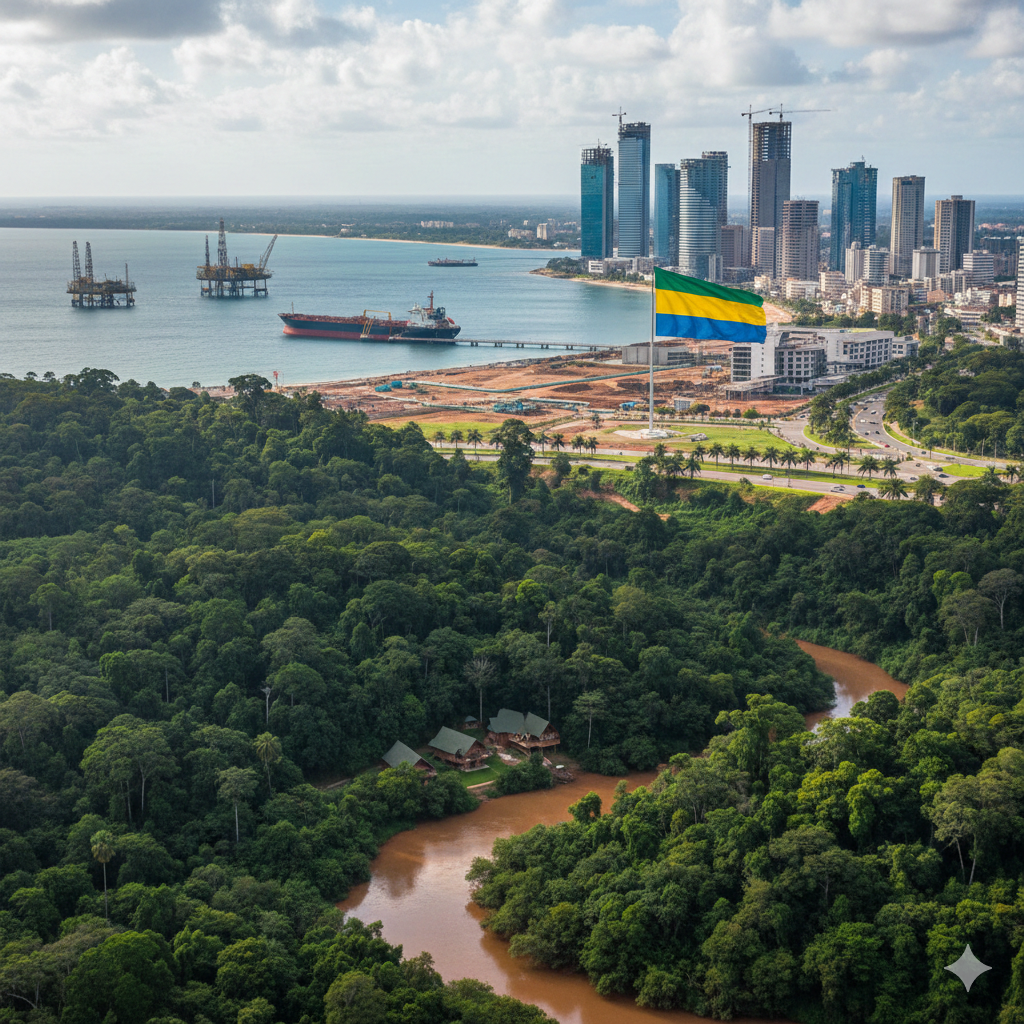
Nestled on the Atlantic coast of Central Africa, Gabon presents one of the continent’s most intriguing economic paradoxes. This nation of approximately 2.3 million people possesses extraordinary natural wealth, yet struggles to translate its abundant resources into broad-based prosperity and economic diversification.
The story of Gabon’s economy begins with its remarkable natural endowments. Dense tropical rainforests blanket nearly 90% of the country’s territory, making it one of the most forested nations on Earth. These forests harbor incredible biodiversity, including forest elephants, gorillas, and countless other species. But beyond their ecological value, they also contain precious hardwoods, particularly okoumé, which has historically been a significant export commodity.
Oil fundamentally reshaped Gabon’s economic landscape after its discovery in the 1970s. Petroleum rapidly became the dominant force in the national economy, currently accounting for roughly 80% of export revenues, about half of government income, and a substantial portion of GDP. This oil wealth elevated Gabon to upper-middle-income status, giving it one of the highest per capita GDPs in sub-Saharan Africa. The capital city of Libreville reflects this wealth in pockets, with modern infrastructure and amenities that contrast sharply with much of the region.
However, this oil dependence has created profound vulnerabilities. Global oil price fluctuations directly impact government budgets and economic stability. When prices crashed in 2014 and again in 2020, Gabon experienced severe fiscal strain, forcing spending cuts and debt accumulation. The country’s oil reserves are also finite and aging, with production declining from peak levels reached years ago. Without major new discoveries, petroleum’s role in the economy will inevitably diminish over the coming decades.The challenge of economic diversification has preoccupied Gabonese policymakers for years. The country has launched ambitious initiatives to develop other sectors, particularly under the “Gabon Emergent” strategic plan introduced in 2009 and updated in subsequent years. This framework aims to transform Gabon into an emerging economy by developing agriculture, tourism, mining, and wood processing while improving governance and infrastructure.
Manufacturing and value-added processing represent critical opportunities. Rather than exporting raw logs, Gabon has implemented policies requiring domestic processing of timber before export, aiming to capture more value from forest resources while creating jobs. The country possesses significant mineral deposits, including manganese, iron ore, and gold. The Moanda manganese mine ranks among the world’s largest, and efforts to expand mining operations continue, though they must balance economic needs with environmental protection.
Agriculture holds considerable potential that remains largely untapped. Despite abundant rainfall, fertile soils, and favorable growing conditions, Gabon imports much of its food. Developing commercial agriculture could reduce import dependence, create employment, and utilize land without threatening primary forests. Palm oil, rubber, and various food crops offer possibilities, though careful planning is essential to avoid the environmental destruction that has plagued agricultural expansion elsewhere.
Tourism presents another avenue for diversification. Gabon’s commitment to conservation, with approximately 11% of its territory designated as national parks, creates opportunities for ecotourism. Loango National Park, where forest meets ocean, offers remarkable wildlife viewing. However, tourism infrastructure remains underdeveloped, and the country’s relatively high costs and limited accessibility have constrained visitor numbers.
The economic benefits of Gabon’s resource wealth have not been evenly distributed. Significant inequality persists, with poverty rates remaining high despite the nation’s upper-middle-income classification. Urban areas, particularly Libreville, concentrate much of the modern economy, while rural regions often lack basic services and infrastructure. Youth unemployment poses a particular challenge, creating social pressures and limiting the development of human capital.Infrastructure development has seen substantial investment in recent years. The Trans-Gabon Railway, though built decades ago primarily to transport manganese, remains economically important. Road networks have expanded, connecting previously isolated regions. The government has invested in ports and the Special Economic Zone at Nkok, designed to attract manufacturers and add value to raw materials. These infrastructure improvements are essential for diversification, enabling sectors beyond oil to flourish.
Governance and institutional quality significantly influence economic outcomes. Gabon has made progress in some areas, implementing reforms to improve the business environment and combat corruption. However, challenges remain in bureaucratic efficiency, transparency, and the equitable distribution of opportunities. Strengthening institutions and ensuring that economic policies benefit the broader population, not just connected elites, will be crucial for sustainable development.
The country faces a demographic transition with important economic implications. A young and growing population requires job creation at a pace that current economic structures struggle to provide. Education and skills development are critical investments, enabling Gabonese citizens to participate in an evolving economy that demands higher skill levels.
Climate change and environmental conservation add another dimension to economic planning. Gabon has positioned itself as a leader in forest conservation, maintaining its forests as carbon sinks while seeking international climate finance. This approach represents an innovative economic strategy, monetizing environmental services while preserving ecosystems. However, balancing conservation with development pressures and local needs remains complex.
Regional integration through organizations like the Economic Community of Central African States and the Central African Economic and Monetary Community offers potential benefits. Expanded regional trade could provide larger markets for Gabonese products and reduce dependence on volatile global commodity markets. However, political instability and poor infrastructure in neighboring countries have limited regional economic cooperation.
Looking ahead, Gabon stands at a crossroads. The oil-dependent model that has sustained the economy for decades will inevitably transform as reserves decline and the world transitions toward renewable energy. The country possesses assets that could support a more diversified, sustainable economy, including forests, minerals, agricultural potential, and significant previous investments in infrastructure and education. Realizing this potential requires sustained policy commitment, continued institutional improvement, transparent governance, and economic structures that create broad-based opportunities.
The nation’s economic future will depend on how effectively it manages this transition, developing new sources of growth and employment while stewarding its remarkable natural heritage. Whether Gabon becomes a model of sustainable development and economic diversification, or remains trapped by resource dependence and inequality, will shape the lives of millions of Gabonese in the decades ahead.