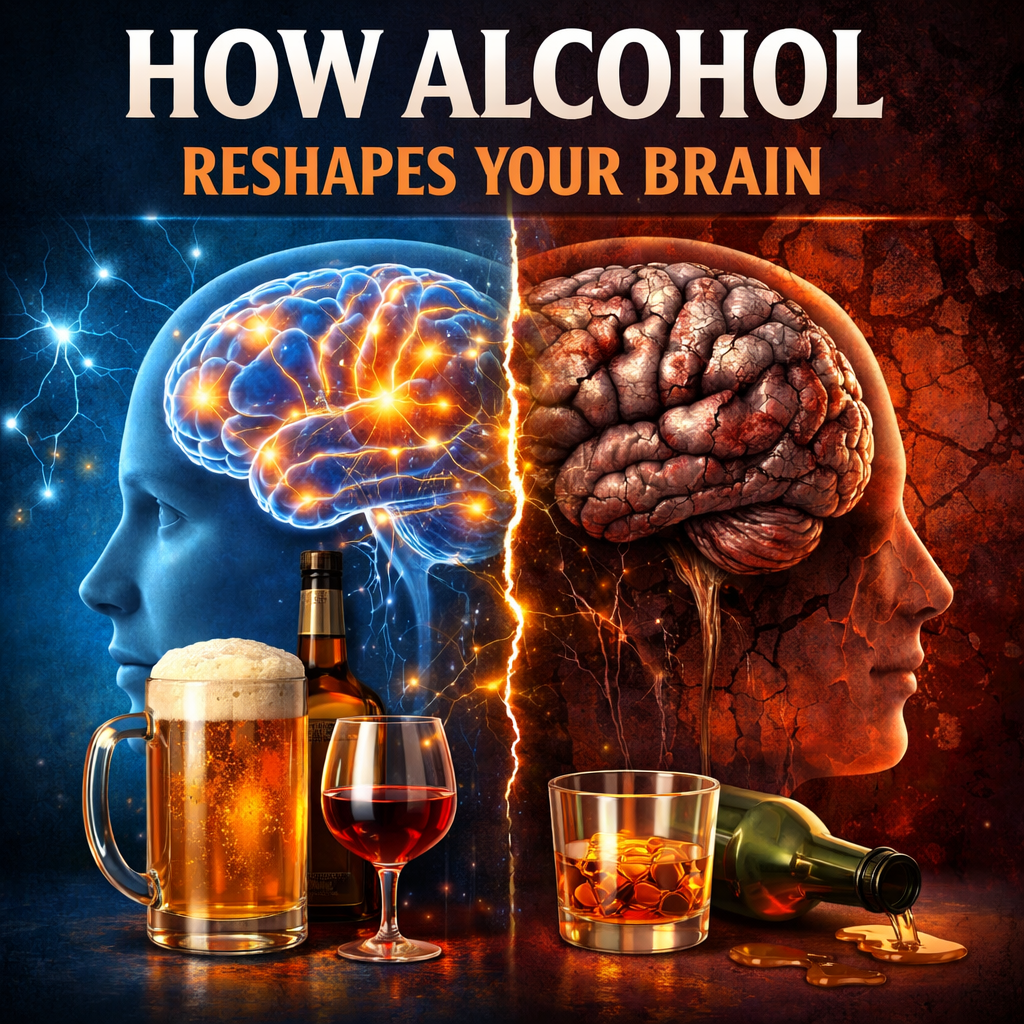
We often speak of alcohol’s effects in terms of a fleeting buzz, a moment of loosened inhibitions, or the throbbing headache of a hangover. These are the immediate, visible signs. But beneath that surface experience, a much quieter and more profound process is occurring—a direct conversation between the substance and the very organ that defines who you are: your brain. The impact is both temporary and lasting, a cascade of chemical and structural changes that alter how we think, feel, and remember.
At the moment of consumption, alcohol doesn’t simply “stimulate” or “depress” the brain in a uniform way. Instead, it delicately, and destructively, tinkers with the brain’s intricate communication system. It enhances the effect of gamma-aminobutyric acid (GABA), the brain’s primary inhibitory neurotransmitter. This is what leads to the initial relaxation, the slowing of speech and movement, and the sedative effect. Simultaneously, it suppresses glutamate, a major excitatory neurotransmitter involved in cognitive functions and memory formation. This double action—putting a foot on the brake while cutting the engine’s power—is why reaction times slow and thinking becomes foggy. Crucially, it also disrupts the delicate ballet of chemicals in the cerebellum, the brain’s coordinator of fine motor skills, leading to the loss of balance and slurred speech we associate with intoxication.
Perhaps the most familiar short-term casualty is the hippocampus, the seahorse-shaped region vital for forming new memories. When alcohol washes over it, the normal process of transferring experiences from short-term to long-term memory is disrupted. This results in the infamous blackout, not a loss of consciousness, but a failure to create the memory in the first place. It’s as if the recording switch has been flipped off.The true cause for concern, however, lies in repeated exposure. The brain is adaptable, a quality known as neuroplasticity. In the face of chronic alcohol use, it attempts to adapt to the persistent chemical imbalance. To counteract the constant depressive effect, the brain downregulates its calming GABA systems and upregulates the excitatory glutamate systems. This rewiring is the foundation of tolerance, requiring more alcohol to achieve the same effect, and dependence, where the brain now needs the substance to maintain its new, unstable equilibrium. Remove the alcohol, and the brain is left in a hyper-excitable, chaotic state, which manifests as the anxiety, tremors, and even seizures of withdrawal.
Over time, the conversation between alcohol and the brain moves from chemistry to architecture. Brain imaging studies reveal that prolonged heavy drinking can lead to an actual reduction in both the brain’s gray matter, which contains the crucial cell bodies, and its white matter, the insulated wiring that connects different regions. The prefrontal cortex, our center for judgment, decision-making, and impulse control, is particularly vulnerable. Damage here erodes the very faculties needed to recognize or escape a problem with drinking. Furthermore, alcohol can interfere with the absorption of vitamin B1 (thiamine), a nutrient essential for brain cell energy. A severe thiamine deficiency can lead to Wernicke-Korsakoff syndrome, a devastating condition characterized by profound confusion, vision problems, and a permanent, gap-filled memory where the sufferer may confabulate stories to fill the voids.
It is a myth that these consequences are reserved for those with severe alcohol use disorders. Research shows that even moderate social drinking, particularly the pattern of binge drinking, can be associated with negative cognitive effects, including subtle declines in processing speed, attention, and planning. The brain’s resilience is remarkable, and abstinence can lead to significant recovery, especially in younger individuals. Some cognitive functions may return, and brain volume can partially rebound. But some alterations, particularly those affecting the intricate wiring and specific memory structures, may be more lasting.
The final takeaway is this: every drink is a neurochemical event. The laughter, the relaxation, the social ease—they all come with a biological receipt. While an occasional glass may be a calculated risk for many, understanding the silent alteration happening within the skull is crucial. The brain is not just another organ; it is the canvas of our personality, the library of our life, and the command center for our future. To drink is to engage in a direct dialogue with it, and that dialogue, over time, can slowly rewrite the script of who we are.