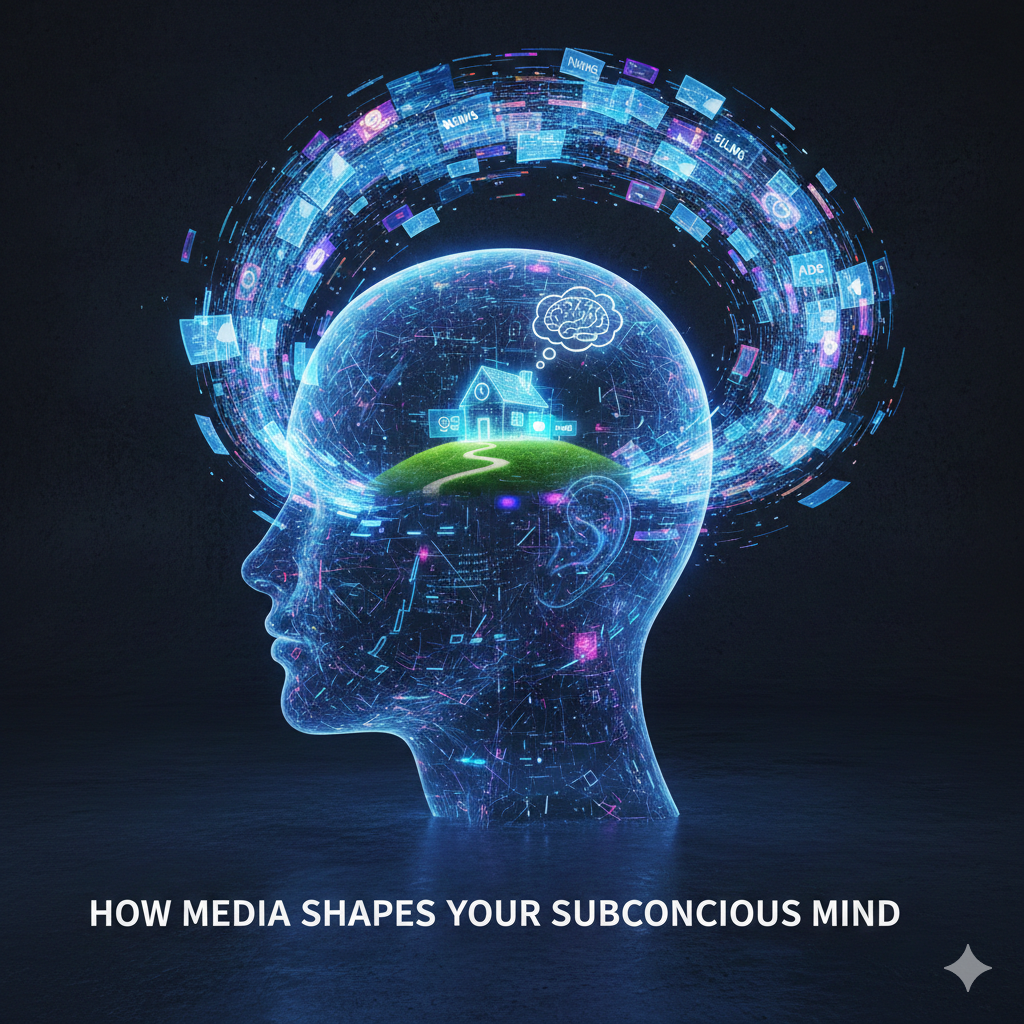
Every day, you scroll through social media feeds, binge television shows, listen to podcasts during your commute, and maybe catch a few news headlines before bed. These moments feel casual, even forgettable. But beneath your conscious awareness, something profound is happening. The media you consume is quietly reshaping the landscape of your mind.
Your subconscious operates like a vast underground river, flowing beneath the surface of your everyday thoughts. While your conscious mind actively evaluates and judges what you encounter, your subconscious absorbs it all with far less discrimination. It’s the difference between a security guard checking IDs at the door and a sponge soaking up whatever liquid touches it. The images, narratives, values, and emotional tones embedded in your media diet seep into this deeper layer of your psyche, influencing your beliefs, behaviors, and perception of reality in ways you rarely notice.
Consider how advertising works. Companies spend billions crafting messages designed to bypass your rational defenses and plant themselves directly into your associative memory. You might consciously dismiss a commercial as silly or manipulative, yet weeks later find yourself reaching for that brand in the grocery store. The jingle plays in your head unbidden. The product feels somehow familiar, trustworthy, like an old friend. This is your subconscious at work, having catalogued countless micro-exposures and woven them into the fabric of your automatic preferences.
The narratives you consume repeatedly become the templates through which you interpret your own life. If the shows you watch consistently portray relationships as battlegrounds of manipulation and betrayal, your subconscious begins to encode suspicion as the appropriate stance toward intimacy. If the news you consume presents the world as an endless cascade of threats and disasters, your nervous system gradually calibrates itself to a state of ambient anxiety. Your subconscious doesn’t distinguish between lived experience and vividly depicted fiction. Both create neural pathways and emotional associations that shape your future responses.This influence extends to your sense of what’s normal and possible. Media creates something psychologists call “availability bias,” where the ease with which examples come to mind shapes your estimation of how common or likely something is. If you’re constantly exposed to depictions of violence, you may unconsciously overestimate how dangerous the world actually is. If you watch endless home renovation shows, you might develop an unconscious dissatisfaction with your living space, not because it has objectively worsened, but because your reference point for “normal” has shifted to million-dollar makeovers.
The emotional tenor of your media consumption also matters tremendously. Content designed to provoke outrage, fear, or envy triggers stress responses in your body and mind. Even if you’re just scrolling passively, your nervous system registers these emotional jolts. Over time, repeated exposure to high-arousal negative content can recalibrate your baseline emotional state. Your subconscious learns to expect threat and conflict, maintaining your body in a subtle state of readiness that manifests as free-floating anxiety or irritability.
Meanwhile, the values embedded in media quietly colonize your moral intuitions. If the heroes in your favorite stories consistently achieve success through ruthless individualism, your subconscious absorbs this as the natural order of things. If the comedies you watch rely on mockery and cruelty for laughs, these patterns of relating become encoded as socially acceptable, even amusing. You might consciously hold different values, but your automatic reactions and gut feelings often reflect the sum of what you’ve absorbed rather than what you’ve deliberately chosen.
The repetition inherent in modern media consumption amplifies all these effects. Your subconscious is exquisitely sensitive to patterns and frequencies. When you encounter the same types of messages, images, and narratives over and over, they become deeply grooved into your mental landscape. This is why representation matters so profoundly. If you never see people like yourself depicted as capable, worthy, or interesting, your subconscious may struggle to imagine those possibilities for you. Conversely, seeing diverse examples of success and humanity expands your unconscious sense of what’s achievable and who deserves dignity.
Social media presents a particularly potent form of subconscious influence because it mimics interpersonal connection while carefully curating what you see. The algorithm feeds you content that provokes engagement, which usually means content that triggers strong emotions. Your subconscious doesn’t register that you’re looking at a heavily filtered highlight reel. Instead, it compares your internal experience, with all its mundane struggles and doubts, to the polished exteriors presented by others. The resulting sense of inadequacy doesn’t feel like a media effect. It feels like truth.
Perhaps most insidiously, media shapes your subconscious assumptions about how attention and communication should work. If you spend hours each day in environments designed to fragment your focus with notifications, autoplay, and endless scroll, your brain adapts. Your subconscious comes to expect constant stimulation and novelty. The slower rhythms of reading a book, having a meandering conversation, or sitting with a single thought begin to feel uncomfortable, even intolerable. You haven’t consciously decided that deep focus is unpleasant. Your subconscious has simply been trained by the media environment you inhabit.
None of this means you’re powerless or that media consumption inevitably corrupts your mind. Awareness itself provides some protection. When you recognize that your mental life is being shaped by your inputs, you can make more deliberate choices about what you allow in. You can seek out media that aligns with the values and perspective you want to cultivate. You can introduce friction into your consumption habits, creating space for reflection rather than passive absorption.
Your subconscious will always be influenced by what you feed it. The question is whether that influence happens by default or by design. The media landscape is engineered to capture and hold your attention, often in ways that serve commercial interests rather than your wellbeing. But within that landscape, you still have agency. You can choose media that enriches rather than depletes, that expands rather than narrows, that nurtures the subconscious mind you want to carry through the world.
The river flows on beneath the surface, but you get to choose which tributaries feed it.
