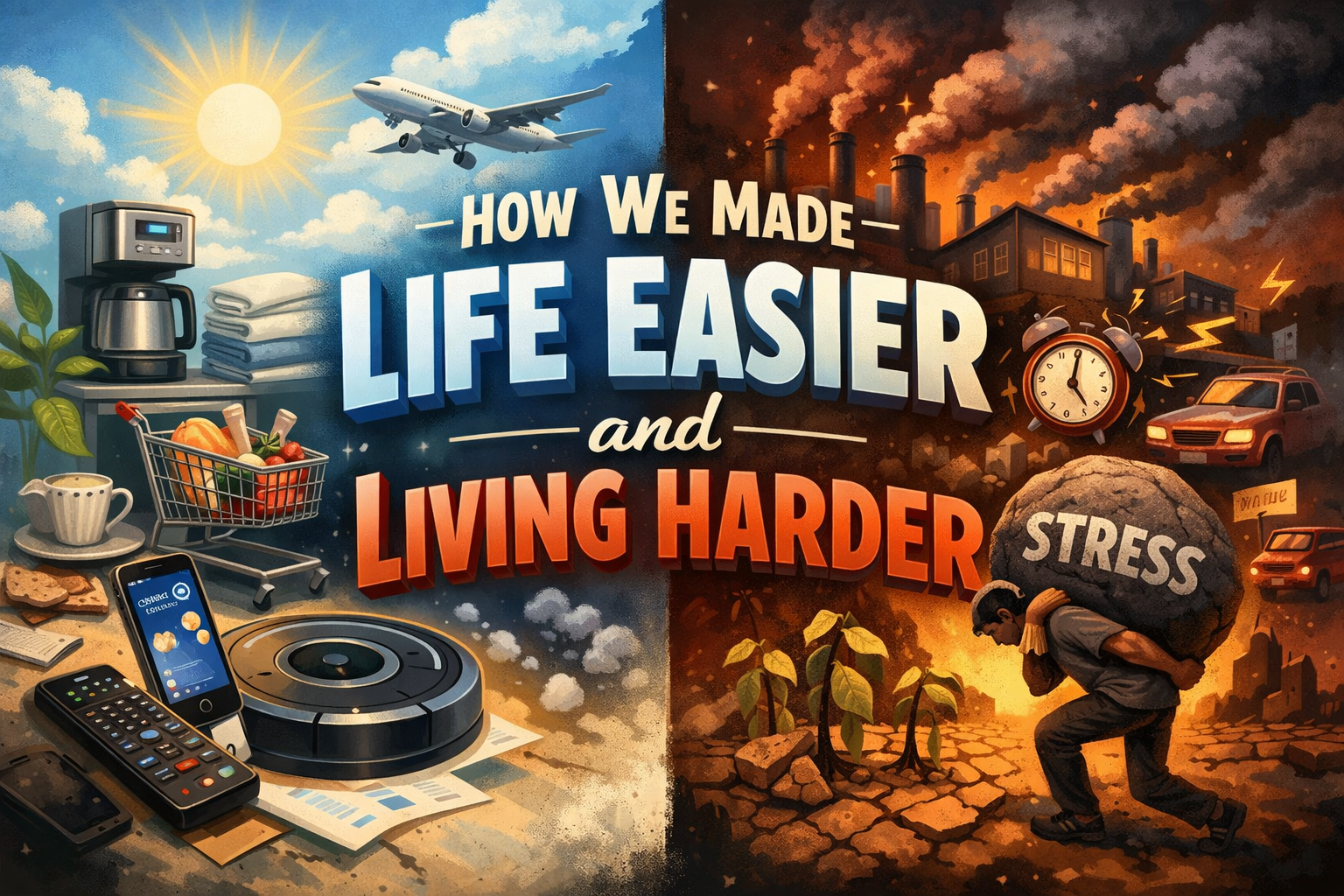
There is a particular kind of exhaustion that comes not from hardship, but from its absence. It is the feeling of lying in a perfectly climate-controlled room, with food available at the tap of a screen, with every conceivable entertainment a thumb-scroll away, and feeling — despite all of it — profoundly empty. We have engineered survival to a point of near-perfection, and in doing so, we may have accidentally engineered meaning out of existence.This is not a romantic argument for suffering. Nobody should romanticize poverty, illness, or backbreaking labor. But there is a difference between surviving and living, and that difference matters enormously. Survival is biological. Living is something else entirely — it is the experience of being a full, striving, purposeful human being. And the tools we have built to serve the first ambition have, quietly, begun to undermine the second.
Consider what difficulty actually does for us, psychologically speaking. Struggle is not merely an obstacle to wellbeing; it is, in carefully calibrated doses, one of its primary ingredients. Psychologists have known for decades that people derive their deepest satisfaction not from ease, but from what Mihaly Csikszentmihalyi called “flow” — that state of total absorption that only occurs when a task is hard enough to demand your full attention, but achievable enough to reward effort. Remove the difficulty, and you do not get more happiness. You get a strange, restless flatness that many people cannot even name.
We have built an entire civilization optimized to remove that difficulty. We have made food require no hunting, no growing, no real preparation if we choose. We have made navigation require no memory of place. We have made communication require no patience for distance or delay. We have made entertainment infinitely abundant, which sounds wonderful until you realize that abundance is the enemy of anticipation, and anticipation was always more than half the pleasure.
The paradox deepens when you look at what happens to communities, not just individuals. For most of human history, survival was a collective project. You needed your neighbors. You needed to know who could set a broken bone, who could fix a roof, who had surplus grain when yours ran short. That mutual dependency, uncomfortable and sometimes suffocating as it was, wove people together. It gave relationships a weight and a purpose that went beyond preference. You did not choose your community the way you choose a playlist. You were embedded in it, for better and worse, and that embeddedness was itself a form of meaning.
Now we have made it possible to survive in near-total isolation. You can work from your apartment, order everything delivered, stream every form of human creativity ever recorded, and go weeks without a conversation that requires anything of you. The dependencies have been cut, one by one, in the name of freedom and convenience. What we did not fully reckon with is that dependency, for all its friction, was also connection. And connection is not a luxury. It is, as far as neuroscience can tell, one of the most fundamental human needs.
The same logic applies to risk. A life with no physical risk, no economic uncertainty, no real stakes of any kind, sounds like paradise from the outside. But humans are creatures who need to care about outcomes. We need to act in ways that matter, to make choices that carry genuine consequences. When you remove all the stakes, you do not liberate people. You leave them with a nagging sense that nothing they do really counts. This is, in part, why people voluntarily seek out difficulty — through extreme sports, through creative endeavors that might fail, through the deliberate choice to start something uncertain. They are not masochists. They are people hungry for the feeling that their actions have weight.
None of this means we should tear down hospitals, cancel agricultural subsidies, or celebrate preventable suffering. The project of making survival easier has saved hundreds of millions of lives, and that matters with absolute moral seriousness. The argument is not against progress. It is for honesty about what progress costs, and for the wisdom to ask what we want to preserve even as we continue to improve.
What we might preserve, above all, is the understanding that a good life is not the same as a comfortable life. That challenge, dependency, risk, and even the occasional experience of going without are not problems to be solved but features to be respected. That the point of making survival easier was never to replace living — it was to free us up to live more fully.
The tragedy is that we forgot the second half of that sentence. We got very good at clearing the ground and never quite got around to deciding what to build on it. We made it easier to survive, and somewhere in that process, without meaning to, we made it harder to feel fully alive.
The question now is not whether to undo what we have built. It is whether we have the self-awareness to use it well — to take the gift of security and ease and choose, deliberately, to fill it with difficulty, connection, and stakes that we have selected for ourselves. Not because we have to. But because we know, somewhere beneath all the comfort, that we want to.