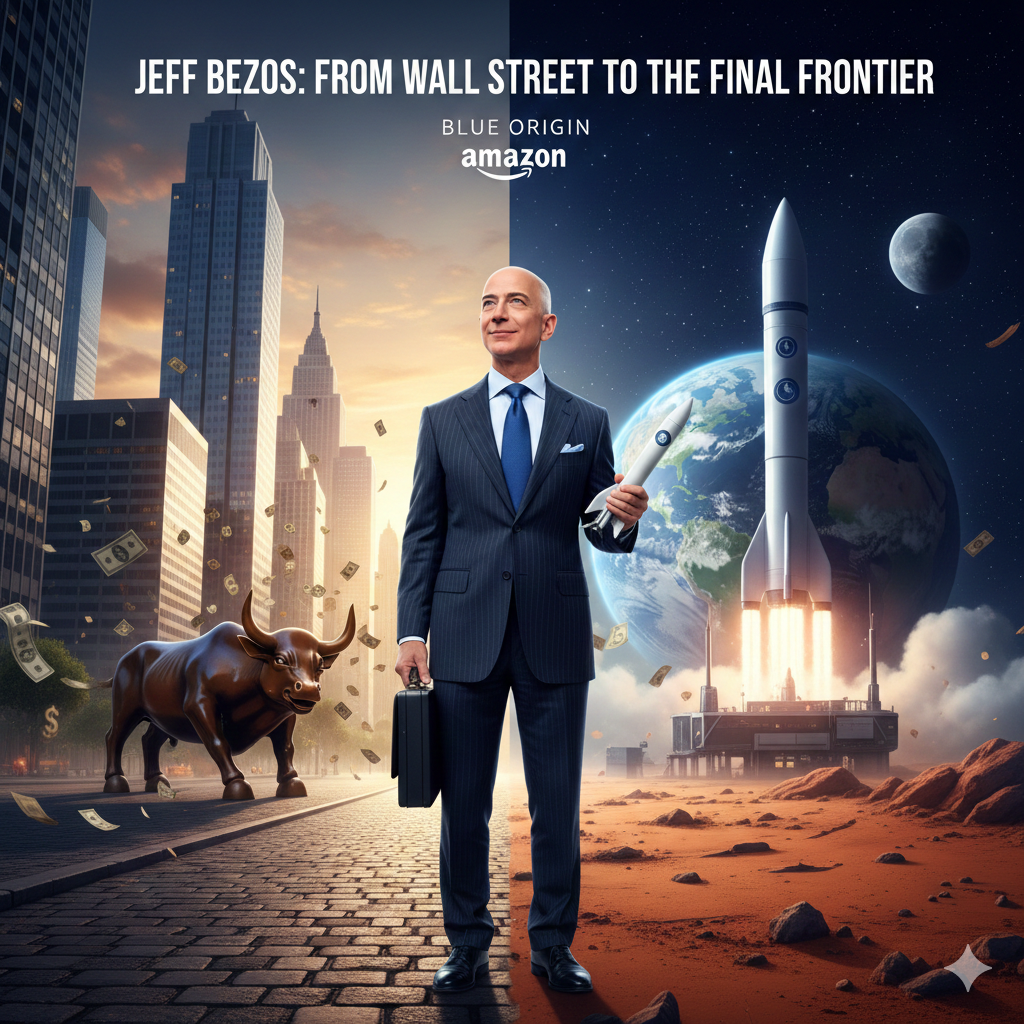
Jeff Bezos transformed retail, redefined cloud computing, and set his sights on space exploration. His journey from a Princeton graduate to one of the world’s wealthiest individuals offers insights into ambition, innovation, and the relentless pursuit of customer-centric business.
Early Life and Education
Born Jeffrey Preston Jorgensen on January 12, 1964, in Albuquerque, New Mexico, Bezos was adopted by his stepfather, Miguel Bezos, a Cuban immigrant. From an early age, he displayed an intense curiosity and entrepreneurial spirit. As a teenager, he worked on his grandfather’s ranch in Texas, developing a work ethic that would define his career.Bezos graduated as valedictorian from Miami Palmetto Senior High School and went on to Princeton University, where he studied electrical engineering and computer science. He graduated summa cum laude in 1986, setting the stage for a career that would blend technology with business innovation.
Wall Street Years
After Princeton, Bezos worked in the financial sector, including positions at Fitel, Bankers Trust, and the investment firm D. E. Shaw & Co., where he became the youngest senior vice president. During his time on Wall Street, Bezos honed his analytical skills and developed an understanding of complex systems that would later prove invaluable.
The Amazon Revolution
In 1994, Bezos made a decision that would change commerce forever. After learning that internet usage was growing at 2,300 percent per year, he quit his lucrative Wall Street job to start an online bookstore. He drove cross-country to Seattle with his wife MacKenzie, writing the business plan along the way.Amazon.com launched from Bezos’s garage on July 16, 1995. The choice of books as the initial product was strategic: they were easy to ship, didn’t require much storage space, and offered millions of potential titles. The company’s name was chosen to suggest scale, referencing the Amazon River, the largest river in the world.
Bezos’s vision extended far beyond books. His early letters to shareholders emphasized long-term thinking over short-term profits, a philosophy that allowed Amazon to reinvest heavily in growth and infrastructure. This approach was often criticized by investors expecting immediate returns, but Bezos remained committed to his strategy.
Expansion and Innovation
Amazon steadily expanded its offerings throughout the late 1990s and early 2000s, adding music, electronics, toys, and eventually becoming “the everything store.” The company pioneered customer reviews, personalized recommendations, and one-click purchasing. Amazon Prime, launched in 2005, revolutionized e-commerce by offering unlimited fast shipping for an annual fee.In 2006, Amazon launched Amazon Web Services (AWS), providing cloud computing services to businesses. This move proved prescient as AWS became one of the company’s most profitable divisions, essentially creating the infrastructure for much of the modern internet.
The introduction of the Kindle e-reader in 2007 disrupted the publishing industry, and Amazon’s acquisition of Whole Foods in 2017 for $13.7 billion signaled its ambitions in physical retail and groceries.
Leadership Philosophy
Bezos’s management style emphasized several key principles. His insistence on “customer obsession” rather than competitor focus shaped Amazon’s culture. The company’s leadership principles, including “bias for action” and “invent and simplify,” became famous in business circles.He was known for his “two-pizza rule” for meetings: no team should be so large that it couldn’t be fed with two pizzas. His annual shareholder letters became required reading for business leaders, offering insights into long-term thinking and innovation.
Bezos also championed the “Day 1” mentality, the idea that companies should always operate with the energy and focus of a startup, regardless of their size. He warned that “Day 2 is stasis, followed by irrelevance, followed by excruciating, painful decline, followed by death.”
Blue Origin and Space Ambitions
While building Amazon, Bezos pursued another childhood dream: space exploration. In 2000, he founded Blue Origin, a space company focused on making space travel accessible. The company’s motto, “Gradatim Ferociter” (step by step, ferociously), reflected Bezos’s methodical approach.Blue Origin achieved significant milestones, including successful rocket landings and the development of the New Shepard suborbital vehicle. In July 2021, Bezos himself flew to space on Blue Origin’s first crewed flight, calling it “the best day ever.”
Other Ventures and Interests
In 2013, Bezos purchased The Washington Post for $250 million, helping to stabilize the struggling newspaper and invest in its digital transformation. He has also invested in various other ventures through his firm Bezos Expeditions, including companies in healthcare, robotics, and artificial intelligence.His philanthropic efforts have included the Bezos Earth Fund, announced in 2020 with a $10 billion commitment to combat climate change, and the Day One Fund, which supports homeless families and creates preschools in low-income communities.
Stepping Down and Legacy
On July 5, 2021, Bezos stepped down as CEO of Amazon, transitioning to the role of executive chairman. Andy Jassy, who had led AWS, took over as CEO. This move allowed Bezos to focus more on Blue Origin, his philanthropic initiatives, and other passions.Bezos’s career has not been without controversy. Amazon has faced criticism over working conditions in its warehouses, its impact on small businesses, antitrust concerns, and its tax practices. His personal wealth, which has fluctuated but reached heights making him the world’s richest person, has sparked debates about income inequality.
Jeff Bezos fundamentally changed how people shop, how businesses operate their technology infrastructure, and how society thinks about space exploration. His relentless focus on the customer, willingness to experiment and fail, and commitment to long-term thinking created one of the most influential companies in history. Whether viewed as a visionary entrepreneur or a controversial billionaire, his impact on the 21st century is undeniable, and his ventures continue to shape commerce, technology, and exploration.