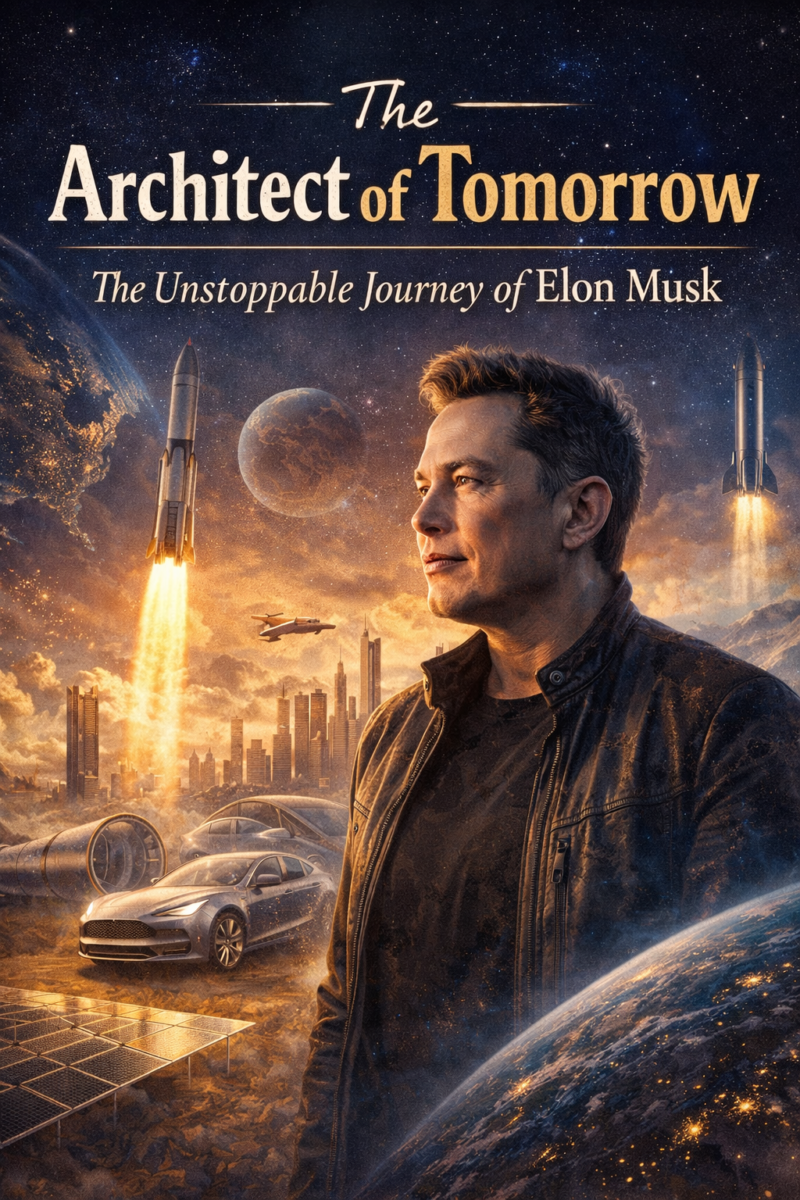
Love him or question him, you can’t ignore him. Elon Musk isn’t just a CEO; he’s a cultural phenomenon, a modern-day industrialist who seems to be drafting the blueprint for the 21st century—and beyond. His life reads less like a traditional career path and more like a sci-fi epic, driven by a single, audacious question: What future do we want to build, and how do we ensure humanity gets there?
The Seed of Ambition: From Pretoria to PayPal
Born in 1972 in Pretoria, South Africa, Musk’s early years were marked by a voracious appetite for knowledge. A self-taught programmer by age 12, he sold his first video game, “Blastar,” for $500. After studying physics and economics at the University of Pennsylvania, he headed to Stanford for a PhD but dropped out after two days, sensing the internet boom of the 90s was an opportunity he couldn’t miss.
His first major venture, Zip2, an online city guide for newspapers, was sold to Compaq for nearly $300 million in 1999. With his share, he co-founded X.com, an online financial services company. After a merger and internal battles, it evolved into what we now know as PayPal, revolutionizing online payments before being acquired by eBay for $1.5 billion in stock. At 31, Musk was a multimillionaire. Most would retire. For Musk, it was merely fuel.The “Insane” Bet: SpaceX and the Mars ObsessionIn 2002, with $100 million of his own money, Musk founded Space Exploration Technologies Corp., or SpaceX. His goal wasn’t just commercial spaceflight; it was to make humanity a multi-planetary species, starting with Mars. The aerospace establishment laughed. Rockets were for governments.
The early years were brutal. Three consecutive launch failures nearly bankrupted the company. The fourth launch, in September 2008, succeeded, saving SpaceX and securing a crucial NASA contract. Today, SpaceX’s reusable Falcon rockets dominate commercial launch, its Starlink constellation beams internet globally, and the colossal Starship is being tested for the eventual journey to the Red Planet. He turned science fiction into a business plan.
The Electric Gambit: Tesla and the Reinvention of the CarIn 2004, Musk joined Tesla Motors (now Tesla, Inc.) as chairman and lead investor, later becoming CEO. The mission: accelerate the world’s transition to sustainable energy. Skepticism was rampant. Electric cars were seen as slow, ugly golf carts.
Through sheer force of will, near-bankruptcy in 2008 (saved by a last-minute funding round he personally secured), and an uncompromising focus on technology and design, Tesla defied all odds. The Roadster, Model S, and now the mass-market Model 3 and Y didn’t just create a new car company—they forced the entire auto industry to pivot to electric. Tesla’s market value skyrocketed, making it one of the world’s most valuable companies and Musk the world’s richest person for a time.
The Vision Web: A Network of Ambition
Beyond rockets and cars, Musk’s ambitions form a sprawling, interconnected web. He co-founded SolarCity, a major solar energy services company now integrated into Tesla, to complete a sustainable energy ecosystem. With Neuralink, he ventures into neurotechnology, aiming to develop brain-computer interfaces to treat neurological conditions and eventually merge human consciousness with AI. His Boring Company seeks to solve urban congestion by building efficient underground tunnel networks. And with his latest venture, xAI, he steps directly into the arena of artificial intelligence, aiming to understand the fundamental nature of the universe. Each venture, no matter how outlandish it initially seems, ties back to his core missions: sustainable energy, preserving humanity’s future, and enhancing human capability.
The Paradox: Genius, Troll, and Icon
Musk is a study in contrasts. He is the engineer-in-chief who sleeps on the factory floor, the dreamer who relentlessly executes, and the public figure who oscillates between inspirational visionary and provocative, sometimes reckless, troll on social media. His management style is described as demanding, even ruthless. His personal life is tabloid fodder. He embraces controversy, whether it’s about AI doomsday scenarios, free speech on X (formerly Twitter, which he acquired in 2022), or public spats with regulators.
The Legacy-in-Progress
So, what is Elon Musk’s legacy? It is, by definition, unfinished. He is a man building his legacy in real-time, for all to see—flaws, triumphs, and all.He has already achieved the impossible multiple times over: making electric cars desirable, making rockets reusable, and making billion-dollar industries look stagnant. He operates on a timescale of centuries, not quarterly reports. He is a living testament to the power of first-principles thinking—breaking down problems to their fundamental truths and building solutions from the ground up, no matter how radical.
Whether he succeeds in getting humans to Mars, achieving full autonomy, or connecting our minds to machines, he has already changed our trajectory. He has forced us to look up, to think bigger, and to demand more from technology and from ourselves. He is the architect of tomorrow, tirelessly, relentlessly building it today—and inviting, or perhaps daring, the rest of us to come along.
The story of Elon Musk is still being written. And the next chapter is always the most anticipated.
