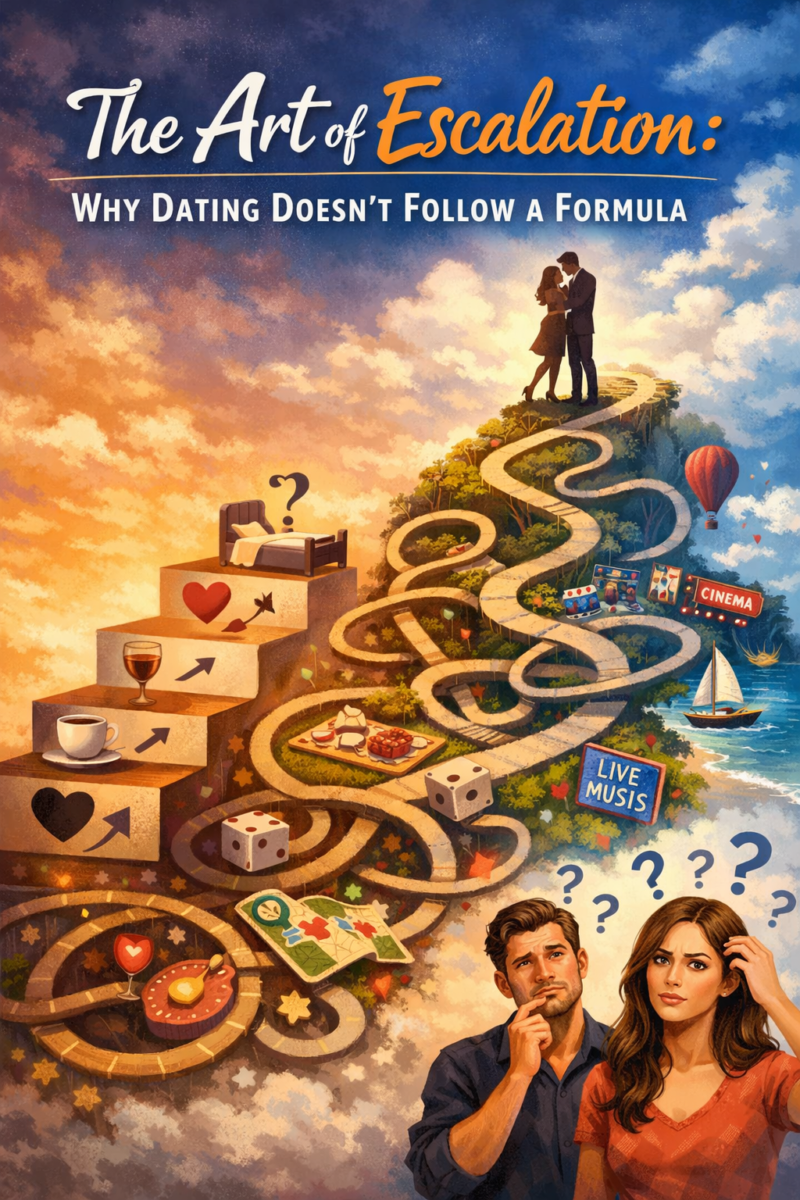
There’s a peculiar trend in dating advice where escalation gets treated like a mechanical process. Touch her arm at minute seven, hold her hand by the second date, lean in for the kiss when she laughs at your third joke. It’s as if human connection operates on some universal timer that just needs the right settings.
But anyone who’s actually dated knows this couldn’t be further from the truth. Escalation in dating is fundamentally an art, not a science, and understanding why reveals something important about human connection itself.Science deals in repeatability and predictable outcomes. If you combine hydrogen and oxygen in the right proportions under the right conditions, you get water every single time. Dating doesn’t work this way because people aren’t chemical compounds. The same approach that feels natural and welcome with one person might feel presumptuous or pushy with another. What creates chemistry on a Tuesday evening might fall completely flat on Thursday, even with the same two people.
The art of escalation lies in reading context, energy, and mutual interest in real time. It’s about noticing when someone leans toward you rather than away, when conversation flows versus when it stalls, when touch is reciprocated versus when someone subtly creates distance. These aren’t datapoints to plug into a formula but rather the nuanced signals that make up human communication.
Consider how different two people can be in how they experience comfort and attraction. Some people are naturally tactile and warm up quickly, comfortable with physical closeness early on. Others need more time to build trust before physical intimacy feels right, regardless of how attracted they are. Some express interest through sustained eye contact and verbal engagement, while others show it through nervous laughter and fidgeting. There’s no universal decoder ring because there’s no universal human experience.
This is actually what makes escalation an art form worth developing. Like any art, it requires cultivating sensitivity, awareness, and responsiveness. A skilled painter doesn’t just follow a paint-by-numbers template but instead responds to what’s emerging on the canvas, adjusting technique and approach as the work develops. Dating works the same way. You’re not following predetermined steps but rather co-creating an experience with another person, paying attention to how they respond and adjusting accordingly.
The moment you try to turn this into a rigid system, you stop being present with the actual person in front of you. You start performing a script rather than having a genuine interaction. And people can sense this. They can feel when someone is following a playbook rather than responding authentically to them as an individual.
What matters most is mutual enthusiasm and consent at every stage. Escalation should feel natural and reciprocal, something both people are moving toward together rather than something one person does to another. When both people are genuinely interested, escalation often happens organically through a series of small mutual steps, each one building comfort and connection for the next.The artistic skill comes in being attuned enough to notice what’s actually happening between you and another person. Are they engaged or distracted? Comfortable or tense? Moving closer or maintaining distance? These observations matter infinitely more than any predetermined timeline or technique.
Ultimately, treating escalation as an art rather than a science means accepting uncertainty and uniqueness. Every connection is different, every person brings their own history and preferences, and every moment contains variables you can’t control or predict. That’s not a bug in the system but rather what makes human connection meaningful in the first place. The artistry is in showing up authentically, staying present, and being responsive to another person’s humanity rather than trying to engineer an outcome.