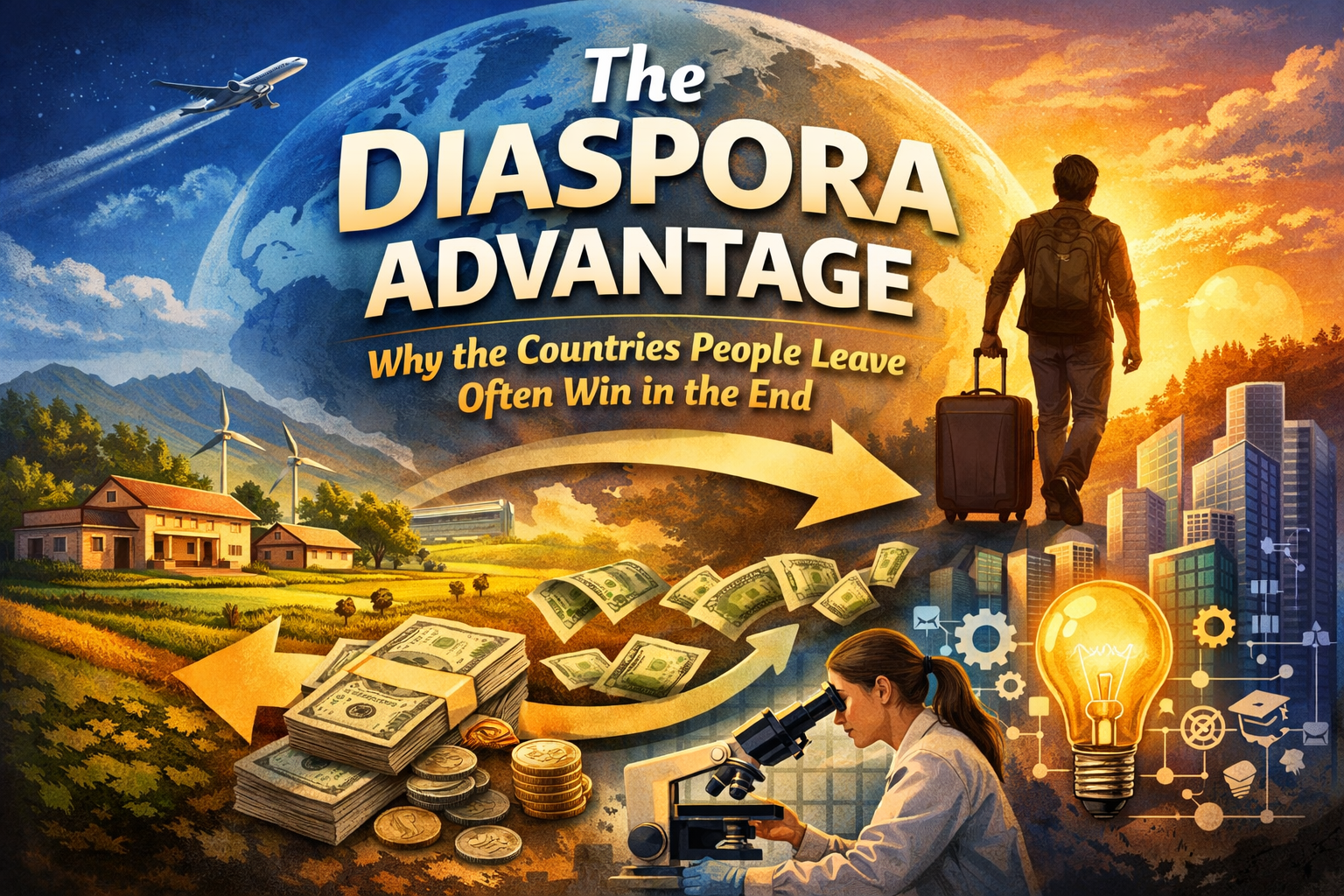
At first glance, mass emigration looks like failure. When large numbers of people leave a country, the instinctive conclusion is that something is broken. Talent is walking out the door. Ambition is being exported. The people most capable of building the future are choosing to build it somewhere else.
But that interpretation is incomplete. What looks like loss in the short term often becomes leverage over time.When people leave, they don’t vanish. They reposition themselves inside stronger systems. They gain access to better institutions, more efficient markets, and higher levels of productivity. A nurse who struggles to earn a decent wage at home can multiply her income abroad. A software developer who lacked opportunity locally can plug into a global tech ecosystem. A small business owner can observe how scalable operations actually work in practice rather than in theory.And then something important happens. They stay connected.
Money is the first signal. Remittances begin as support for family, but at scale they become a stabilizing force for entire economies. They smooth consumption, fund education, and inject foreign currency directly into local systems without passing through layers of bureaucracy. In many countries, these inflows quietly underpin economic resilience in ways that headline GDP figures don’t fully capture.
But money is the most visible effect, not the most powerful one.The deeper shift comes from exposure. People who live abroad see how things can function when systems are aligned. They experience reliability, accountability, and speed. They learn what professional standards look like when they are enforced consistently. And when they stay in touch with home, those comparisons travel back with them.Expectations begin to change. What once felt normal starts to feel inefficient. What once seemed acceptable starts to feel avoidable. This doesn’t transform a country overnight, but it creates pressure. Over time, that pressure accumulates.
Diasporas also become networks, and networks are economic infrastructure. A country with a large global footprint of its people has built-in bridges to other markets. Trust moves faster when there is shared language, culture, or background. A founder trying to raise capital has a warmer introduction. A freelancer trying to find clients has a credible entry point. A company trying to expand internationally has people on the ground who understand both sides.These connections reduce friction, and in economics, reducing friction is everything.
As the network matures, opportunities start to flow in both directions. Outsourcing relationships form. Trade becomes easier. Investment finds its way into places that once felt too distant or uncertain. Entire industries can emerge from these cross-border links, not because of government strategy, but because of human relationships.
Then comes the phase that tends to surprise people. Some of those who left begin to return.They don’t come back empty-handed. They return with capital, with skills, and with a different frame of reference. They’ve seen what works elsewhere, and they’re less willing to accept limitations that once felt fixed. They build businesses, fund developments, and create pockets of higher-functioning environments within their home countries.
Even when they don’t return permanently, they still shape outcomes. They invest from abroad. They mentor. They connect local talent to global opportunities. They influence how their country is perceived on the world stage.
None of this means emigration is painless. In the early stages, it can absolutely slow domestic progress. Losing skilled workers creates real gaps. Families are separated. Communities thin out. The benefits take time to compound, and there is no guarantee that every country will capitalize on them.
But history shows a pattern. Countries that produce large, globally integrated diasporas often develop a second engine for growth outside their borders. Over time, that external engine feeds back into the domestic one.What begins as departure turns into distribution. What looks like loss becomes reach. And what feels like a setback can quietly become an advantage.The countries that rise later are often the ones whose people left first, learned quickly, and never really stopped building—no matter where they went.