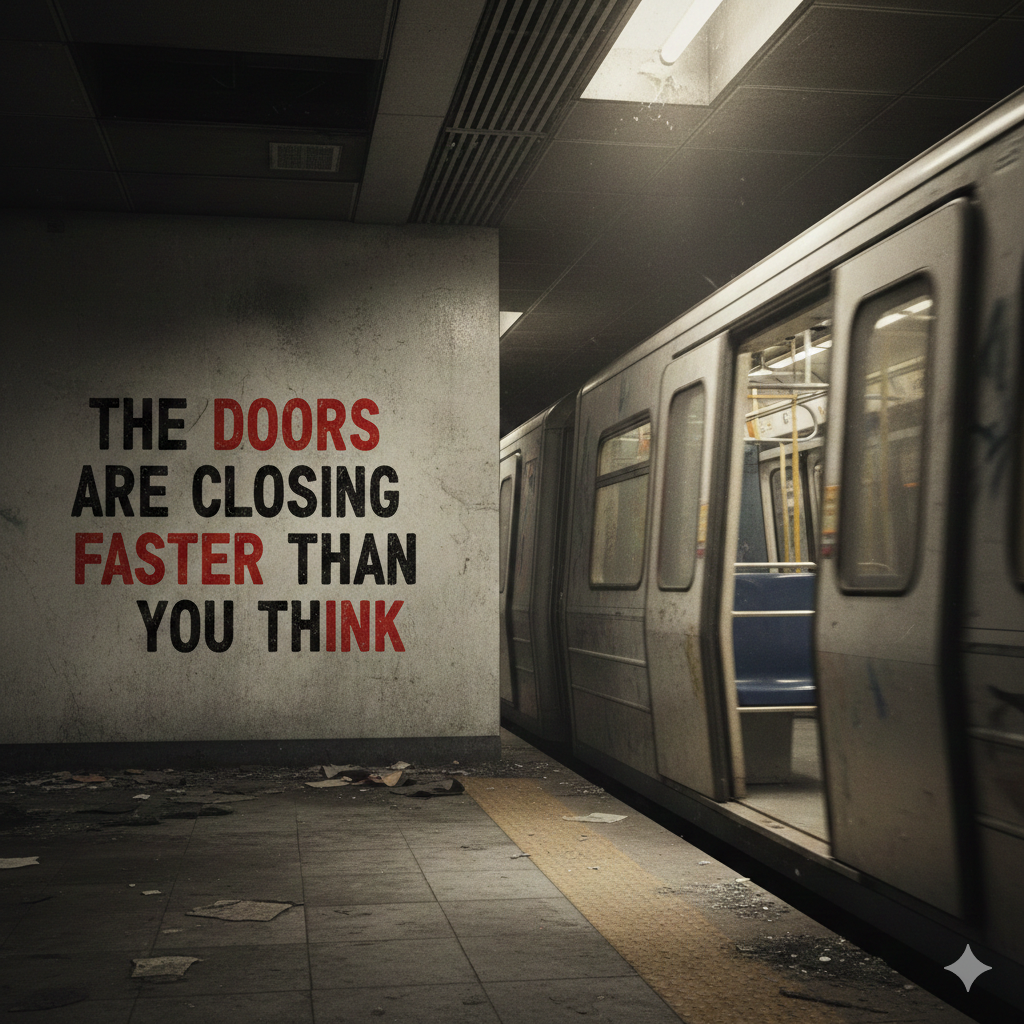
There’s a peculiar illusion most of us carry about time. We imagine our options stretching out before us like an endless hallway, each door waiting patiently for us to decide whether to walk through. We tell ourselves we’ll figure things out eventually, that we have plenty of time to make the big calls about career, relationships, where to live, what to pursue. But here’s the uncomfortable truth: those doors are closing behind you right now, and they’re slamming shut faster than you realize.
I’m not talking about some abstract mortality reminder or motivational cliché about seizing the day. I’m talking about the very concrete way that indecision itself becomes a decision, and how the architecture of your life hardens around you while you’re still thinking things over.
Consider your career. Every year you spend in a particular industry or role, you’re not just gaining experience—you’re also narrowing the range of pivots that remain realistic. That doesn’t mean change becomes impossible, but it does mean the cost escalates. The 25-year-old who wants to switch from consulting to medicine faces a very different proposition than the 35-year-old with a mortgage and two kids. The door doesn’t lock completely, but it gets heavier with each passing year. Your professional network calcifies around your current trajectory. Your financial obligations grow to match your income. Your identity becomes increasingly entangled with what you do.The same principle applies to geography. Maybe you’ve always thought you’d spend a few years living abroad, or try out that city you visited once and loved. But then your friend group solidifies in your current location. Your partner gets a job opportunity they can’t pass up. Your parents get older and need you closer. Suddenly, the decision to move isn’t just about you anymore—it’s about unwinding an entire web of commitments and relationships. What felt like a simple choice at 23 has become a logistical nightmare by 33.
Relationships operate on an even more unforgiving timeline. We like to pretend that love exists outside of practical constraints, but the reality is that your pool of potential partners contracts dramatically as you age. Not because you become less desirable, but because more people pair off, because your social circles become less fluid, because the spontaneous encounters that lead to romance become rarer. If you want children, biology imposes its own ruthless deadlines. You can debate the fairness of these constraints all you want, but they don’t care about your philosophical objections.The cruelest part is that you often don’t realize a door has closed until you try to walk back through it. You think you’re just postponing a decision, giving yourself more time to gather information and weigh your options carefully. Then one day you look up and discover that the choice has been made for you by accumulated circumstances. You’re not a consultant anymore who might go to medical school—you’re a senior manager with golden handcuffs. You’re not someone considering different cities—you’re a homeowner with equity and a fixed mortgage rate. You’re not exploring relationship possibilities—you’re single at an age where the dating pool has gotten uncomfortably shallow.This isn’t an argument for recklessness or impulsive decision-making. Rough decisions don’t mean careless ones. But they do mean accepting that you’re operating with incomplete information and making your best guess anyway. Waiting for certainty is itself a gamble, one that bets on the future offering you the same options you have today. That’s usually a bad bet.
The optimal strategy isn’t to agonize until you’ve achieved perfect clarity about your life’s direction. It’s to make a rough call based on what you know now, with the understanding that you can course-correct later if needed. Yes, some decisions are harder to reverse than others, but even the big ones rarely result in complete catastrophe if they turn out wrong. What does result in catastrophe is deferring so long that you lose the agency to decide at all.
Think of it like crossing a river by stepping on stones. You can stand on your current stone and carefully study every possible rock ahead, trying to plot the perfect path across. But while you’re deliberating, the water is rising. Some of those stones are going to slip under the surface. Eventually you’ll have to make a leap that’s longer and more precarious than it would have been if you’d just picked a direction and started moving.
Your twenties and early thirties are when you have maximum optionality and minimum obligations. This is the time when wrong choices are cheapest and changes of direction are easiest. But our culture has somehow convinced young people that these are the years to “find yourself” and “explore your options” indefinitely, as if the universe will patiently wait while you conduct a decades-long investigation into your own preferences.
It won’t wait. The doors are closing right now. Every month you spend in a job you’re ambivalent about is a month you’re not building skills in a field you might actually care about. Every year you stay in a city out of inertia is a year you’re not developing roots somewhere you chose intentionally. Every relationship you let drift without commitment is foreclosing on the possibility of deeper partnership and shared life-building.
Make the rough call. Pick a direction that seems approximately right and commit to it properly, not half-heartedly. You can always adjust later, but only if you’re actually moving. Standing still doesn’t preserve your options—it watches them evaporate while you convince yourself you’re being thoughtful and deliberate.
The doors are closing. Walk through one while you still can.