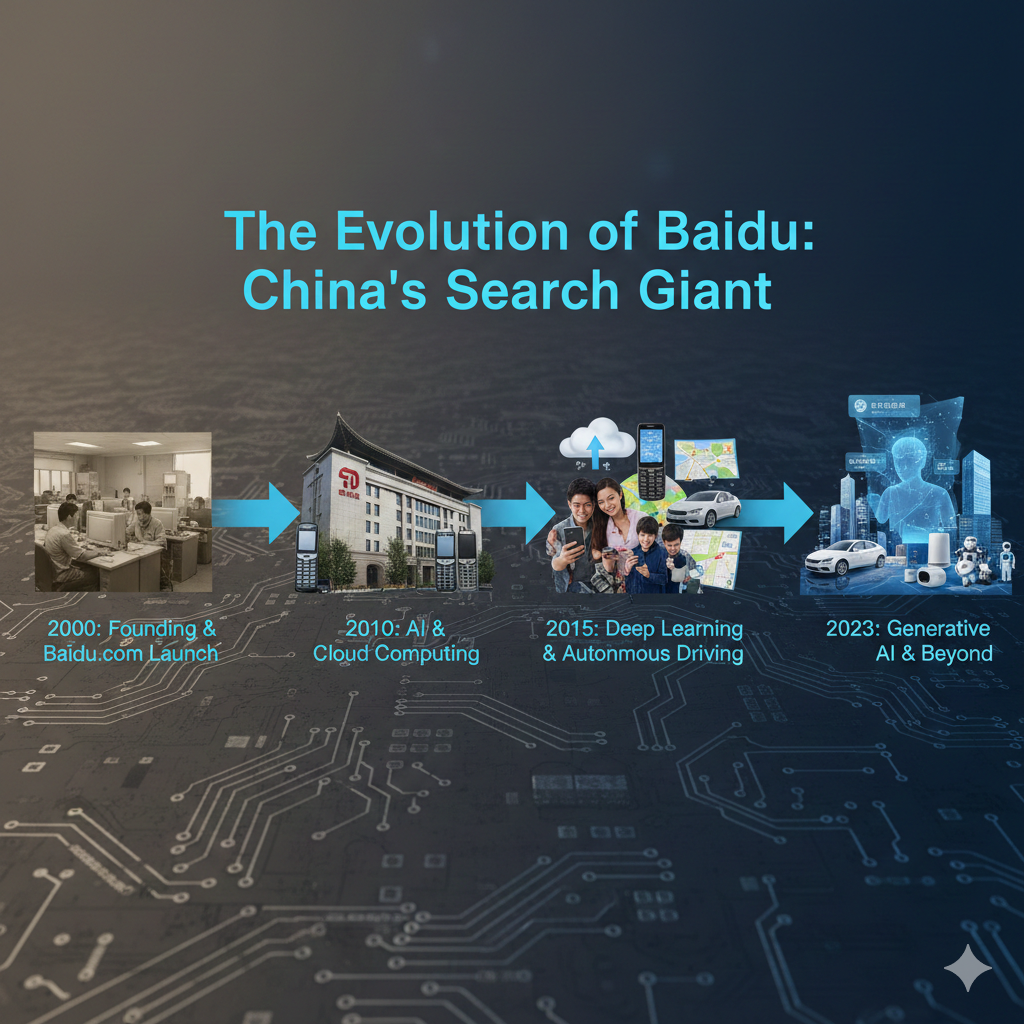
In the landscape of global technology companies, few stories are as compelling as that of Baidu, often called “China’s Google.” Yet this comparison, while convenient, barely scratches the surface of a company that has shaped how over a billion people access information online.
The Beginning
Baidu was founded in January 2000 by Robin Li and Eric Xu in Beijing. Li, who had previously worked at Dow Jones and Infoseek in the United States, brought crucial expertise in search technology. While at Infoseek, he had developed RankDex, an early search ranking algorithm that predated Google’s PageRank. This technical foundation would prove essential to Baidu’s success.
The company’s name comes from a poem written during the Song Dynasty over 800 years ago, roughly translating to “hundreds of times” and suggesting a persistent search for an ideal. From the outset, Li and Xu recognized that China’s internet users needed a search engine optimized for Chinese language queries, which presented unique technical challenges compared to English-language search.
Early Growth and Challenges
Baidu’s timing was fortuitous. China’s internet population was exploding in the early 2000s, growing from roughly 22 million users in 2000 to over 100 million by 2005. Initially, Baidu provided search services to other Chinese portals like Sina and Sohu, but in 2001, the company pivoted to offering search directly to consumers through Baidu.com.
The competitive landscape was fierce. Google had entered China in 2000, and other local competitors vied for market share. However, Baidu had distinct advantages. The company understood local user preferences and behaviors better than foreign competitors. Chinese internet users, for instance, preferred denser information displays and were more accepting of advertising integrated into search results. Baidu also faced fewer cultural and linguistic barriers than its Western competitors.
By 2003, Baidu had begun to pull ahead, and the company introduced innovations tailored to the Chinese market. Baidu Tieba, a keyword-based discussion forum launched in 2003, became one of the world’s largest Chinese-language online communities. The following year, Baidu introduced Baidu Baike, a Chinese-language collaborative encyclopedia similar to Wikipedia.
Going Public and Market Dominance
August 5, 2005, marked a watershed moment when Baidu went public on the NASDAQ stock exchange. The IPO was spectacularly successful, with shares jumping 354% on the first day of trading, making it one of the most successful tech IPOs in American market history at that time. This success reflected investor optimism about China’s internet growth and Baidu’s dominant position.
The company’s timing was again fortunate. In 2006, Google faced increasing friction with Chinese authorities over content censorship and cyber attacks. By 2010, Google effectively withdrew from mainland China, redirecting users to its Hong Kong site. While Google’s departure was prompted by principled concerns about censorship and security, it left Baidu as the undisputed leader in Chinese search, eventually capturing over 70% market share.
Diversification and Innovation
With its search business secure, Baidu aggressively diversified. The company acquired online video platform iQiyi in 2012 (later taking it public in 2018), positioning itself in the streaming entertainment space. Baidu also invested heavily in mobile apps as smartphones became the primary internet access point for Chinese users.Perhaps most significantly, Baidu made major commitments to artificial intelligence and autonomous driving. In 2013, the company established the Institute of Deep Learning, China’s first institute dedicated to deep learning research. Robin Li positioned Baidu as an AI-first company, arguing that artificial intelligence would be as transformative as the mobile revolution that preceded it.In 2017, Baidu launched Apollo, an open-source autonomous driving platform designed to accelerate the development of self-driving vehicles. The initiative attracted over 100 partners, including major automakers, and represented Baidu’s ambition to lead in next-generation transportation technology. The company began testing autonomous vehicles in Chinese cities and expanded internationally.
Recent Challenges and Transformations
The 2010s brought both opportunities and controversies. In 2016, Baidu faced intense criticism following the death of a college student who had sought cancer treatment through a hospital advertised on Baidu’s platform. The incident sparked national outrage about medical advertising on the platform and led to increased regulatory scrutiny. The company implemented reforms to its advertising practices, but the episode damaged its reputation.
Competition also intensified from unexpected directions. ByteDance, the company behind TikTok and its Chinese version Douyin, emerged as a formidable competitor not just in social media but in how users discovered information. Instead of actively searching, users increasingly consumed algorithmically recommended content. Baidu had to adapt its strategy to this new paradigm.
The COVID-19 pandemic accelerated certain trends. Baidu’s AI and cloud computing businesses grew as digitalization accelerated across Chinese industries. The company’s autonomous driving technology continued advancing, with robotaxi services expanding to multiple cities. In 2023, Baidu launched ERNIE Bot, its answer to ChatGPT and other large language models, positioning itself in the generative AI revolution.
The Present and Future
Today, Baidu remains one of China’s most valuable technology companies, though it faces a vastly different competitive landscape than in its early days. The company has evolved from a pure search engine into a diversified technology conglomerate with significant investments in AI, cloud computing, autonomous driving, and content platforms.
The challenges ahead are substantial. Chinese regulators have increased oversight of technology companies, potentially constraining growth strategies. Competition for advertising revenue remains fierce. International expansion has proven difficult given geopolitical tensions and the company’s deep integration with the Chinese market.
Yet Baidu’s story reflects broader themes in Chinese technology development: rapid domestic growth, adaptation to local preferences, navigation of regulatory requirements, and ambitious investments in emerging technologies. From its founding in a Beijing apartment to its current position as an AI and autonomous driving powerhouse, Baidu has consistently bet on technological transformation while remaining deeply rooted in understanding Chinese internet users. Whether those bets will secure its position for another quarter century remains one of the compelling questions in global technology.