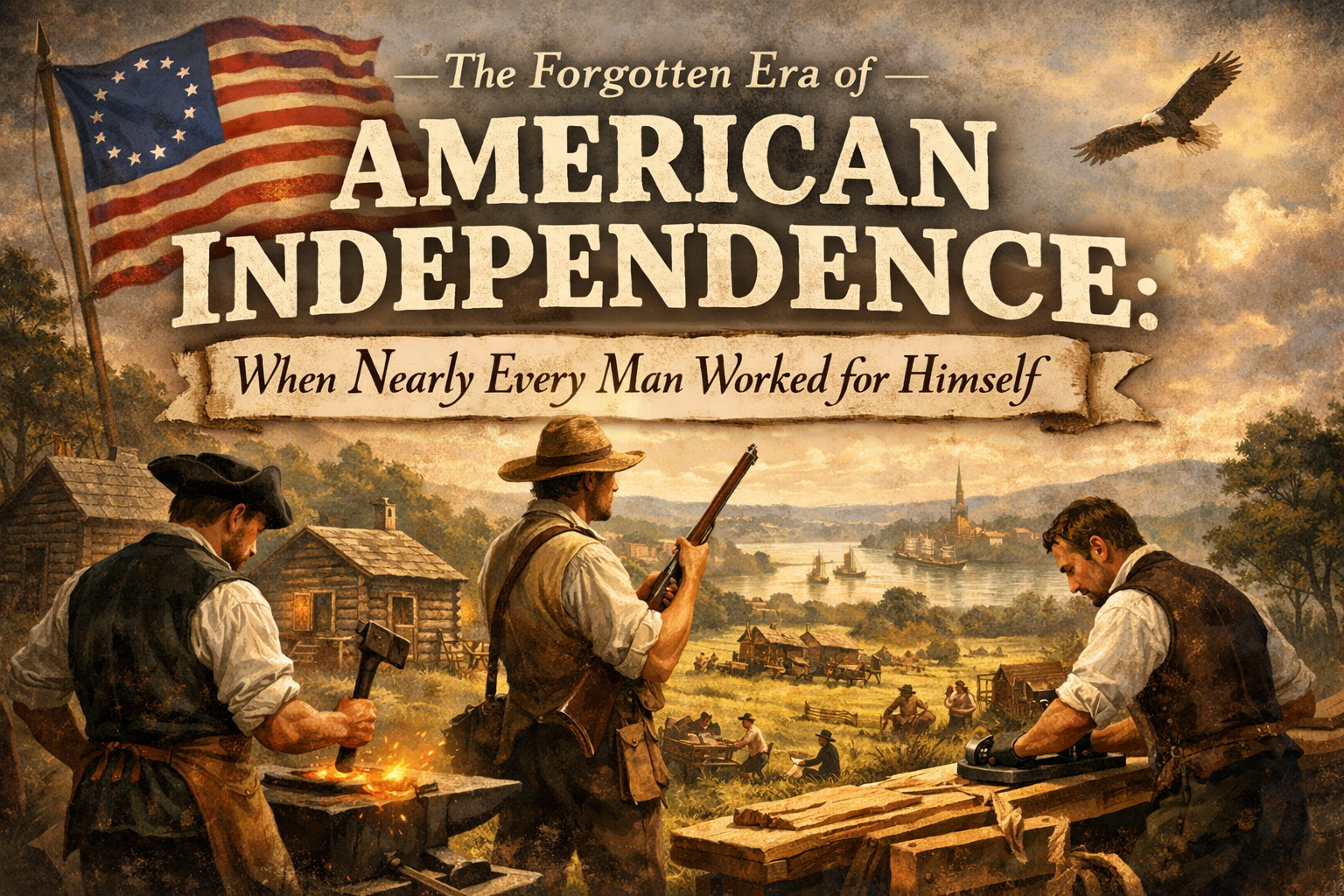
Walk through any modern American city today and you’ll see a landscape shaped by employment. Glass office towers filled with salaried workers, retail chains with hourly employees punching clocks, factories operating on shift schedules. We take for granted that most people work for someone else—that employment is the natural order of economic life. But travel back two centuries to the early 1800s, and you would find a radically different America. An America where the concept of “going to work” meant walking to your own workshop, field, or storefront. An America where the vast majority of men were not employees, but proprietors of their own livelihoods.
This was the age of the self-employed majority, a chapter of American history so thoroughly erased from our collective memory that we struggle to imagine it ever existed.
The Economic Landscape of a Young Nation
In the decades following the Revolution, the United States remained overwhelmingly rural and agricultural. The census of 1810 revealed that roughly eighty-five percent of Americans lived in rural areas, with the majority engaged in farming. But these were not the tenant farmers or agricultural laborers that would later populate the industrial era. These were independent proprietors who owned their land, however modest the plot, and worked it for their own account.
The typical American farmer of 1820 did not receive wages. He did not have a boss. He arose each morning to labor on property he owned, producing goods he would sell or trade in markets he chose, keeping the profits or absorbing the losses himself. His economic fate rested entirely in his own hands, for better or worse. This was self-employment not as a modern career choice or entrepreneurial aspiration, but as the default condition of working life.
The pattern extended far beyond agriculture. In towns and villages across the new nation, skilled craftsmen operated as independent artisans. The blacksmith owned his forge. The carpenter maintained his own tools and hired helpers only when demand required. The printer might employ a few journeymen, but he remained the master of his shop, bearing full responsibility for its success. The merchant purchased goods on his own credit and sold them at prices he determined. The physician, the lawyer, the surveyor—all operated as independent practitioners building personal reputations and private practices.
Why Independence Prevailed
Several forces conspired to make self-employment the norm rather than the exception. The abundance of land available for settlement meant that any white man with modest means could acquire property and establish himself as an independent farmer. The relative scarcity of labor meant that those who possessed skills could command premium rates working for themselves rather than accepting subordinate positions. The limited scale of enterprise meant that most businesses required little capital to enter, allowing craftsmen to set up shops with tools they already possessed.
The legal and social structure reinforced this independence. The United States had inherited no feudal tradition of fixed social ranks. No aristocracy controlled access to land or opportunity. White men enjoyed political rights that were explicitly tied to property ownership and independence, creating powerful incentives to maintain autonomous economic standing. To be a dependent employee was to occupy a diminished status, suitable for apprentices, indentured servants, or the unfortunate. The ideal of the independent citizen-proprietor shaped not just economic behavior but the very definition of American manhood.
The Meaning of Work
For these self-employed men, work was not a discrete activity separated from life, governed by clock time and corporate policy. The farmer’s labor followed the rhythms of seasons and weather. The artisan’s schedule responded to customer demand and personal energy. The merchant’s hours stretched to accommodate opportunity. There were no weekends in the modern sense, yet also no rigid distinction between work and leisure, no time cards to punch, no supervisors to report to.
This independence carried profound psychological weight. The self-employed man experienced directly the connection between effort and reward. He bore the anxiety of uncertainty without the comfort of guaranteed wages, but he also enjoyed the satisfaction of building something entirely his own. His identity was not occupational but proprietorial. He was not “a blacksmith” in the sense of performing a function within an organization; he was the blacksmith, the owner of that particular establishment, known by his personal reputation and individual skill.
The Beginning of the End
Even as self-employment dominated the early nineteenth century, forces were gathering that would eventually dismantle this world. The transportation revolution of canals and railroads would expand markets beyond local boundaries, favoring larger-scale operations over small workshops. The factory system, still in its infancy in New England textile mills, would eventually spread across industries. The corporate form of business organization, rare and suspect in the early republic, would become the dominant vehicle for economic activity.
Yet in 1820 or 1830, these developments remained largely invisible to most Americans. The self-employed majority appeared permanent, the natural state of a free people. The transformation to a wage-earning society would require decades, meeting resistance and generating the political conflicts over industrial capitalism that would define the remainder of the century.
Recovering a Lost Vision
We live today in the world that replaced that early American independence. The employee relationship has become so ubiquitous that we struggle to conceive of alternatives. We speak of entrepreneurship as a risky deviation from the norm, forgetting that dependence on wages was once the exception. We worry about the “future of work” while remaining ignorant of its deep past.
Understanding this history matters not for nostalgic purposes, but for expanding our sense of possibility. The early nineteenth century demonstrates that organizing economic life around independent proprietorship is not utopian fantasy but historical reality. It reveals that the employment relationship, for all its apparent inevitability, is a relatively recent invention. And it reminds us that questions about the distribution of property, the scale of enterprise, and the meaning of independence have shaped American society from its earliest days.
The self-employed majority of the early 1800s built a nation while working for themselves. Their legacy persists not in our economic structures, which have transformed beyond recognition, but in the enduring American rhetoric of independence, self-reliance, and the dignity of being one’s own master. We have forgotten that these were once lived realities for most men, not merely aspirational slogans. Recovering that memory allows us to ask more honestly what we have gained and what we have lost in the long transition from a nation of proprietors to a nation of employees.