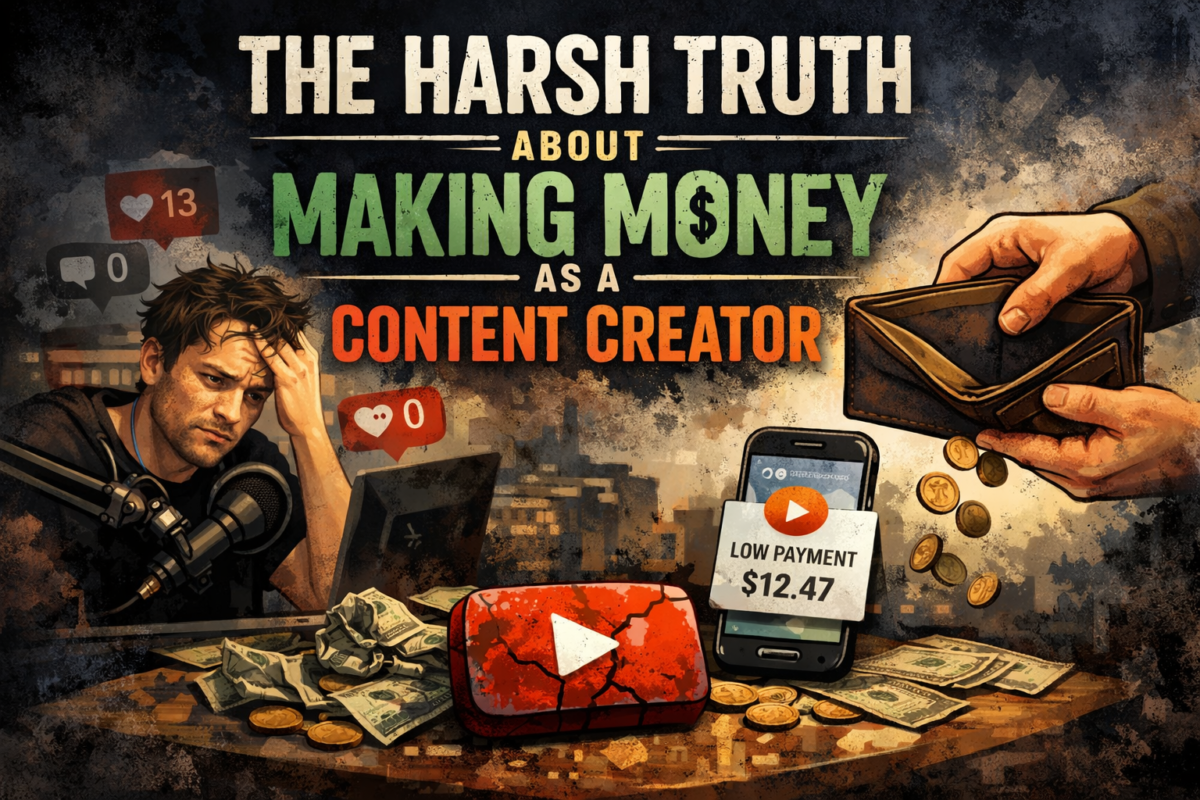
The internet has done a remarkable job of selling a particular dream. You have seen it countless times — the laptop on a beach, the passive income screenshot, the creator who built an audience of millions and now earns more in a month than most people make in a year. It looks attainable. It looks like a meritocracy where talent and consistency are all you need. And for a small number of people, that version of events is more or less true.
For the overwhelming majority of people who try it, the reality is something else entirely.
The Math Nobody Talks About
The content creation economy runs on a winner-take-most model that the platforms marketing themselves to aspiring creators are not particularly eager to advertise. On YouTube, the top one percent of channels capture the vast majority of views, ad revenue, and sponsorship deals. The same pattern holds on Instagram, TikTok, Spotify, and every other major platform. There is an enormous pool of creators producing content, and the economic rewards are concentrated at the very top of that pool in a way that makes the odds of meaningful income look more like the lottery than a career.
The average YouTube channel with ten thousand subscribers — which is itself a milestone that takes most creators years to reach — earns somewhere between $200 and $500 per month from ad revenue. That figure, before taxes, represents the return on potentially thousands of hours of work across scripting, filming, editing, optimizing, promoting, and engaging with an audience. When you divide the income by the hours invested, the effective hourly rate for most content creators is not just modest — it is frequently below minimum wage.
The Hidden Costs
What the highlight reel of successful creators almost never shows is the infrastructure required to produce content at a competitive level. The camera equipment, lighting, microphones, and editing software that make a channel look professional are not cheap. Neither is the time spent learning to use them. A creator who wants to compete with established channels in almost any niche quickly discovers that the barrier to entry, while lower than it was a decade ago, is still substantial in terms of both money and time.Then there are the softer costs that are harder to quantify but just as real. The mental energy of constantly generating ideas. The emotional labor of putting your face, voice, and opinions in front of a public audience and managing the feedback — including the negative kind. The relentless pressure of the algorithm, which rewards consistency above almost everything else and punishes creators who slow down or take a break. Burnout among content creators is not just common — it has become something of a defining feature of the profession, with some of the platform’s biggest names regularly stepping away or quitting entirely after describing the grind as unsustainable.
The Monetization Timeline
One of the most misleading aspects of the content creator dream is the implied timeline. The success stories that circulate on social media tend to compress years of grinding work into a narrative that feels sudden and inevitable in retrospect. What rarely gets discussed is how long most successful creators worked before earning meaningful income — and how many people with equivalent talent and effort simply never got there.YouTube requires a channel to accumulate one thousand subscribers and four thousand watch hours before it can even apply to monetize through ads. For most creators starting from zero, that threshold alone takes between one and three years to reach. And crossing it does not mean the income becomes significant — it means the income becomes possible. The gap between possible and livable is vast, and most creators never close it.
Sponsorship deals and brand partnerships, which represent the real money for mid-tier creators, generally do not materialize until a channel has demonstrated consistent viewership in the tens of thousands. Building to that level while earning little to nothing along the way requires either a secondary income source, substantial savings, or a tolerance for financial stress that most financial planning advice would not endorse.
The Opportunity Cost Nobody Calculates
Perhaps the most underappreciated dimension of the content creation gamble is what economists call opportunity cost — what you give up by pursuing one path instead of another. The thousands of hours a person invests in building a YouTube channel or a blog or a podcast that never gains traction are hours that could have been spent developing a marketable skill, building a freelance client base, advancing in a career, or starting a service business with a far more predictable income trajectory.
A person who spends two years and two thousand hours trying to build a monetizable content channel, only to abandon it with a few hundred subscribers, has not just lost the income they hoped to earn. They have also foregone two years of progress toward something that might have actually worked. That is a cost that rarely appears in the conversation about content creation as a path to financial freedom.
When It Does Work, It Usually Looks Different
The content creators who do build sustainable income from their work tend to share a few characteristics that the surface-level success narrative leaves out. Most of them entered a niche early, before it became saturated. Many of them had pre-existing audiences, platforms, or professional credibility that gave them a head start. A significant number of them treat content creation as a marketing tool for a separate business — a consulting practice, a course, a software product, a service — rather than the business itself. In these cases, the content is not the product. It is the funnel.
This distinction matters enormously. A CPA who creates YouTube videos about small business tax strategy is not trying to earn ad revenue — they are attracting clients. A business coach who publishes a newsletter is not monetizing the newsletter directly — they are filling their coaching program. When content creation is in service of something else that generates reliable income, the math changes significantly. When content creation is the income strategy itself, the math is brutal for most people who try it.
A More Honest Conversation
None of this means content creation is without value or that nobody should try it. It means that anyone considering it as a path to financial independence deserves an honest accounting of the odds, the timeline, the costs, and the alternatives. The platforms that benefit from a large pool of aspiring creators have very little incentive to provide that honesty. The creators who made it have survivorship bias baked into every piece of advice they give — they are, by definition, not representative of the people who tried and failed.
The dream is real for some people. The work is real for almost everyone. And the income, for the vast majority who pursue it, never arrives in the form the dream promised.Before investing years of your life and thousands of hours into building an audience that may never come, it is worth asking whether there is a more direct path to what you actually want — and whether the content creator identity is the goal, or simply one possible route to a destination that has other roads leading to it.