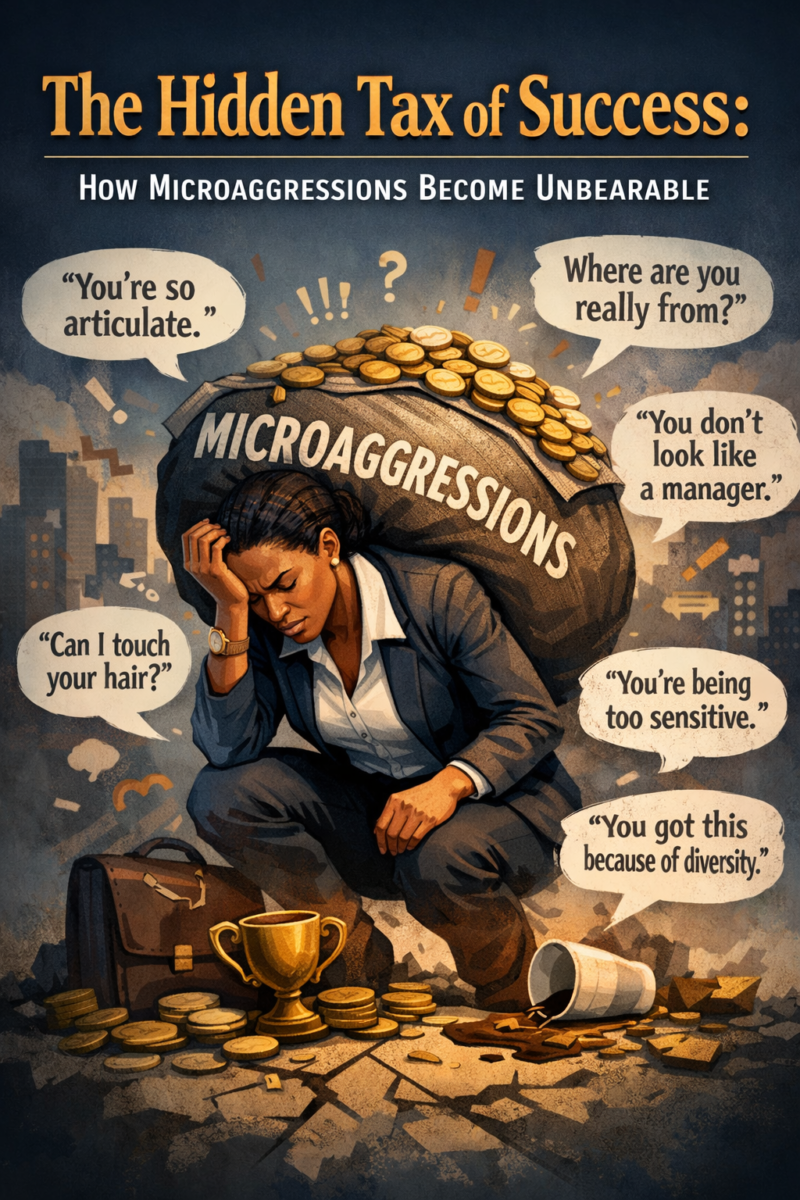
When you’re twenty-five and grinding through seventy-hour weeks, a dismissive comment from a colleague barely registers. You’re too busy proving yourself, too focused on the next milestone, too determined to let anything slow you down. The casual assumptions about your capabilities, the surprised reactions when you speak up in meetings, the subtle exclusions from after-work drinks—they roll off your back because you’ve got momentum on your side and something to prove.But here’s what nobody tells you about climbing the ladder: the microaggressions don’t disappear when you succeed. They multiply. And worse, they start costing you something you can no longer afford to lose.
By the time you’ve reached middle management or built up some financial security, something fundamental has shifted. You’ve proven yourself a hundred times over. You’ve delivered results, managed teams, closed deals, solved problems that stumped everyone else. You’ve earned your seat at the table through sheer competence and years of effort. And yet the same tired patterns persist. Someone talks over you in the meeting you’re leading. A client asks to speak to “whoever’s in charge” when you’ve just introduced yourself as the director. A colleague feels entitled to question your judgment on matters where you’re clearly the expert.
The exhaustion hits differently now because the math has changed. When you were starting out, you had time and energy to burn. You could absorb these slights as the price of entry, shrug them off as temporary obstacles on the path to somewhere better. You told yourself that once you reached a certain level, once you had the credentials and the track record, things would be different.
But they’re not different enough. And now you’re calculating the return on investment of your emotional labor in ways you never did before. Every microaggression requires a decision: Do I address this directly and risk being labeled as oversensitive? Do I let it slide and feel the slow burn of resentment? Do I carefully educate this person, knowing I’ll probably have to educate the next person and the person after that? Each option extracts a toll.The cumulative weight becomes staggering. You’re no longer just dealing with individual incidents but with the pattern recognition that comes from experience. You know how this conversation will unfold before it even starts. You can predict the subtle skepticism you’ll face in the client pitch. You’ve learned to preemptively establish your credentials in every new interaction because you’ve learned the hard way what happens when you don’t. This kind of constant vigilance is cognitively expensive.
What’s particularly insidious is how microaggressions intensify precisely when you should be able to relax. You’ve reached a level of success that should mean respect by default, authority without question, the benefit of the doubt. Instead, you’re still fighting the same battles, just in nicer conference rooms. The gap between where you should be and where others treat you as being becomes a source of chronic frustration.The financial cushion you’ve built offers some buffer, but it also raises the stakes. You’re no longer willing to tolerate nonsense just to keep a paycheck. You’ve got options now. You could walk away. And sometimes you think about it more than you’d like to admit. The golden handcuffs loosen when every day requires you to swallow indignities that your peers simply don’t face.
Meanwhile, you’re expected to mentor the next generation, to be the representation that you needed when you were starting out. But you’re running on fumes. The energy that could go toward innovation, strategy, or supporting others gets diverted into managing other people’s biases and assumptions. You become a shock absorber for a system that refuses to change, and the impact accumulates in your body: the tension headaches, the Sunday night dread, the snapping at loved ones over minor things because your reserves are completely depleted.
The tragedy is that success was supposed to insulate you from this. You did everything right. You worked harder, got the degrees, delivered the results, played the game. And the reward is discovering that the game never really ends. The goalposts don’t just move—they multiply. Each new level brings new variations of the same fundamental disrespect, just wrapped in more polite language and delivered by people with better titles.This is the hidden tax that nobody warns you about: the emotional and psychological toll of constantly being underestimated despite overwhelming evidence to the contrary. When you’re young and hungry, you can power through on adrenaline and optimism. When you’re established and accomplished, you’re forced to confront the fact that some people will never see you clearly no matter what you achieve. And that realization is genuinely depleting in ways that early-career struggles never were.
The calculation becomes stark: Is this worth it? Not the job itself, but the perpetual tax on your humanity. The answer varies by day, by situation, by how much you’ve got left in the tank. But the question itself—the fact that you’re asking it after years of success—reveals the true cost of microaggressions. They’re not just annoying. They’re corrosive. And they become unbearable precisely when you’ve earned the right to be unburdened by them.