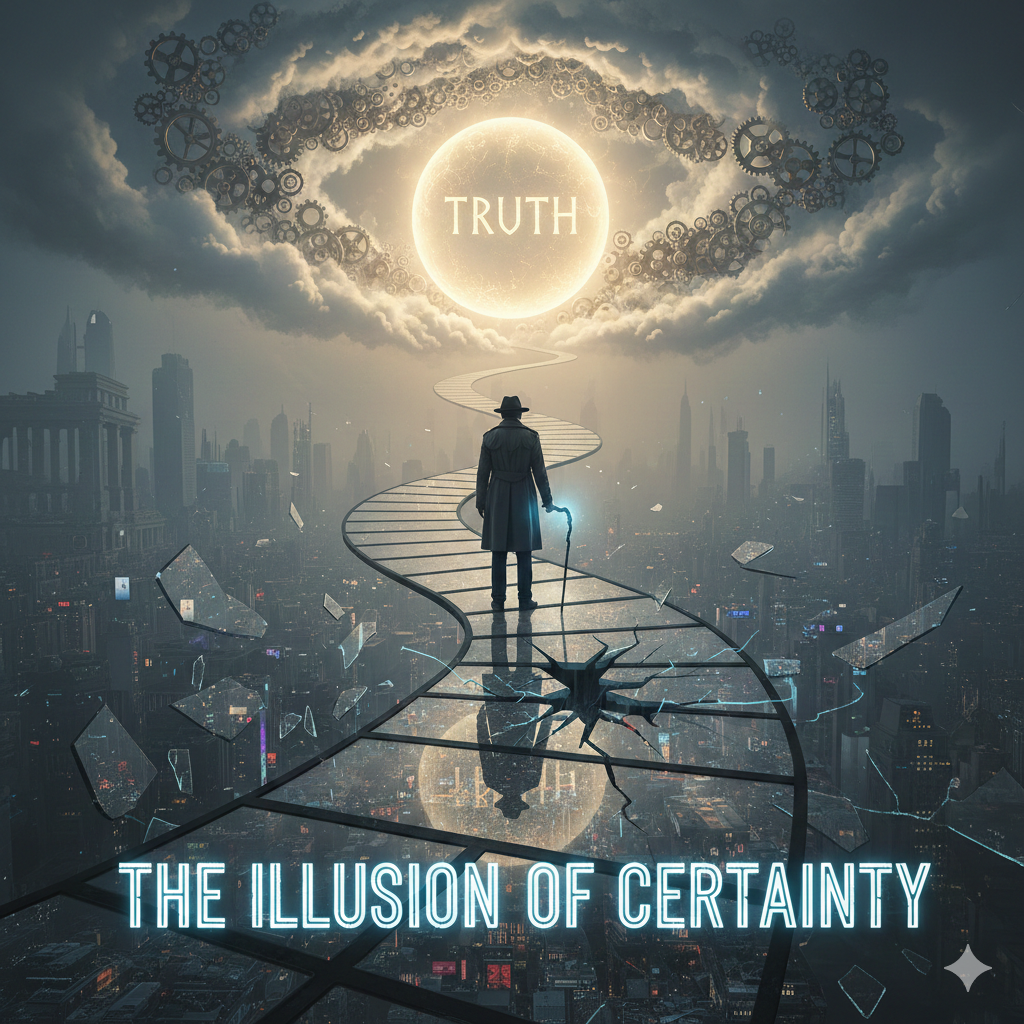
We spend our lives making predictions. Tomorrow will be sunny. The market will bounce back. This relationship will last. That investment will pay off. We speak with such confidence about what’s coming, as if the future were a book we’ve already read rather than blank pages we’re frantically trying to imagine into existence.
But here’s the uncomfortable truth we rarely acknowledge: nobody actually knows what’s going to happen. Not the economists with their elaborate models, not the meteorologists with their satellite imagery, not the fortune tellers with their crystal balls, and certainly not you or me with our carefully constructed plans.
What we call prediction is really just sophisticated guessing. We look at patterns from the past, consider what we know about the present, and extrapolate forward. Sometimes our guesses turn out to be accurate, and we mistake that accuracy for genuine foresight. We forget about all the times we were spectacularly wrong, about the surprises that upended our expectations, about the events nobody saw coming.
Think about the major turning points in history. The fall of the Berlin Wall. The 2008 financial crisis. The pandemic that reshaped global society. Yes, there were people who warned about these possibilities, but even they couldn’t tell you exactly when or how these events would unfold. Hindsight makes everything seem inevitable, but living through uncertain times reveals just how opaque the future really is.
The problem is that uncertainty makes us deeply uncomfortable. Our brains evolved to find patterns and make predictions because that helped our ancestors survive. The human who could predict where predators might lurk or when fruit would ripen had a better chance of passing on their genes. So we’re hardwired to seek certainty even when none exists, to create narratives that make the chaotic world feel manageable and comprehensible.
This need for certainty drives us to trust experts and authorities who speak with conviction. We want someone to tell us what’s going to happen, to give us a roadmap through the fog. And there’s no shortage of people willing to oblige, offering their forecasts and projections with impressive confidence. But confidence isn’t the same as accuracy. Often, the most certain voices are simply the ones who’ve convinced themselves of their own conjectures.
Financial markets offer perhaps the clearest illustration of this phenomenon. Thousands of highly educated analysts spend their days trying to predict which stocks will rise and which will fall. They have access to mountains of data, sophisticated algorithms, and decades of historical trends. And yet, study after study shows that most professional investors fail to consistently beat the market average. If the future were truly predictable with enough information and analysis, this wouldn’t be the case.
Even in our personal lives, we constantly make predictions that turn out to be wrong. We’re certain we’ll hate a new job only to find it fulfilling. We’re convinced a friendship will last forever, then drift apart. We plan our lives around assumptions about our health, our relationships, our finances, only to have unexpected events force us to improvise and adapt. The future has a way of ignoring our expectations.
This doesn’t mean that all predictions are equally worthless or that we should give up on planning entirely. Some things are more predictable than others. The sun will rise tomorrow. Dropped objects will fall. Patterns do exist, and past behavior often provides useful clues about future outcomes. But there’s a crucial difference between making informed estimates with acknowledged uncertainty and claiming to truly know what’s coming.The weather forecast that says there’s a seventy percent chance of rain tomorrow is honest about its limitations. It’s giving you probabilities, not certainties. But notice how often we strip away that nuance in daily conversation, transforming “probably” into “definitely” and “might” into “will.” We’re so hungry for certainty that we manufacture it even when the information doesn’t support it.
Perhaps the most pernicious aspect of this illusion is how it affects our response to being wrong. When our predictions fail, we often rationalize the failure rather than acknowledging the fundamental unpredictability we’re dealing with. The economy didn’t recover as expected because of some factor we claim we couldn’t have foreseen, even though the truth is that we were always just guessing. We tell ourselves we would have known if only we’d had better information, rather than accepting that better information might not have helped.
There’s something liberating in accepting that the future is genuinely uncertain. It frees us from the burden of needing to know what’s coming and allows us to focus instead on building resilience and flexibility. If we can’t predict the specific challenges we’ll face, we can at least prepare ourselves to adapt to whatever emerges. We can make provisional plans while remaining ready to adjust them. We can hold our predictions lightly, as working hypotheses rather than established facts.
This doesn’t mean embracing nihilism or abandoning all attempts to anticipate what’s ahead. But it does mean being more honest about what we’re doing when we make predictions. We’re conjecturing, extrapolating, hoping. We’re making educated guesses based on incomplete information about a complex system we don’t fully understand. Sometimes we’ll guess right. Often we won’t.
The experts and leaders who acknowledge this uncertainty, who speak in probabilities and possibilities rather than certainties, are paradoxically the ones we should trust most. They’re being honest about the limits of their knowledge. The ones who promise they know exactly what’s coming, who never express doubt or revise their forecasts, are either deluding themselves or trying to delude you.In the end, the future remains stubbornly unknowable. We can study trends, analyze data, and make informed projections, but we’re always working with incomplete information about a world that contains far more variables than we can track or model. The best we can do is acknowledge this fundamental uncertainty, remain humble about our predictions, and stay flexible enough to respond when reality inevitably surprises us.
Because it will surprise us. It always does.