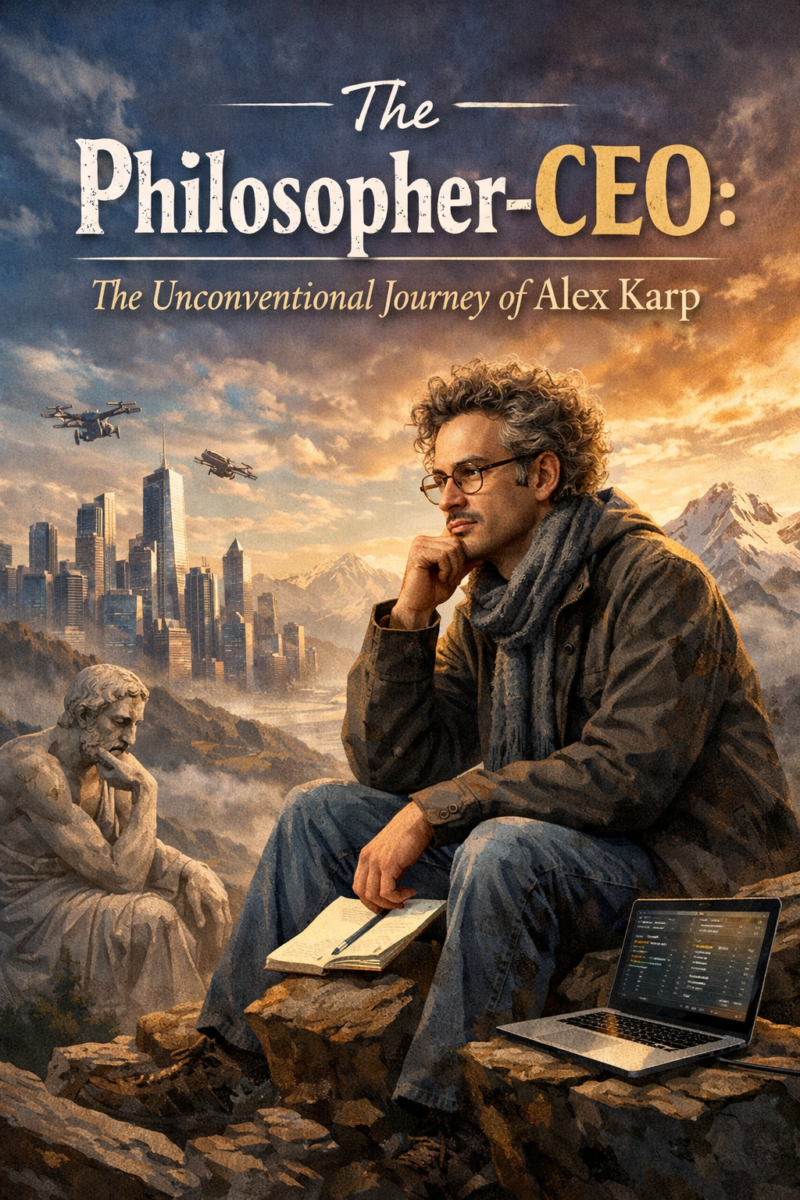
If you picture the typical Silicon Valley leader, Alex Karp is the antithesis. He is a man who quotes German philosophy as fluently as he discusses machine learning, who favors dystopian novels over tech manifestos, and whose company operates from a windowless, plant-free headquarters he calls “the Shire.” This is not the story of a programmer or a marketer. This is the story of a doctor of social thought who, almost by accident, built one of the world’s most powerful and controversial tech companies: Palantir Technologies.
His path was anything but linear. Born to a family of artists and academics, Karp’s early life was steeped in the humanities. He studied at Haverford College, earned a JD from Stanford Law School, and ultimately pursued a PhD in Neoclassical Social Theory at the University of Frankfurt, studying under the philosopher Jürgen Habermas. He was, by his own account, a thinker fascinated by the structure of societies, not the structure of code. For years, he moved in the rarefied world of European academia and dabbled in boutique investment firms, a world away from the server rooms of Palo Alto.
The pivot came through a friendship. His Stanford classmate, Peter Thiel, along with a small group of other founders, had started a company with a staggering, almost mythic ambition: to create software that could find hidden patterns in the world’s most chaotic data. They called it Palantir, after the all-seeing stones in J.R.R. Tolkien’s legendarium. In 2004, they asked Karp to become CEO. He was an improbable choice—a philosopher with no operational tech experience, taking the helm of a complex startup born from PayPal’s fraud-fighting algorithms and a post-9/11 desire to prevent terrorist attacks. Karp himself said he was “the least qualified person” for the job on paper. Yet, his unique perspective was precisely the point.Karp’s leadership has been defined by a series of convictions that defy tech industry norms. From the beginning, he embraced secrecy and exclusivity. Palantir would not sell software as a product; it would sell a service, embedding its engineers—often called “forward-deployed engineers”—directly with its clients to solve their hardest data integration problems. Its first and most important clients were in the government sector: intelligence agencies like the CIA (an early investor), the Department of Defense, and later, law enforcement. While other Silicon Valley giants preached a gospel of consumerism and connection, Palantir built its foundation in the shadows of national security. This choice created an indelible and permanent tension.
Karp became the public face of this tension, a role he wears like a tailored black suit. He is a fierce and unapologetic defender of the West, of government partnerships, and of the idea that technology must serve the hard realities of geopolitics and security. He openly scorns the social media-driven “addiction economy” of much of Silicon Valley, positioning Palantir as a builder of “mission-critical software” for institutions that actually sustain society. This moral certainty, coupled with Palantir’s work with immigration authorities and military bodies, has made the company a lightning rod for activist criticism and employee dissent. Karp does not shy away from these battles; he seems to engage with them as a necessary part of his philosophical project.
The company’s aesthetic reflects its CEO’s singular mind. The famously sparse office, the intense focus on privacy and security, the culture described as demanding and quasi-monastic—all feel like extensions of Karp’s belief system. He runs what is effectively a technology company like a peculiar blend of a philosophy seminar and a special ops unit. This approach culminated in a legendary direct listing in 2020, where Karp delivered a defiant, theatrical address that was part shareholder pitch, part political treatise, condemning what he saw as the weakness of Silicon Valley’s engineering mindset in the face of rising global adversaries.
So, what is Alex Karp’s legacy-in-progress? It is the legacy of the outsider who infiltrated the most powerful rooms in the world. He did not just build a company; he built a vessel for a specific, contentious worldview—that in a dangerous world, the power of data must be harnessed by the state and by large, complex institutions to ensure survival. He is the philosopher-king of the surveillance age, a CEO who argues that to defend an open society, you must sometimes build tools that feel closed, secretive, and immensely powerful.
While others speak of disruption, Karp speaks of order. While others seek to connect individuals, he seeks to arm institutions. In an industry obsessed with the new, Alex Karp’s most radical act may be his old-world belief in power, sovereignty, and the sober, unsentimental use of technology in what he perceives as a perpetual struggle. His story is a testament to the idea that in the 21st century, the most impactful technology might just be built by someone who thinks not like an engineer, but like a philosopher who has seen the abyss and decided to build a fortress.