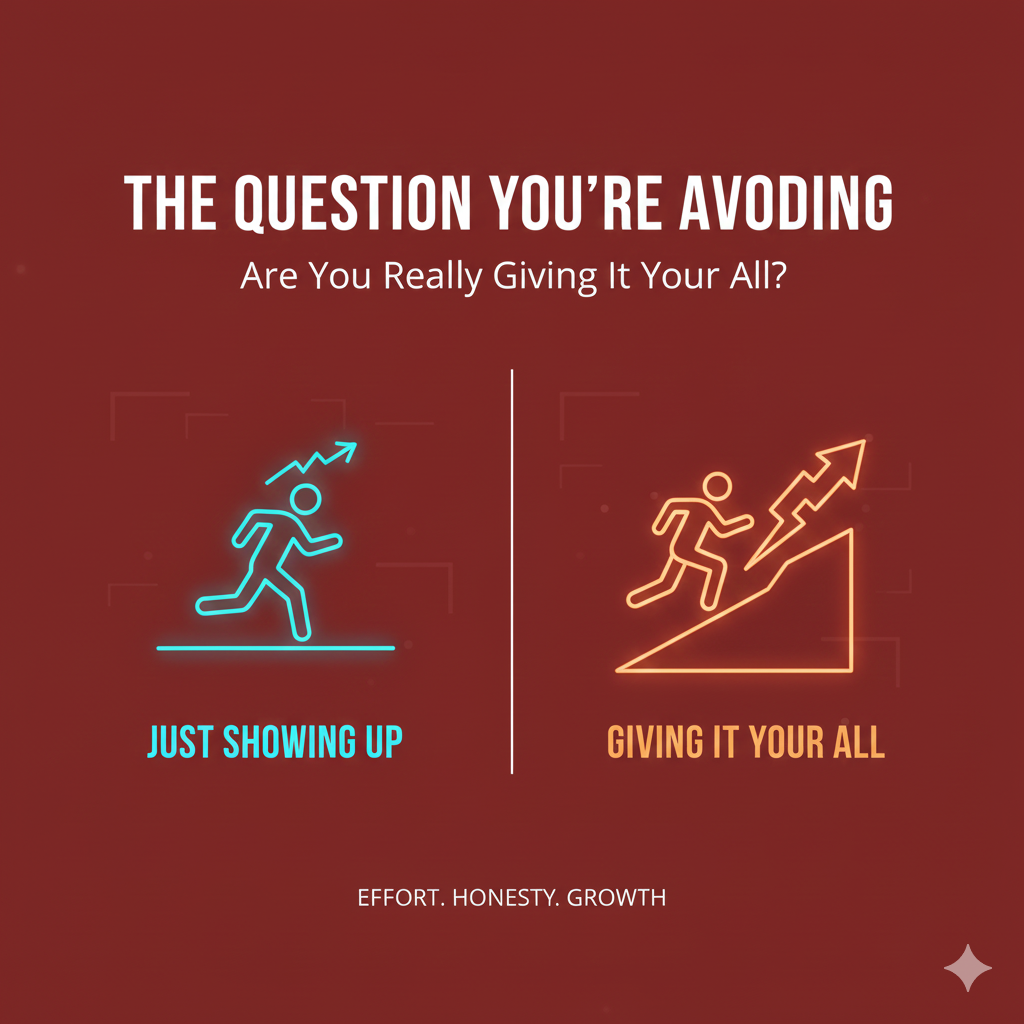
There’s a question that keeps surfacing in the quiet moments—when you’re lying in bed at 2 AM, when you’re sitting in traffic, when you’re mindlessly scrolling through your phone for the third hour straight. It’s uncomfortable, persistent, and you’ve gotten pretty good at pushing it away.
Am I really giving this my all?
You know the answer. You’ve always known it. The real issue isn’t figuring out whether you’re genuinely trying your hardest—it’s what you’re going to do with that knowledge.
The Body Keeps Score
Your body tells the truth even when your mind wants to negotiate. When you’re truly pushing yourself to your limits, you feel it. There’s a specific kind of exhaustion that comes from real effort—the mental fatigue after hours of focused concentration, the physical tiredness after a genuine workout, the emotional depletion after a difficult conversation you didn’t avoid.
Compare that to how you feel after a day of “busy work”—shuffling papers, attending meetings that could have been emails, reorganizing your desk for the third time this week. You might feel tired, but it’s a different kind of tired. It’s the fatigue of friction and distraction, not the fatigue of maximum effort. Your body knows the difference, even if you’re not admitting it to yourself.When you collapse into bed after truly giving something your all, there’s often a sense of satisfaction underneath the exhaustion. When you haven’t, there’s usually something else—a vague restlessness, a nagging sense that you could have done more, a relief that the day is over mixed with guilt about how you spent it.
The Stories We Tell Ourselves
We’re remarkably creative when it comes to explaining why we’re not at full capacity. Some of the greatest hits include:”I’m waiting for the right moment.” The conditions will never be perfect. You know this. There will always be some reason why now isn’t ideal—you’re too busy, too tired, too broke, too unprepared. People who give it their all work with what they have, not what they wish they had.”I’m being strategic about my energy.” Sometimes this is true. Often it’s a sophisticated way of saying you’re avoiding the hard thing. Real strategy involves prioritizing ruthlessly and then attacking those priorities with everything you have. It doesn’t mean keeping your intensity at a comfortable simmer across everything you touch.”I need to maintain work-life balance.” Balance is important, genuinely important. But be honest—are you actually achieving healthy balance, or are you using “balance” as permission for half-effort? Giving something your all doesn’t mean neglecting everything else in your life. It means that when you’re working on something that matters, you’re fully present and fully engaged, not counting the minutes until you can do something easier.
The Midnight Inventory
Here’s a simple test: At the end of the day, could you look someone you deeply respect in the eye and describe exactly how you spent your time without feeling embarrassed? Not your carefully curated highlight reel—the actual, granular reality of where your hours went?How much time did you spend genuinely focused versus merely appearing busy? How many times did you choose the comfortable option over the challenging one? How often did you stop when you were merely tired versus when you had nothing left to give?The answers to these questions create a kind of internal ledger. You can hide this ledger from everyone else, but you can’t hide it from yourself. It shapes how you feel about yourself in ways that have nothing to do with external success or recognition.
The Gap Between Capable and Committed
There’s a particular kind of suffering that comes from knowing you’re capable of more than you’re delivering. It’s worse than failing while giving your absolute best, because at least then you have the dignity of knowing you left nothing on the table.When you’re coasting on talent, intelligence, or past accomplishments, some part of you remains permanently unsatisfied. You might achieve things that look impressive from the outside, but internally, you know you’re operating at 60 or 70 percent. That gap between what you could be and what you are becomes a constant source of low-grade disappointment.The truly uncomfortable realization is that this gap exists by choice. Not because you lack time or resources or opportunity, but because maximum effort is uncomfortable. It requires focus when you’d rather be distracted, discipline when you’d rather be spontaneous, and persistence when you’d rather quit. It means risking genuine failure instead of the safety of not-really-trying.
What Giving Your All Actually Looks Like
Giving your all doesn’t mean working yourself into exhaustion every single day or sacrificing everything else you care about. It’s not about toxic productivity or burnout or martyrdom.It means that when you commit to something—a project, a relationship, a goal—you show up fully. You do the boring parts. You push through when motivation fades. You make the difficult phone call. You have the uncomfortable conversation. You do the work when no one is watching and there’s no immediate reward.
It means being honest about your priorities and then aligning your actions with those stated priorities. If your health matters, you actually go to the gym instead of just talking about it. If your business matters, you do the hard work of marketing even though it’s uncomfortable. If your relationship matters, you engage in the difficult work of communication rather than avoiding conflict.
Most importantly, it means you stop negotiating with yourself. You stop recalculating how little you can get away with and start asking how much you can contribute. You stop looking for permission to coast and start holding yourself to the standard you know you’re capable of meeting.
The Relief of Honest Effort
Here’s what’s rarely discussed: giving your all is actually less stressful than half-effort. When you’re genuinely trying your hardest, you can let go of the guilt, the self-judgment, and the constant internal negotiation about whether you should be doing more. You know the answer is no—you’re already doing everything you can.
There’s a clarity and peace that comes from this kind of honesty with yourself. Success or failure becomes cleaner. Either your best was enough or it wasn’t, but at least you don’t have to carry around the heavy knowledge that you didn’t really try.
The question isn’t whether you’re perfect or whether you’re maximizing every minute of every day. The true question is simpler: When you look at how you spent today, do you recognize someone operating at full capacity, or someone going through the motions?
You already know the answer. You’ve known it for a while now.The only remaining question is: what are you going to do about it?