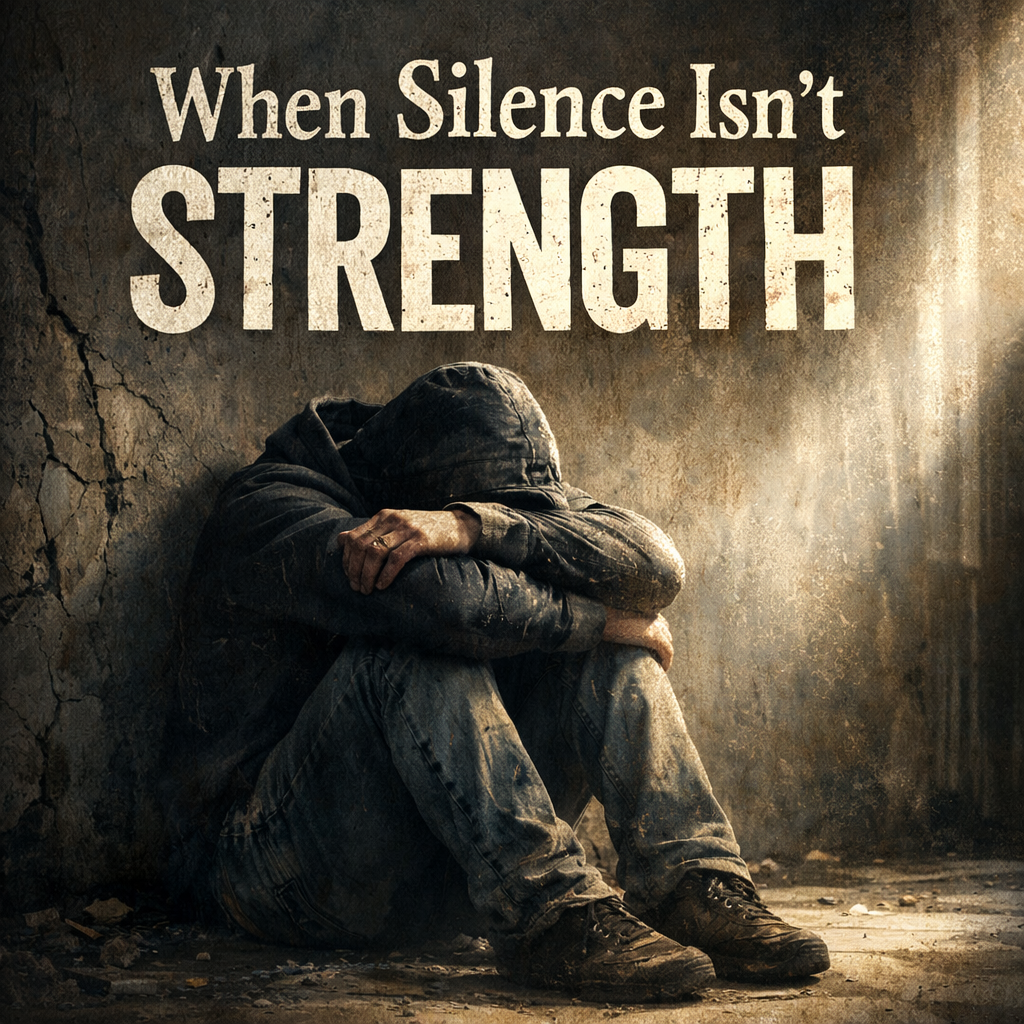
For generations, a familiar archetype has been held up as an ideal of masculine strength: the stoic man, the silent pillar, the one who bears weight without a word. His feelings are a locked vault, his vulnerabilities are secret flaws to be buried, and his emotional expression is a frivolity he cannot afford. We’ve mistaken this rigidity for resilience. But I’m here to suggest we’ve had it backwards. The real weakness isn’t in feeling; it’s in the inability to express it.
True strength has always been about integration, not denial. It’s the fortitude to face the full spectrum of human experience within yourself—fear, sadness, uncertainty, tenderness—and to acknowledge it honestly. What we call stoicism is often just fear wearing a mask of control. It’s the fear of being seen as less, the fear of the messy unknown of one’s own heart, the fear of rejection if the interior world were ever revealed. And isn’t fear, when it dictates your entire way of being, a form of weakness? A man governed by the fear of his own humanity is not a fortress; he is a prisoner in a self-made cell.
This performance of invulnerability creates a profound fragility. An emotion that isn’t expressed doesn’t vanish; it goes underground. It ferments into resentment, leaks out as unexplained anger, or manifests as a cold distance that poisons relationships. It becomes a physical weight, contributing to the silent suffering we see in men’s health statistics. This isn’t strength. It is a brittle brittleness, a system with no pressure valve, guaranteed to eventually crack under a stress it was never designed to handle. The weak man believes he can outrun his emotions. The strong man knows he must move through them.
Furthermore, this inability shuts down the very connections that make us human. Intimacy, in friendship, family, or love, is built on the bridge of shared vulnerability. When a man cannot say “I’m hurting,” or “I’m scared,” or “I need you,” he effectively severs that bridge. He condemns himself to relational solitude. He asks others to love a silhouette, while keeping the real person in shadow. It takes immense courage to say, “This is me, all of me,” and risk being seen. The far easier, and weaker, path is to hide.
We must retire the old, broken metric. Strength is not the absence of feeling; it is the courage to feel fully and to communicate it with integrity. It is the wisdom to know that seeking help is an act of strategy, not surrender. It is the confidence to be soft in a hard world, not because you are naïve, but because you are secure enough not to confuse tenderness with frailty.
The strongest man isn’t the one with the most impenetrable armor. He is the one with the self-awareness to know his own depths, the bravery to share them, and the resilience to heal and grow through that process. He builds his foundation on the bedrock of authentic self-knowledge, not on the shifting sand of performance. He understands that to be vulnerably human is his greatest power, not a secret shame. It’s time we stop celebrating the silence that breaks men and start honoring the voice that sets them free.