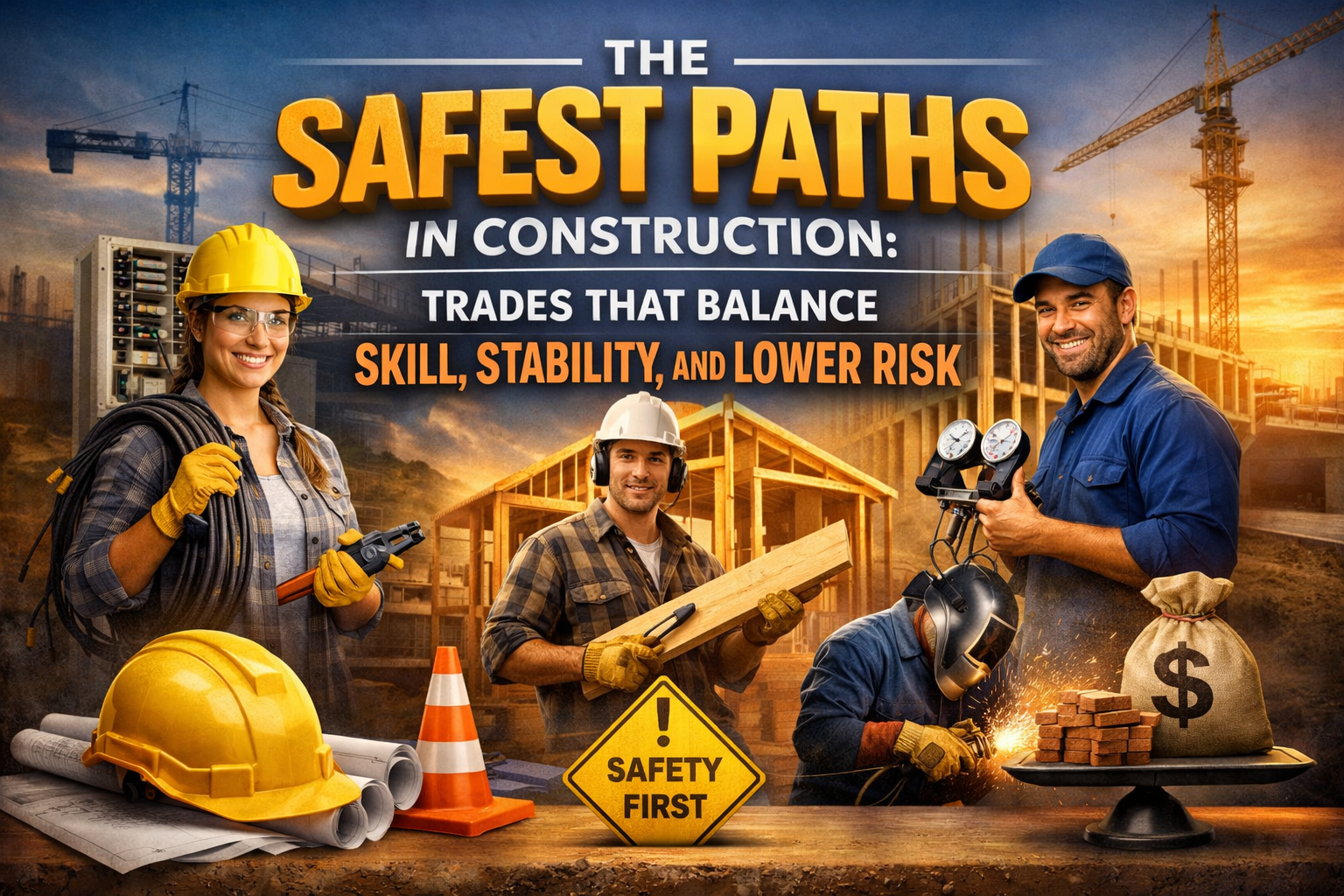
Construction has always carried a reputation for danger, and not without reason. Heavy machinery, working at heights, electrical systems, and unpredictable job sites all create real risks. But not all construction trades are created equal. Some roles consistently offer a safer day-to-day experience while still providing solid income, long-term stability, and opportunities for specialization.
When you look closely, the least dangerous construction trades tend to share a few key characteristics. They avoid prolonged work at height, minimize exposure to heavy moving equipment, limit direct contact with high-voltage systems, and often take place indoors or in more controlled environments. These factors don’t eliminate risk entirely, but they shift the odds significantly in your favor.
Painting is one of the clearest examples. While there is some exposure to ladders and chemicals, most residential and interior painting work happens at manageable heights and in predictable settings. Compared to trades like roofing or structural steel, the physical risks are much lower. Over time, experienced painters often move into higher-end interior work, which further reduces hazards while increasing pay.
Flooring installation follows a similar pattern. Whether working with tile, laminate, or hardwood, the job is physically demanding but relatively grounded. There’s little need to operate dangerous machinery beyond standard cutting tools, and most of the work is done at ground level. The biggest risks tend to come from repetitive strain rather than acute accidents, which makes it safer in terms of life-threatening incidents.
Drywall finishing and taping also rank among the safer options. Hanging drywall can be more physically intensive, but finishing work is typically slower-paced and detail-oriented. It usually takes place indoors after the structure is already stable, which removes many of the hazards present in earlier construction phases. As workers specialize, they often transition away from heavy lifting and into more refined finishing roles.
Cabinetmaking and finish carpentry stand out as well. While general carpentry can involve framing and structural work, finish carpentry is a different world. It focuses on precision, aesthetics, and interior spaces. The environment is more controlled, and the tools, while still requiring respect, are used in predictable ways. Over time, skilled finish carpenters can command high rates while avoiding many of the dangers associated with rough construction.
Low-voltage electrical work offers another path that balances technical skill with reduced risk. Unlike high-voltage electricians who deal with major power systems, low-voltage specialists work on data cables, security systems, and smart home installations. The work still requires knowledge and care, but the consequences of mistakes are generally less severe. As buildings become more connected, this niche continues to grow in both demand and earning potential.
Inspection and estimation roles deserve attention too, even though they sit slightly outside traditional trade work. Inspectors, estimators, and project coordinators often come from hands-on backgrounds but transition into positions where physical risk drops dramatically. They remain close to the construction process without being exposed to its most dangerous elements. For someone thinking long-term, these roles represent a natural progression toward both safety and higher leverage.
It’s important to be realistic. No construction trade is completely safe. Even in lower-risk roles, accidents can happen, especially when shortcuts are taken or safety protocols are ignored. But the difference between trades is not subtle. Some paths expose you daily to fall risks, heavy loads, and high-energy systems, while others allow you to work in controlled environments with far fewer variables.
Choosing a safer trade doesn’t mean sacrificing income or respect. In many cases, the opposite is true. The trades that rely more on precision, specialization, and consistency often allow for longer careers, fewer injuries, and a smoother transition into business ownership or supervisory roles.
In the end, construction rewards awareness. If you understand where the real risks lie and choose your path accordingly, you can build a career that is not only profitable, but sustainable over decades.