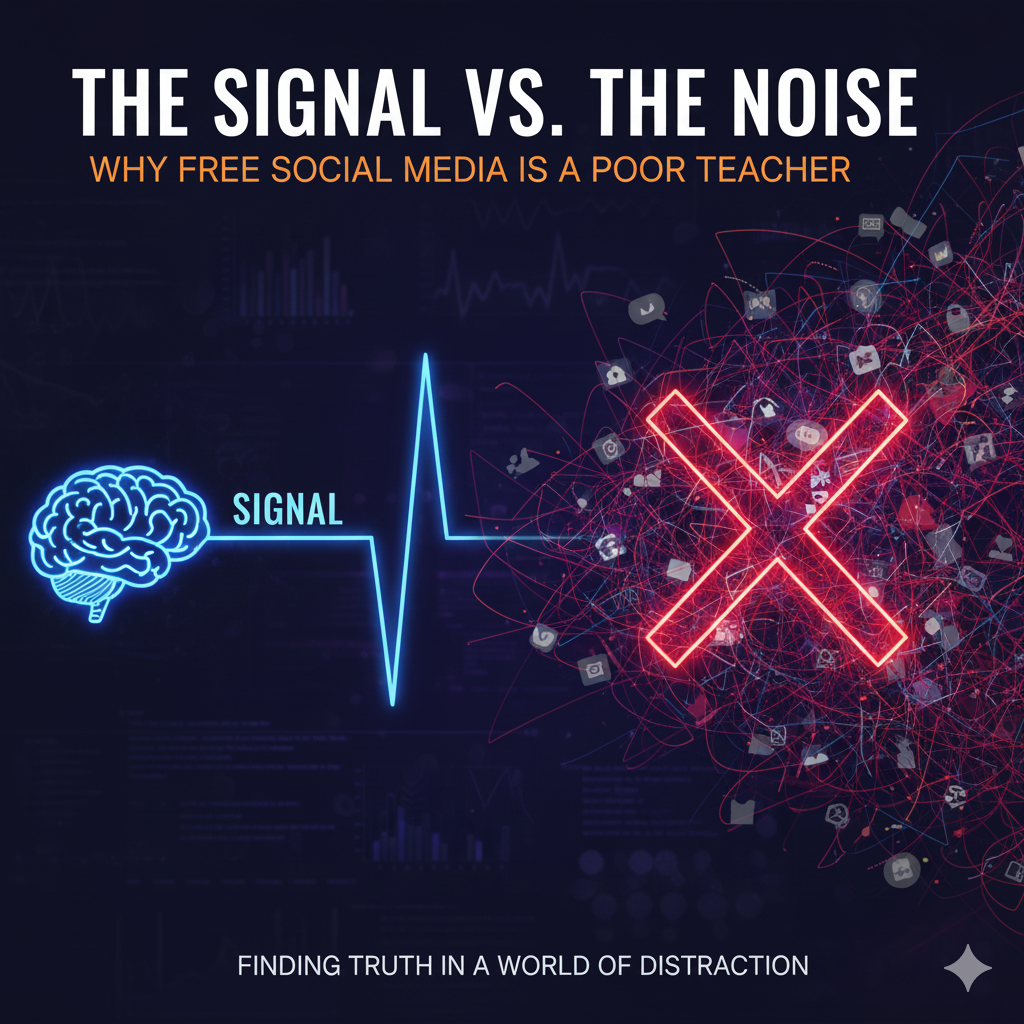
In the age of endless scrolling, we are constantly bombarded with information. From fleeting thoughts on X (formerly Twitter) to short-form video clips on TikTok, the firehose of content is always on. But when it comes to genuine learning and acquiring reliable knowledge, we must ask a critical question: What is the true value of statements made on social networks that don’t require a financial or reputational investment?
The uncomfortable truth is that for serious education, the signal-to-noise ratio on these platforms is dangerously low. The best way to learn something of substance is not through the casual, unvetted pronouncements of the unpaid digital sphere, but by prioritizing content from professional writers, accredited educators, and dedicated educational platforms.
The Incentive Problem: Virality Over Veracity
The core issue with free social media content is one of incentives. The algorithms that govern these platforms are not designed to reward accuracy, depth, or nuance; they are designed to reward engagement and virality. A content creator on a free platform is primarily incentivized to maximize attention by using sensationalism, controversy, or emotional triggers to stop the scroll. They are also driven to generate volume, posting frequently to maintain visibility in the feed, which often sacrifices research and quality control. Finally, they are incentivized to confirm bias, telling the audience what they want to hear, which leads to echo chambers rather than critical thinking. When the creator’s “payment” is likes, shares, and ad revenue based on eyeballs, their primary goal shifts from informing to performing. The statement itself becomes a means to an end—a hook for engagement—rather than a carefully researched piece of knowledge. This environment is structurally incapable of consistently producing high-value educational material.
The Investment Barrier: Where Quality Resides
Contrast this with the sources that demand an investment, whether it’s your time, a subscription fee, or a commitment to a structured course. This investment acts as a powerful quality filter. For example, professional writers and journalists are driven by incentives like salary, reputation, and book sales, and their work is subject to rigorous quality control mechanisms such as editorial review, fact-checking, and peer review. Their value proposition lies in providing depth, accuracy, context, and a structured argument. Similarly, educational videos and courses, often supported by tuition or subscription fees, are built on a foundation of curriculum design, pedagogical structure, and expert review, ensuring step-by-step learning, visual clarity, and skill mastery. Free social media posts, on the other hand, are motivated by likes and shares, have no formal quality control, and primarily offer entertainment, quick takes, and emotional resonance.When you read a book by a professional writer, watch a masterclass from an accredited expert, or subscribe to a specialized newsletter, you are consuming content where the creator has a significant reputational and financial stake in its quality. Professional writers are paid for their research, their ability to synthesize complex ideas, and their commitment to accuracy, with their careers depending on the credibility of their published work. Educational videos are often part of a structured curriculum, designed by experts who understand how people learn, and the video’s success is measured by the student’s mastery, not its view count. In these environments, the incentive is aligned with the learner’s goal: to acquire reliable, deep, and actionable knowledge.
The Low-Value Trap: Wasting Your Most Precious Resource
The greatest cost of relying on free social media for learning is not financial; it is the cost of your time and attention. Every minute spent sifting through unverified claims, half-truths, and superficial takes is a minute not spent engaging with material that has been vetted, structured, and designed for genuine comprehension. The casual nature of social media encourages passive consumption—a form of intellectual snacking that leaves you feeling full but malnourished. True learning requires active engagement, which is best facilitated by the structured narratives of professional writing and the deliberate pacing of educational videos.
Be a Discerning Consumer of Knowledge
To accelerate your learning and build a robust knowledge base, you must become a discerning consumer of information. Stop treating your feed as a classroom. Instead, dedicate your learning time to sources where the creators are held accountable for their claims and where the business model is built on the transfer of genuine value. Prioritize the professional, the structured, and the vetted. Invest in your education, and you will find that the signal you receive is infinitely clearer, deeper, and more reliable than the noise of the unpaid crowd. Your intellectual growth depends on it.